


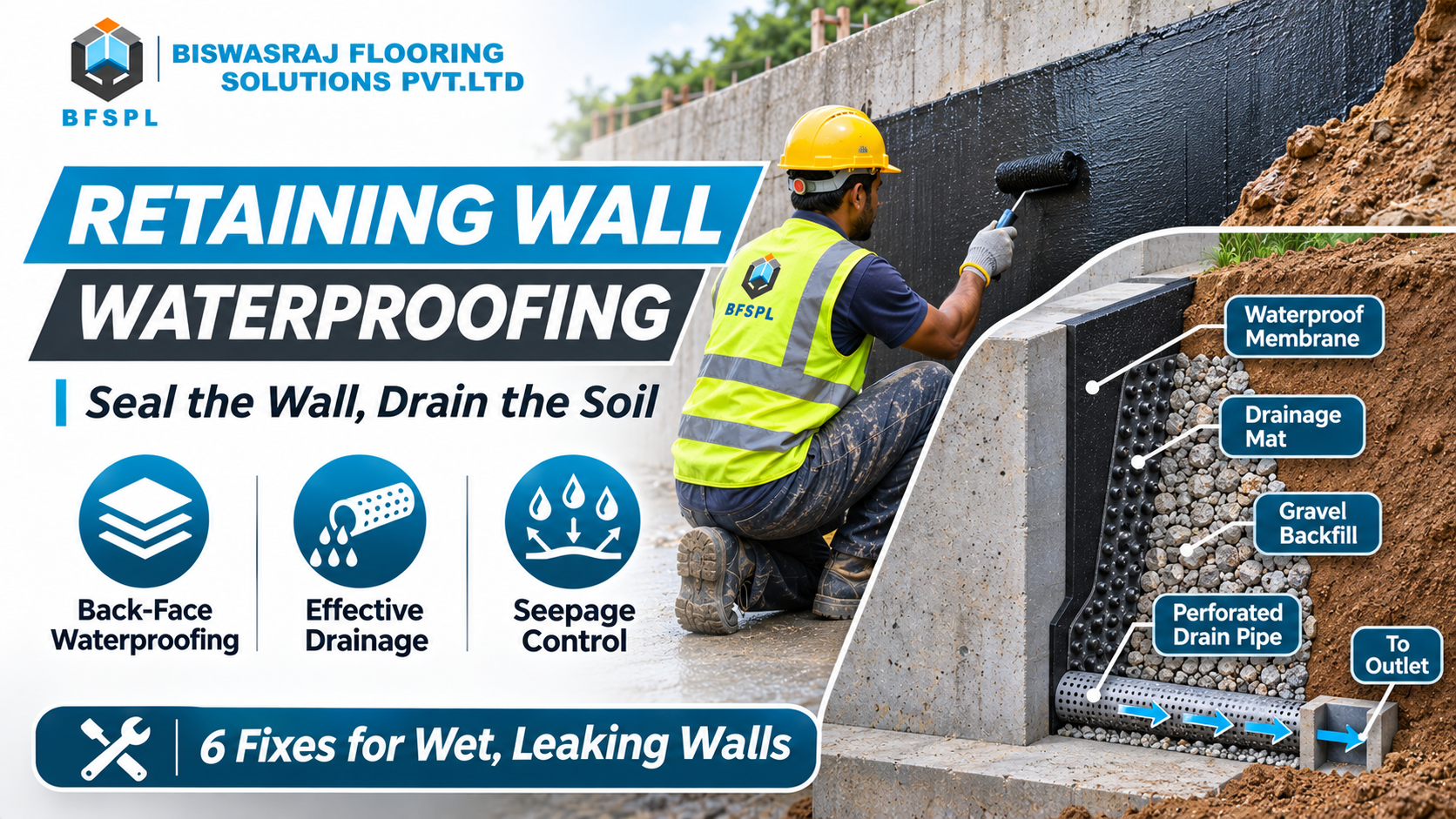
Retaining wall waterproofing protects a wall that holds back soil by sealing its back face and draining water away before pressure builds. Saturated soil 3 metres deep pushes about 29 kPa of water pressure onto the base of a wall, so drainage matters as much as the waterproof layer.
Many retaining walls are also the outer walls of a basement or a lower-level room. If the space behind yours is in use, our basement waterproofing guide explains how seepage is traced indoors.
At A Glance
- Two jobs
- Seal the back face and drain the water away
- Drainage parts
- Free-draining backfill, drain pipe, and weep holes or outlets
- Best time
- During construction, before backfilling
- Existing walls
- Inside treatments, injection, and drain repair
A wall with blocked drains will leak through almost any coating.
Why Do Retaining Walls Get Wet And Leak?
Retaining walls sit against soil that holds water after every rain. When that water cannot drain away, it builds pressure behind the wall and pushes through joints, cracks, and porous concrete. Retaining wall waterproofing fails when it treats the wet face but leaves that pressure in place.
The usual causes are:
- Blocked or missing drainage: clay or silt backfill that holds water against the wall
- No back-face protection: the soil side was never coated or wrapped
- Construction joints: the joint between the base and the wall stem, or between pours
- Cracks: shrinkage, settlement, or overload cracks running through the stem
- Surface water: rain from paving, roofs, or slopes running straight to the top of the wall
- Clogged weep holes: outlets silted up or blocked by plants and debris
Pressure rises with depth, which is why the lower part of a wall is usually the wettest. Water stands highest against the base when drains stop working, and that is where seepage, efflorescence, and rust stains tend to appear first.
What Are The Signs Of A Failing Retaining Wall?
Look for damp patches, white salt deposits, and water stains on the exposed face, especially near the base and along joints. Weep holes that stay dry after heavy rain are a warning too, because they suggest the water behind the wall has nowhere to go.
| Sign | What it points to | What to check |
|---|---|---|
| Damp band near the base | Water standing behind the wall | Drain pipe and weep holes |
| White salts on the face | Water moving slowly through the concrete | Back-face protection and drainage |
| Wet lines along joints | Leaking construction or movement joints | Joint sealing and waterstops |
| Rust stains near cracks | Water reaching the reinforcement | Crack width and steel condition |
| Dry weep holes after rain | Blocked drains or clogged backfill | Outlet condition and backfill |
| Leaning, bulging, or new wide cracks | Excess pressure or structural distress | Get a structural engineer to inspect |
The last row is not a waterproofing problem alone. A wall that is moving needs an engineer’s assessment before anyone seals or coats it.
If the wet face is inside a room, our post on treating damp walls and seepage problems helps you separate retaining wall seepage from plumbing leaks or rising damp.
How Do Drainage And Waterproofing Work Together?
Drainage relieves the pressure, and the waterproof layer stops what water remains from passing through the wall. Retaining wall drainage takes the load off the wall; the waterproofing keeps the face dry and protects the steel. Either one alone usually falls short.
A complete system behind the wall has these parts:
- Waterproof layer: a membrane, bitumen coating, or crystalline treatment on the soil face
- Protection board or drainage mat: keeps backfill from damaging the membrane and carries water down
- Free-draining backfill: clean granular material, not the clay dug out of the site
- Filter fabric: stops fine soil washing into the drainage layer and clogging it
- Perforated drain pipe: runs along the base and carries water to a safe outlet
- Weep holes or outlets: let any trapped water escape through the wall
Weep holes need special attention. A study for the US transportation research network describes conventional weep holes as traditional weep holes, which are likely to become clogged during the lifespan of the wall, and recommends drains that can be cleaned and maintained.
Getting retaining wall waterproofing right means planning outlets that can be inspected and flushed, not just holes cast into the face and forgotten.
How Should A New Retaining Wall Be Waterproofed?
The best moment is during construction, before backfilling, when the back face can be reached. Seal the soil side, build in drainage at the base, detail every joint, and protect the membrane before any soil goes back against the wall.
For new construction, the order is:
- Detail the joints: install waterstops in construction joints between the base and the stem.
- Prepare the back face: remove tie holes, fins, and honeycombing, then repair them.
- Apply the waterproof layer: membrane or coating on the soil face, turned onto the footing.
- Protect it: fix protection board or a drainage mat over the membrane.
- Lay the drain: perforated pipe at the base, wrapped in filter fabric and granular material.
- Backfill in layers: use free-draining material and compact it without tearing the membrane.
- Cap the top: seal the top of the backfill and slope the ground away from the wall.
Working space is essential for this. IS 3067 calls for at least 600 mm around a below-ground wall so external treatment can be laid properly. Our industrial waterproofing guide for floors and basements explains that detailing in more depth.
Once the backfill is in, the soil face is out of reach for good. Retaining wall waterproofing done at this stage takes far less effort than any repair later.
How Do You Fix Seepage In An Existing Retaining Wall?
If you are working out how to stop water seeping through retaining wall faces that are already backfilled, start with the drainage, then treat the wall itself. Opening up the drains often reduces seepage more than any coating, and it makes every later treatment last longer.
Work through the options in this order:
- Clear the outlets: rod and flush weep holes and drain outlets, and remove plants and silt
- Add relief drains: drill new outlets where the old ones are blocked or missing
- Divert surface water: fix gutters, kerbs, and paving that send rain to the top of the wall
- Inject active leaks: seal flowing cracks and joints with injection grouting
- Treat the face: use a crystalline or cementitious system that works from the exposed side
- Excavate if needed: for serious cases, dig out the back, waterproof it, and rebuild the drainage
Treating only the exposed face with paint traps moisture and usually fails within a season. Retaining wall waterproofing applied from the front must be designed to resist water pushing from behind.
Cracks need to be understood before they are sealed. Our concrete floor crack repair guide explains how to tell a stable crack from one that will keep moving.
Which Waterproofing Systems Suit Retaining Walls?
The right retaining wall waterproofing system depends on whether you can reach the soil side, how much water the wall faces, and whether the wall moves. Membranes suit new walls with open backs, while crystalline and cementitious systems suit existing walls treated from the front.
| System | Applied to | Best for | Watch out for |
|---|---|---|---|
| Sheet membrane | Soil face, before backfill | New walls, high water exposure | Needs protection during backfilling |
| Bitumen coating | Soil face, before backfill | Garden and boundary walls with modest exposure | Can be damaged by sharp backfill |
| Crystalline treatment | Either face | Concrete walls treated from the front | Not for block or brick walls |
| Cementitious coating | Exposed face | Damp walls with low pressure | Needs good drainage behind |
| Injection grouting | Cracks and joints | Active leaks at points | Treats points, not whole faces |
Block and brick retaining walls need extra care. They have many mortar joints and cannot use crystalline treatments, so drainage and a sealed soil face matter even more.
How Do You Keep A Retaining Wall Dry Long Term?
Most walls start leaking again because the drains stop working, not because the waterproofing wears out. A short routine keeps outlets open and water moving away from the wall before it builds pressure behind it.
- Before every monsoon: clear weep holes, outlets, and the drain at the base
- After heavy rain: check that outlets are flowing and note any new damp patches
- Every year: look for new cracks, leaning, or bulging along the wall
- Keep the top sealed: maintain paving, kerbs, and slopes that shed water away
Our monsoon proofing checklist shows how to plan drain clearing and repairs in the dry season, before the rains arrive.
Frequently Asked Questions
Can you waterproof a retaining wall from the front?
Yes, with systems designed to resist water pushing from behind, such as crystalline or cementitious treatments. Clearing and improving the drainage should come first.
Do all retaining walls need weep holes?
Most concrete and masonry walls need some way to release water. Weep holes, outlets, or a drain at the base keep pressure from building behind the wall.
Why are my weep holes dry when the wall is wet?
The outlets are probably blocked, or the backfill is clogged with fine soil. Water is reaching the wall but cannot drain out, so it seeps through instead.
Is paint enough to stop retaining wall seepage?
No, because paint traps moisture and peels off once water pressure builds behind it. Fix the drainage and use a system made for walls holding back soil.
Should a leaning retaining wall be waterproofed?
Not first. Retaining wall waterproofing will not fix a wall that is moving, so a structural engineer must assess any leaning or bulging wall before treatment.
Can garden retaining walls skip waterproofing?
Low garden walls often need only good drainage and a protective coat on the soil side. Taller walls, and walls next to buildings, need fuller protection.
What Do The Numbers Say?
- About 29 kPa Water pressure at the base of a wall holding back 3 metres of saturated soil with no drainage Standard hydrostatic formula (P = density x g x depth)
- 600 mm Working space IS 3067 calls for around a below-ground wall so external treatment can be laid BiswasRaj Flooring, Industrial Waterproofing Services guide
Is Your Retaining Wall Ready For A Proper Fix?
Start with the drainage and the cause of the water, not with a coating. Our team inspects the wall, the outlets, and the ground above it, then recommends retaining wall waterproofing that suits the wall and its exposure. Explore our waterproofing services to arrange a site visit.
Sources
- Design of Maintainable Drains for Earth Retaining Structures: Final Report and Design Guide (Midwest Transportation Center, University of Missouri, via US DOT ROSA P)
- Industrial Waterproofing Services for Floors and Basements (BiswasRaj Flooring Solutions Pvt. Ltd.)
- Waterproofing Services in India (BiswasRaj Flooring Solutions Pvt. Ltd.)