


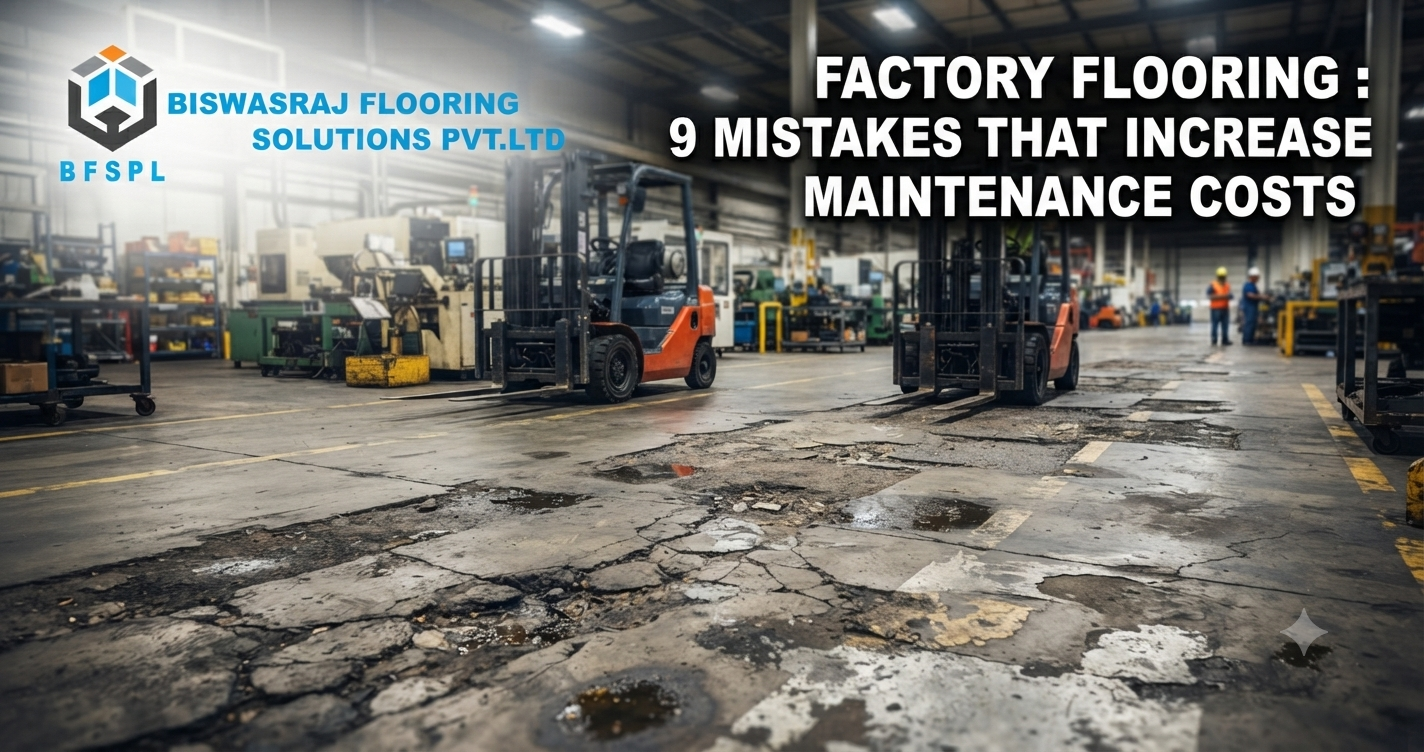
Factory Flooring: 9 Mistakes That Increase Maintenance Costs
 10 Sep 2026
Factory Flooring: 9 Mistakes That Increase Maintenance Costs
- Posted by Nagananda Udupa
A factory floor undergoes a continuous cycle of forklift travel, machinery operation, pedestrian and vehicle traffic plus exposure to oil, moisture, abrasive materials or other environmental challenges. If the factory flooring is not properly planned, installed or maintained this can cause issues that may not be immediately apparent. Minor imperfections can progress into cracks, dusting, uneven spots, damaged joints and costly repairs.
By avoiding common mistakes associated with factory flooring planning, installation and maintenance businesses can significantly reduce their risk of increased maintenance costs.
Most Common Mistakes That Increase Factory Flooring Maintenance Costs.
1. Not considering the cost based on the initial outlay
One of the biggest mistakes is to select a floor purely on the initial outlay.
A cheaper option may incur increased maintenance and repair costs due to the suitability for the operating conditions. Before determining costs businesses should assess the following:
Forklift traffic
Machinery
Vehicle movement
Abrasion
Chemical exposure
Moisture
Flatness
Service life
Maintenance
Often the cheapest option incurs the highest cost over the floor’s lifecycle. Different industries expose a floor to varying levels of stress. A factory which packs products will have different requirements to an automobile workshop, engineering or chemical processing factory. For example, one factory may have a higher requirement for abrasion resistance, whereas another may focus more on chemical resistance or ease of cleaning. Therefore, it is essential to ensure that a factory floor is suitable for the operating environment. Even the best materials cannot overcome the effects of an inadequately prepared surface. Before applying a coating or treatment it is essential to remove dust, oil, grease, weak concrete, loose particles, existing coatings or contamination from the substrate. This is especially important when applying a coating over an existing concrete floor. Poor preparation can easily lead to adhesion or peeling problems. Fork lifts can place enormous stress on a factory floor. Turning, accelerating, braking and continuous movement can gradually damage a vulnerable floor surface. In addition to the number of forklifts operating within a factory it is essential to consider the turning points, stopping points and frequent routes. Areas of high traffic should be given particular consideration as repetitive mechanical movement can accelerate surface degradation. Joints are a vital element of many concrete floor systems and can be a focal point for forklifts. This means that the impact from wheels can gradually damage the edge of joints, creating rough spots that progressively worsen. As a result, it is important to regularly inspect high traffic joints for deterioration. Some factories handle oils, solvents, cleaning chemicals or other substances. A flooring system which is suitable for an arid production line, may not be appropriate for an area exposed to aggressive chemicals. Before selecting a coating or flooring system it is essential to consider the type, concentration and frequency of chemical exposure. Where chemical resistance is required it is essential to specify a flooring system suitable for the operating environment. Water can place huge stress on a factory floor. Areas exposed to constant washing, process water or poor drainage should be carefully considered. Water can also affect certain coating systems and cause adhesion problems if the substrate is not suitable for the application. In addition, manufacturers should consider drainage, water flow, cleaning methods and water exposure or slope (if applicable). Good floor planning and maintenance should consider how water will move across a factory rather than focusing solely on the surface finish. A factory floor does not always require the same flooring system throughout. Different areas can require different considerations such as: Factory AreaMain concern Production AreaMachinery and continuous traffic Loading AreaHeavy vehicle movement Storage Area Fork lift and pallet traffic WorkshopImpact, oil and abrasion Chemical AreaChemical exposure Washing AreaWater and moisture High Traffic RoutesRepeated vehicle movement It is usually more cost effective to select a flooring system based on the requirements of a specific area, rather than treating all sections of a factory the same. Minor imperfections in factory floor surfaces are often overlooked when production is running smoothly. A small crack, damaged joint or area of surface degradation may not initially impact operations. However, continued forklift and industrial traffic can gradually widen the area of damage. Regular inspections can identify problems such as cracks, surface degradation, dusting, damaged joints, uneven areas, peeling, spalling or surface contamination early, reducing the extent of repairs. Factory flooring is not always simply selecting a strong material. A complete factory flooring system should be considered from planning, installation to maintenance. This will include: 1. Understanding the factory’s operations 2. Assessing the existing substrate 3. Identifying traffic and loading conditions 4. Considering chemical and moisture exposure 5. Selecting an appropriate flooring system 6. Preparing the surface correctly 7. Installing the flooring according to the required specifications 8. Inspecting the completed floor 9. Maintaining high traffic areas A professional assessment can help identify the most suitable approach for both new and existing factory floors. Not all damaged factory floors require complete replacement. If the existing concrete slab is structurally suitable, options such as repair, grinding, polishing, densification or an appropriate coating may be considered based on the condition of the floor. This can be particularly useful for factories which want to improve their existing floor while reducing disruption to operations. However, the appropriate solution will depend on the actual condition of the substrate and the cause of the damage. For reliable factory flooring solutions, explore BiswasRaj Flooring’s range of professional industrial flooring services. Factory managers can periodically check: Are cracks widening? Are forklift routes excessively worn? Is concrete producing dust? Are floor joints damaged? Are the coatings peeling? Are there areas where water remains after cleaning? Has the floor become uneven? Are machinery or vehicle movements being affected? Are repairs being repeated in the same location? If several of these are prevalent a professional floor assessment may be worthwhile. Factory flooring refers to flooring systems designed for manufacturing and production environments where floors experience industrial traffic, machinery, loads, abrasion and other demanding conditions. Traffic, machinery, loading conditions, chemical exposure, moisture, abrasion, required flatness, cleaning requirements and the existing substrate should all be considered. In many situations, existing floors can be repaired or refurbished instead of completely replacing them. The appropriate method depends on the condition and cause of the damage. Epoxy can be suitable for certain factory environments where a seamless and easy to clean surface is required. The system should be selected according to traffic, substrate condition and chemical exposure. Proper initial planning, suitable flooring selection, correct surface preparation, regular inspection and early repair of defects can help reduce unnecessary maintenance. Factory floor performance depends on proper planning, surface preparation, suitable flooring selection and timely maintenance. Understanding operating conditions helps businesses choose durable, easy-to-maintain factory flooring solutions. If your floor shows cracks, dusting or wear, a professional assessment can determine whether repair, refurbishment or replacement is needed. 2. Ignoring the type of activity taking place in the factory
3. Inappropriate surface preparation
4. Not taking into account fork lift traffic
5. Not considering the joints
6. Not considering chemical exposure
7. Ignoring drainage and moisture
8. Not using the same flooring throughout the factory
9. Delaying repairs for minor problems
How Proper Factory Flooring Can ReduceMaintenance
New Factory Flooring Or Refurbishment?
Factory Flooring Maintenance Checklist

Frequently Asked Questions
What is factory flooring?
Which factors should be considered before choosing factory flooring?
Can existing factory flooring be repaired?
Is epoxy flooring suitable for factory floors?
How can factory flooring maintenance costs be reduced?
Conclusion
Looking for the right factory flooring solution for your facility?
Contact BiswasRaj Flooring for professional guidance and reliable flooring solutions.