

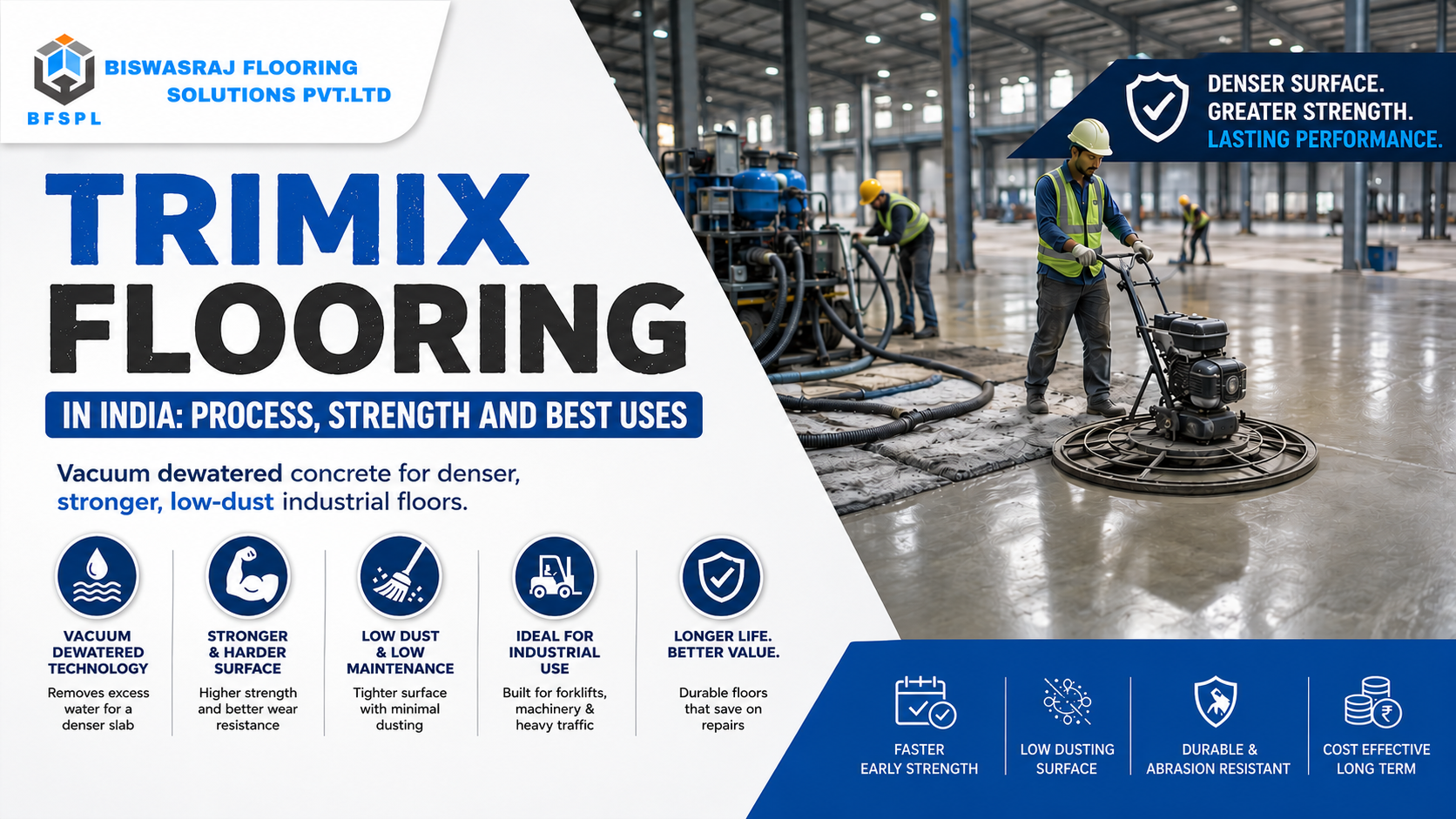
Trimix Flooring in India:
Process, Strength and Best Use
 31 Jul 2026
Trimix Flooring in India:
Process, Strength and Best Use
- Posted by Sathish K
Ordinary concrete carries more water than it needs. That surplus makes the mix easy to place, then leaves fine pores behind as it evaporates, which is why so many industrial slabs end up soft, dusty and quick to wear.
Trimix flooring attacks that problem while the concrete is still wet. Vacuum mats pull the excess water out within minutes of placement, and the slab hardens denser than it otherwise would.
Quick Answer
• Vacuum suction removes surplus water from fresh concrete before it sets
• The lower water content leaves a denser, harder and less dusty surface
• Three machines give the method its name: screed vibrator, vacuum pump and power float
• Best suited to medium and heavy duty industrial floors on open ground slabs
• Trimix and VDF are two names for the same process
What Is Trimix Flooring?
Trimix flooring is a concrete finishing method in which vacuum mats draw surplus mixing water out of a freshly placed slab, before the concrete sets. Removing that water lowers the effective water to cement ratio at the surface, which produces a harder, denser and more abrasion resistant floor.
The name comes from the three pieces of equipment used in sequence. Contractors also call it vacuum dewatered flooring, and in India the two terms are used interchangeably on drawings and in tenders.
• Screed vibrator: levels and compacts the poured concrete
• Vacuum pump and mats: extract the surplus water through filter cloth
• Power float and trowel: compact and finish the stiffened surface
If a tender document says VDF and the quotation says Trimix, nobody is changing the specification on you. Confirm the slab thickness, the mix grade and the finish tolerance instead, because those are the numbers that actually vary.
How Does The VDF Flooring Process Work?
The VDF flooring process runs to a strict clock. Once concrete is placed, the crew has a narrow window to dewater and float before the slab stiffens beyond working. Trimix flooring is far less forgiving of delays than a conventional pour.
1. Prepare the base. Compact and level the sub-base, then test it, because a weak base undoes everything above it.
2. Set formwork and reinforcement. Fix the shuttering to line and level, then place mesh or fibres as specified.
3. Place the concrete. Pour to the designed thickness in defined bays.
4. Screed vibrate. Run the vibrating screed across the bay to compact and strike off to level.
5. Lay the vacuum mats. Cover the fresh surface with filter cloth and top mats, sealed at the edges.
6. Dewater. Run the pump for roughly one to two minutes per centimetre of slab thickness and collect the extracted water.
7. Power float and trowel. Float first, then trowel to close and harden the surface.
8. Cure under control. Keep the slab wet or covered so it gains strength without shrinkage cracking.
Steps five and six are where the quality is won or lost. Short dewatering leaves water behind, and an over run pulls out cement paste along with the water.
This is also why the method needs a crew that has done it before. The window between placing and floating is measured in minutes, and there is no way to go back and redo a bay once it has stiffened.
Why Is A Trimix Floor Stronger Than Ordinary Concrete?
Because strength in concrete tracks the water to cement ratio very closely. The American Cement Association puts it simply: with everything else equal, a lower water content gives stronger concrete. Trimix flooring removes that water physically rather than trying to design it out of the mix.
The effect is concentrated where you need it, in the top layer that takes the wheel loads and the abrasion.
|
Property |
Conventional finished slab |
Vacuum dewatered slab |
|
Surface water content |
Higher, evaporates over days |
Reduced within minutes of placement |
|
Surface porosity |
More open, absorbs oil and stains |
Tighter, resists penetration |
|
Dusting tendency |
Common as paste wears |
Markedly lower |
|
Early strength gain |
Slower |
Faster, so earlier handover |
|
Wear under forklift traffic |
Higher |
Lower |
The trade off is honest and worth stating. Vacuum dewatering does not make an ordinary slab into a super flat floor, and it does not correct a poorly compacted sub-base. It improves the concrete, not the engineering underneath it.
That is worth knowing before you sign. If your real problem is settlement or an undersized slab, no finishing method will fix it, and a survey of the base will save you more money than any surface upgrade.
Where Does A Trimix Floor Fit Best?
It fits medium and heavy duty ground floor slabs where wear resistance and low dusting matter more than extreme flatness. Trimix flooring is the default choice for a great many Indian warehouses, workshops and plant floors because it delivers a strong surface at a sensible cost.
Typical applications include:
• Warehouses and godowns with counterbalance forklift and pallet truck traffic
• Manufacturing and assembly shop floors carrying static machinery loads
• Automotive workshops, service bays and vehicle parking decks
• Cold storage and food grade units where dusting is a contamination risk
• Loading yards, ramps and external hardstanding areas
Where it is not the right answer is equally clear. Very narrow aisle warehouses with racking above roughly ten metres need defined movement flatness, which is a different specification altogether. Our vacuum dewatered flooring service page sets out the grades and thicknesses we work to.
How Does It Compare With Laser And Truss Screed Floors?
Each method solves a different problem. Trimix flooring targets density and surface hardness, laser screeding targets speed and level accuracy over large pours, and truss screeding targets consistent levelling across very wide bays. Many projects use more than one.
|
Method |
Main strength |
Typical use |
Main limitation |
|
Trimix or VDF |
Dense, hard, low dusting surface |
Warehouses, workshops, plant floors |
Not a high tolerance flatness system |
|
Laser screed |
Fast placement, accurate levels |
Large open industrial slabs |
Higher plant and mobilisation cost |
|
Truss screed |
Even levelling across wide bays |
Long, wide pours and hardstandings |
Slower than laser on very large areas |
|
Grinding and polishing |
Restores and refines an existing floor |
Old or dull slabs needing a reset |
Works on what is already there |
If levelness across a wide bay is your priority, compare it against truss screed flooring. If you already have a slab and want the surface improved rather than replaced, concrete grinding and polishing is usually the cheaper route.
What Should You Check Before Hiring A Contractor?
Ask about method and measurement, not just rate per square foot. A capable VDF flooring contractor will talk you through dewatering time, mix grade, curing regime and joint layout without being prompted, because those four items decide whether the floor lasts.
• Dewatering time per slab thickness, and how the extracted water volume is recorded
• Concrete grade and mix design, confirmed against your actual wheel and rack loads
• Joint spacing and cutting time, since late cutting is a common cause of random cracking
• Curing method and duration, which is where cost is most often quietly saved
• Flatness tolerance, written into the quotation rather than left to goodwill
• Handover testing, including what happens if a bay fails to meet the specification
Ask to see completed floors that are three or four years old rather than three or four weeks old. A vacuum dewatered floor looks excellent on handover day almost regardless of how carefully it was built.
The difference between a good job and a poor one shows up at the joints and in the dust, and it takes a couple of monsoons and a few thousand forklift passes to appear.
Frequently Asked Questions
Is Trimix flooring the same as VDF flooring?
Yes. Trimix flooring and vacuum dewatered flooring describe the same vacuum extraction method, and Indian contractors use both names for it on the same job.
How thick should a vacuum dewatered slab be?
It depends on wheel loads, rack leg loads and the sub-base. Industrial slabs commonly run between 100 and 200 mm, confirmed by a structural design rather than a rule of thumb.
When can forklifts run on the finished floor?
Foot traffic is usually allowed after a few days and full loading after the specified curing period. Faster early strength gain is one of the practical benefits of the process.
Does it stop concrete dusting completely?
It reduces dusting sharply but does not always eliminate it. Adding a chemical densifier or a hardener topping during the pour gives you the most dust free result.
Can it be laid on an existing concrete floor?
No. The vacuum process only works on freshly placed concrete, so an existing slab needs grinding, an overlay or a coating instead.
Is it suitable for outdoor areas?
Yes. Loading yards, ramps and parking decks benefit from the denser surface, provided the joints are detailed and sealed for water and thermal movement.
Ready To Specify Your Slab?
Start with the loads and the flatness you actually need, then let the method follow. A short site visit settles the slab thickness, joint layout and grade far faster than a phone call, and it tells you honestly whether Trimix flooring is the right fit for your building.
Request a free site visit and quotation and we will walk your site before putting a number to it.