


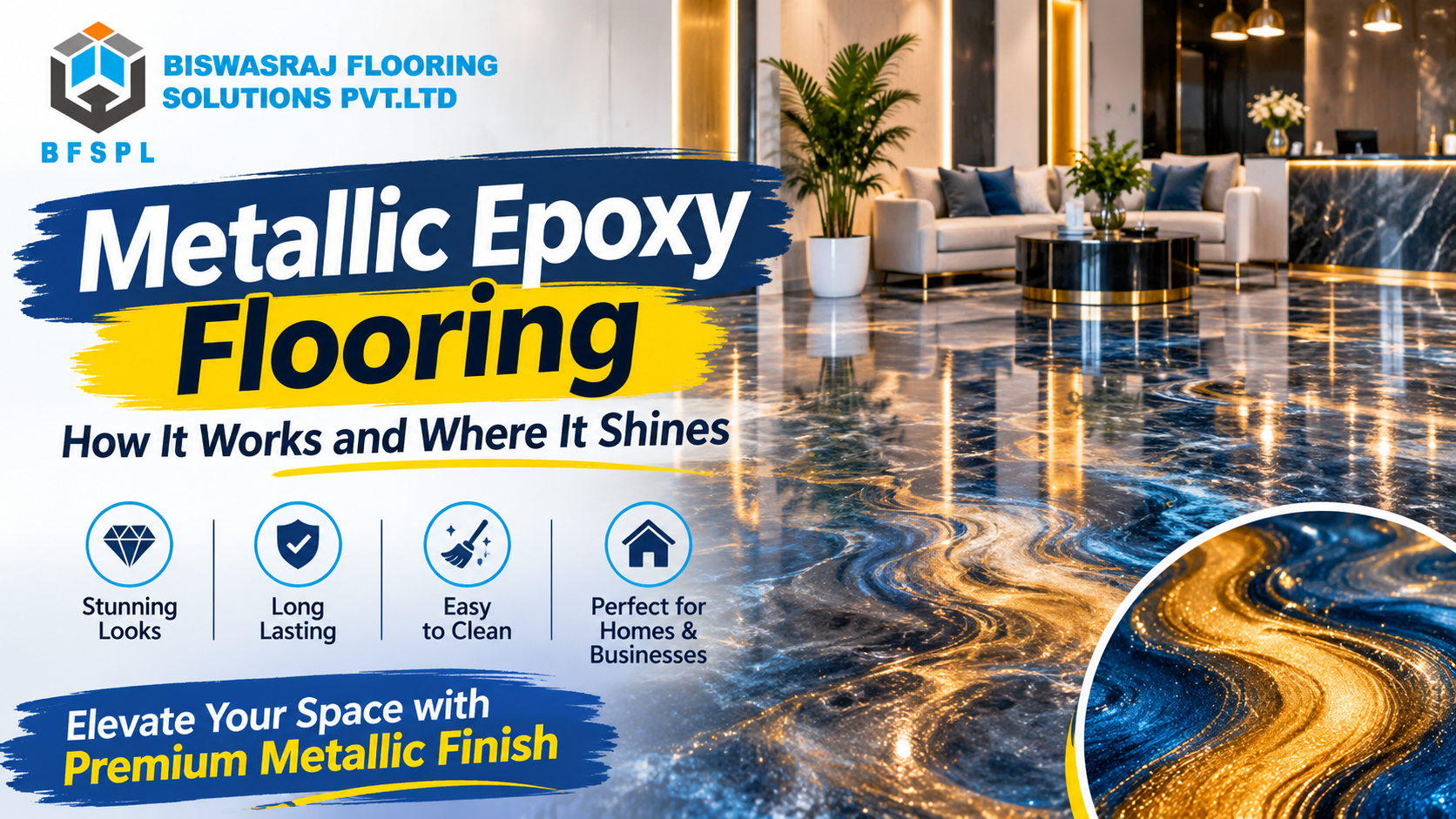
How is metallic epoxy flooring made?
Metallic epoxy flooring turns plain concrete into a seamless, marble-like surface. Learn how it is made, where it works, the 7-step install, and how to keep the shine for years.
Metallic epoxy flooring is a decorative resin floor where metallic pigments float in epoxy to create swirls, depth, and a marble-like shine. Like other epoxy systems BiswasRaj installs, most projects finish in 3 to 7 days and last 8 to 10 years or more with normal care.
If you are still comparing finishes, our guide to the main types of epoxy flooring systems explains coatings, self-levelling layers, screeds, and mortars. This post covers the decorative end: what a metallic finish is, where it suits, how it goes down, and how to keep it looking new.
What are the key facts about our services?
- Business Type
- Home And Construction Business
- City
- New Delhi
- Installation Duration
- 3 to 7 days
- Floor Lifespan
- 8 to 10 years or more
What Is Metallic Epoxy Flooring And How Does It Get Its Look?
Metallic epoxy flooring is a poured resin finish that carries fine metallic or pearlescent pigment. While the resin is still wet, installers move that pigment with rollers, brushes, or a light solvent mist, so it settles into swirls, ripples, and cloud patterns that resemble polished stone or molten metal.
The pigment is made of tiny reflective particles that catch light at different angles. As the resin levels out, those particles drift, stack, and turn, which creates the sense of depth you notice as you walk across the room. Because the movement happens by hand in liquid resin, no two pours ever match exactly.
Four choices shape the final look:
• Base coat colour: a dark base makes the metallic layer look deeper, a light base keeps it soft
• Pigment tone: silver, copper, gold, bronze, pearl, or a blend of two or three
• Technique: long roller swirls, brushed veins, or solvent “cells” that look like lava
• Topcoat sheen: high gloss gives a mirror effect, satin cuts glare and hides light scratches
This is why a sample board matters. Seeing the base colour and pigment together under your own lighting is the best way to judge the result before the main pour.
How Is It Different From 3D And Plain Epoxy Floors?
The main difference is how the design forms. Metallic epoxy flooring creates its pattern from pigment moved by hand, so every floor is one of a kind. A 3D floor seals a printed image under clear resin, while a plain epoxy coating is a single solid colour built mainly for function.
|
Feature |
Metallic epoxy |
3D epoxy |
Plain epoxy coating |
|
How the design forms |
Pigment worked by hand in wet resin |
Printed graphic sealed under a clear coat |
Solid colour with no pattern |
|
Design control |
Partial, every pour is unique |
Full, the image is chosen in advance |
Not needed |
|
Typical look |
Marble, pearl, lava, or brushed metal |
Ocean, rock, or custom scenes |
Uniform matte or gloss |
|
Best suited to |
Showrooms, lounges, offices, homes |
Feature zones and brand spaces |
Factories, warehouses, utility rooms |
|
Matching a later repair |
Hard to blend invisibly |
Very hard once printed |
Easy |
Metallic is usually the simpler of the two decorative systems to lay, and many projects combine both: a metallic field across the room with one printed panel at the entrance. Our 3D epoxy flooring guide explains how the printed layer is built and sealed.
Where Does A Metallic Finish Work Best?
Metallic epoxy flooring works best indoors, in spaces where appearance matters and traffic is mostly people or light wheels. Car showrooms, retail stores, office lobbies, restaurants, salons, and living areas are ideal. It suits forklift aisles, loading docks, and rooms in strong direct sunlight far less well.
Here is how different spaces use it:
• Car and bike showrooms: the reflective surface bounces display lighting and makes vehicles stand out
• Retail and jewellery stores: a premium floor supports a premium product without busy patterns
• Corporate lobbies and meeting rooms: a seamless, polished surface sets the tone for visitors
• Restaurants, cafes, and salons: no grout lines means fewer places for dirt and moisture to collect
• Homes: living rooms, home theatres, kitchens, and basements gain a single continuous surface
Choosing metallic epoxy for homes works best where the floor is meant to be the design centrepiece, such as an open living and dining area. Pair it with a satin topcoat if the space gets a lot of daylight.
Heavy industrial floors are a different job. Forklift traffic, pallet drops, and chemical spills call for functional systems built for load and resistance, which our epoxy flooring services for factories, warehouses, and commercial spaces cover in detail.
What Are The Benefits And Limits Of A Metallic Floor?
The biggest strengths of metallic epoxy flooring are a seamless, easy-clean surface, a high-end look that tiles cannot copy, and good resistance to everyday stains. Its limits are a slippery surface when wet, possible yellowing in direct UV light, and repairs that are hard to blend.
Benefits
• Seamless surface: no joints or grout, so spills wipe away and dust has nowhere to hide
• Unique design: every floor is custom, so no two showrooms or homes look the same
• Brighter rooms: the reflective finish spreads light, which helps display areas and dim corridors
• Stain resistance: cured epoxy shrugs off tea, oil, and most household spills when wiped promptly
• Fewer renovations: a worn topcoat can be refreshed without removing the decorative layer
Limits and how to manage them
|
Limit |
Why it happens |
How to manage it |
|
Slippery when wet |
High-gloss resin has a very smooth surface |
Add fine anti-slip aggregate to the topcoat or choose satin |
|
Yellowing near windows |
Epoxy can amber under ultraviolet light |
Seal with a UV-stable polyurethane or polyaspartic topcoat |
|
Visible scratches |
Grit grinds into gloss over time |
Use entrance mats and felt pads, recoat traffic lanes |
|
Hard-to-match repairs |
Each pour has a unique pattern |
Protect the floor well, plan repairs at room or zone edges |
A well-specified metallic floor coating handles these limits at the design stage, so the topcoat choice should be agreed before work begins, not after.
How Is A Metallic Epoxy Floor Installed Step By Step?
A professional metallic epoxy flooring installation follows seven stages, from testing the slab to sealing the final topcoat. Most failures trace back to the early preparation steps, because resin only bonds and levels properly on clean, dry, and sound concrete.
1. Inspect and test the slab. Check for cracks, hollow areas, level differences, and moisture. Coating manufacturers generally require moisture testing before installation on concrete, and ASTM F2170 sets out a standard method for measuring relative humidity inside concrete floor slabs. New concrete needs at least 28 days of curing first.
2. Grind the surface. Diamond grinding removes laitance, oil, paint, and old coatings, and opens the pores so the primer can grip.
3. Repair and prime. Cracks and joints are filled, then a primer seals the concrete and stops air from rising into the coats above as pinholes.
4. Lay the base coat. A tinted, self-levelling layer sets the background colour and gives a flat, even stage for the design.
5. Pour and work the metallic layer. Pigmented resin goes down in sections, and the crew shapes swirls, veins, or cells while it is still workable.
6. Seal with a clear topcoat. Epoxy, polyurethane, or polyaspartic protects the design, with anti-slip aggregate added where needed.
7. Cure and hand over. The floor stays closed for the curing period the system specifies before furniture, display units, or vehicles return.
Peeling, bubbling, and white patches almost always point back to steps 1 to 3. Our guide on why epoxy floors peel, bubble and fail walks through each cause and the fix.
How Do You Keep A Metallic Floor Looking New?
Daily dust mopping, weekly damp mopping with a pH-neutral cleaner, and felt pads under furniture keep a metallic finish bright. Grit is the main enemy, because fine sand acts like sandpaper on the gloss topcoat and slowly dulls the reflective effect.
A simple care routine:
• Daily: dry dust mop or microfibre sweep, especially near entrances
• Weekly: damp mop with diluted pH-neutral floor cleaner, then let it air dry
• Spills: wipe oil, juice, and chemicals quickly so they do not etch the topcoat
• Avoid: bleach, acidic or citrus cleaners, steel wool, and abrasive scrubbing pads
• Furniture: felt pads under chair legs, and lift heavy items rather than dragging them
• Every few years: have the clear topcoat recoated in high-traffic lanes once the gloss wears
Treating the topcoat as the sacrificial layer is the key idea.
As long as it is renewed before wear reaches the metallic layer, the decorative design underneath stays intact for the full life of the floor. This is also why decorative epoxy flooring in a busy showroom benefits from a planned recoat schedule rather than waiting for visible damage.
Frequently Asked Questions about Metallic Epoxy Flooring
What is metallic epoxy flooring?
Metallic epoxy flooring is a decorative resin floor that features metallic pigments suspended in epoxy, creating swirls and a marble-like shine. It transforms plain concrete into a seamless and visually appealing surface.
How long does it take to install metallic epoxy flooring?
Most metallic epoxy flooring projects are completed within 3 to 7 days. The installation duration can vary based on the specific requirements of the project.
Where can I use metallic epoxy flooring?
Metallic epoxy flooring is ideal for indoor spaces where appearance matters, such as car showrooms, retail stores, offices, and homes. It is less suitable for heavy industrial areas or spaces with heavy forklift traffic.
How do I maintain metallic epoxy flooring?
Maintaining metallic epoxy flooring involves regular cleaning to remove dust and spills. A worn topcoat can be refreshed without removing the decorative layer, ensuring the floor remains vibrant.
Is metallic epoxy flooring slippery?
Yes, metallic epoxy flooring can be slippery when wet due to its smooth, high-gloss surface. To manage this, anti-slip aggregates can be added to the topcoat or a satin finish can be chosen.
What do the flooring statistics show?
- 14+ years experience serving flooring clients BiswasRaj Flooring, 3D Epoxy Flooring guide
- 3 to 7 days typical epoxy flooring installation time BiswasRaj Flooring, Epoxy Flooring service page
- 8 to 10 years or more epoxy floor service life in normal use BiswasRaj Flooring, Epoxy Flooring service page
Ready To Plan Your Metallic Floor?
BiswasRaj Flooring has served clients for over 14 years from offices in Delhi, Bangalore, and Pune, and is ISO 9001:2015 certified. Share your floor area and a few photos through our contact and enquiry page to arrange a site visit and a metallic epoxy flooring sample for your space.
Serving India and nearby: Bangalore, Karnataka, New Delhi, Delhi.