

Flooring Types: Laser Screed Flooring vs Epoxy Flooring
 03 Sep 2026
Flooring Types: Laser Screed Flooring vs Epoxy Flooring
- Posted by Nagananda Udupa
Choosing the right floor for an industrial, commercial, warehouse or mega construction project is not an easy task. There are many different types of floor that can be used. In this article we discuss the various flooring types and look at how laser screed flooring differs from epoxy flooring.
Flooring Types Explained
Depending on the type of building, industry or even personal preference there are many different types of flooring. A perfect choice can only be made if the characteristics of the floor are known. There are concrete flooring, vdf flooring, laser screed flooring, epoxy flooring, industrial flooring, super flat flooring, joinless flooring, fmgrade flooring or flooring densification systems.
What is Laser Screed Flooring?
Laser Screed Flooring is a form of concrete flooring construction. Using laser guided equipment concrete is placed and the floor is levelled.
As compared to manually levelling concrete, laser screed technology enables very accurate concrete floor levels to be achieved and therefore has a number of advantages and benefits over conventional concrete floor construction techniques. Laser screed flooring is mainly used in warehouses, factories, logistics facilities, distribution centers or in large scale commercial construction.
Some of the advantages of laser screed flooring are:
• Laser guided equipment ensures highly accurate floor levels
• Laser screed flooring produces superior flatness.
• Laser screed allows faster floor installation.
• Laser screed reduces need for manually levelling concrete
• Ideal for large floor areas.
• Laser screed flooring allows for more efficient operation of forklift trucks, equipment, storage systems etc.
What is Epoxy Flooring?
Epoxy Flooring is a coating or resinous system that is applied to a prepared concrete floor. Epoxy flooring can be designed and formulated to meet the required performance criteria. Epoxy floor coatings are usually applied in factories, warehouses, garages, workshops, commercial buildings, laboratories or even in hospitals.
Epoxy flooring systems come in a wide variety of colours, thicknesses and specifications depending on the system that is chosen to suit the purpose for which it is to be used.
Some of the advantages of epoxy flooring are:
• Epoxy flooring systems are very durable and suitable for heavy traffic.
• Abrasion resistant epoxy systems protect against wear and tear.
• Ease of maintenance is ensured.
• Chemical resistant epoxy systems protect against chemical exposure.
• Aesthetics are improved with epoxy flooring systems.
• Epoxy flooring protects concrete substrates and reduces dust formation.
Laser Screed Flooring vs Epoxy Flooring
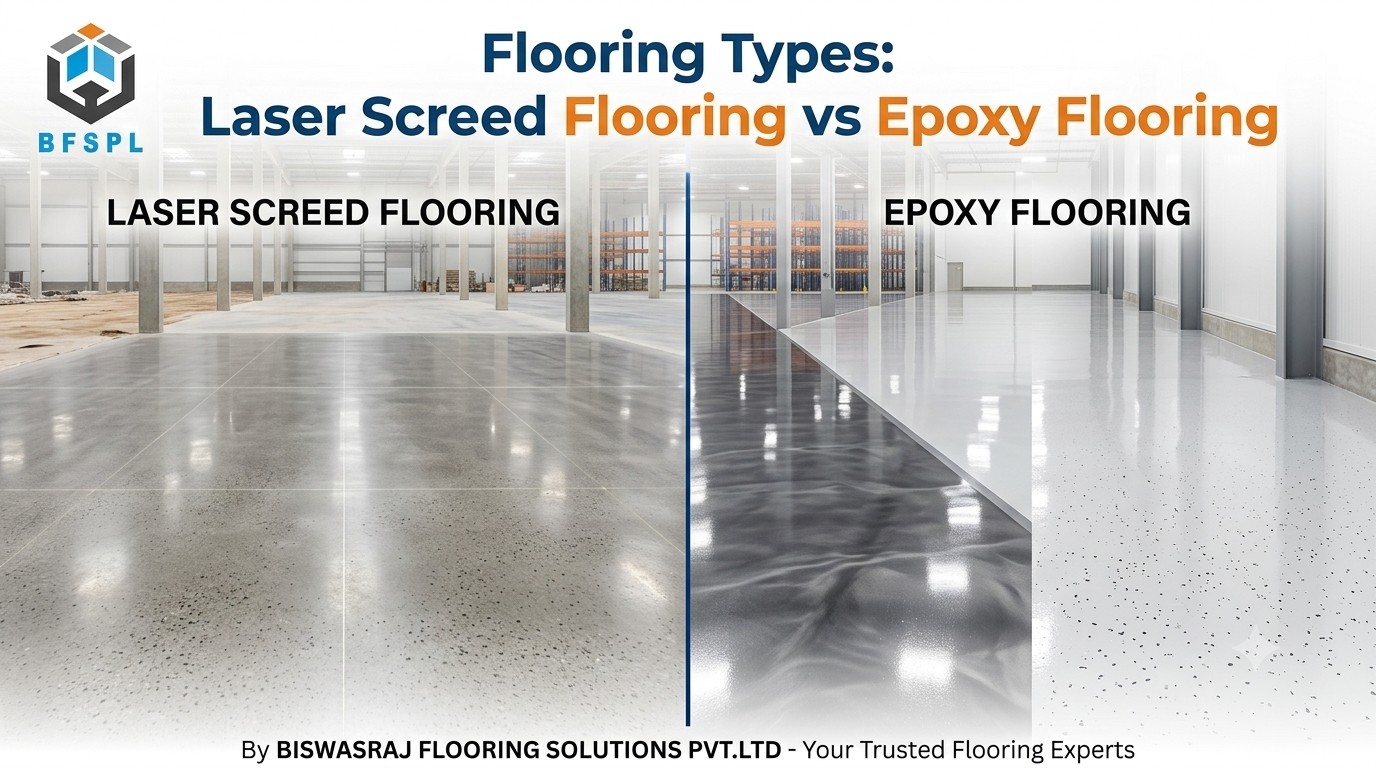
While both laser screed flooring and epoxy flooring have their advantages and benefits they serve completely different purposes and are not necessarily competing products but rather products that can complement each other in the overall flooring system for a particular application.
Laser Screed Flooring vs Epoxy Flooring
In some cases, laser screed and epoxy flooring can be combined, i.e., concrete can be laid using laser technology and an appropriate surface protection system such as epoxy can be applied to the concrete floor.
How to Choose Different Floors
When choosing from various floor types the requirement and/or use for which the floor is needed must firstly be considered.
1. Choice of Floor Use
Consider the specific use for the floor. A warehouse floor used for forklift traffic and material storage will have different requirements from an office floor.
2. Traffic and Load
If the floor is to be subjected to heavy traffic and/or heavy loads, the floor choice should reflect this requirement. Pallet trucks, forklift trucks, vehicles or large pedestrian traffic will impose different loading and traffic requirements on the floor.
3. Surface Requirements
If the floor requires high levels of accuracy and flatness then laser screed technology is ideal for achieving this requirement during concrete floor laying.
If a high standard of surface protection is required then an epoxy system is ideal for giving the required surface protection.
4. Chemical Exposures
If the facility is a manufacturing plant or workshop there will be chemical exposures and the chemical exposure resistance of the flooring system should be considered.
5. Cleaning and Maintenance
Floors that are easy to clean and maintain are always advantageous. Epoxy systems are generally chosen for easy maintenance and cleanliness.
6. Long Term Performance
The cheapest floor is not always the most cost effective floor in the long run. Consider the cost effectiveness over the lifetime of the floor and not only the initial purchase/installation cost. Factors such as proper installation, traffic and loading, maintenance and environmental exposure will determine the cost effectiveness.
Where is Laser Screed Flooring Used?
Laser screed flooring is ideally suited to large concrete floor areas where high accuracy and flatness levels are required.
Typical applications for laser screed flooring include:
• Warehouses
• Manufacturing Plants
• Distribution Centers
• Logistics Facilities
• Industrial Buildings
• Large Commercial Facilities
• Storage Areas
• Parking or other similar large concrete floor applications
The floor specification should always be based on the use for which the floor is intended.
Where is Epoxy Flooring Used?
Epoxy flooring is suitable for all commercial and industrial facilities in which a high standard of surface protection and easy maintenance is required.
Typical applications for epoxy flooring include:
• Manufacturing Units • Warehouses • Workshops • Garages • Showrooms • Commercial Buildings • Laboratories • Healthcare Facilities • In food processing areas – with appropriate system The correct epoxy system and application should be chosen according to the environment. This depends on the application. In some cases it is possible to use laser screed technology to lay concrete and then follow this up with an appropriate epoxy system once the concrete floor has cured and the surface has been prepared. Applying an epoxy system should not be done on any concrete floor without prior preparation. The surface cleanliness, moisture conditions, strength, curing, presence of cracks, surface profile or other environmental conditions should be taken into account before installation. When choosing a floor it is easy to make some common mistakes. This is usually due to some of the following reasons: • Not taking into account the proposed use for the floor. • Not ensuring that the surface is prepared correctly. • Not considering the traffic that the floor will be subjected to. • Not considering the moisture conditions. • Only considering aesthetics without regard for performance. • Choosing the wrong specification for the floor. Laser screed flooring is commonly used for large warehouses, factories, logistics facilities, and commercial spaces. Laser screed flooring provides accurate levelling, improved flatness, consistent floor elevations, faster installation across large areas, and reduced dependence on manual levelling. Epoxy flooring is widely used in factories, warehouses, workshops, garages, showrooms, laboratories, and commercial spaces. Yes. Laser screed technology can be used to create an accurately levelled concrete floor, while epoxy flooring can later be applied as a protective and finished surface when the project requirements are suitable. Consider factors such as floor usage, traffic, load requirements, chemical exposure, maintenance needs, surface conditions, and expected service life. Get the Right Flooring Solution for Your Project Choose the right flooring solution for your project with expert guidance and quality installation. From laser screed flooring to epoxy flooring, get a system designed for durability and performance. Contact us today to discuss your flooring requirements and get started. Can Laser Screed and Epoxy Flooring be Combined?
Common Mistakes When Choosing a Floor
Frequently Asked Questions1. What are the main flooring types used in industrial buildings?
Common flooring types include concrete flooring, VDF flooring, laser screed flooring, epoxy flooring, super flat flooring, and jointless flooring. 2. What is laser screed flooring used for?
3. What are the benefits of laser screed flooring?
4. Where is epoxy flooring commonly used?
5. Can laser screed flooring and epoxy flooring be used together?
6. How do I choose the right flooring type for my project?