


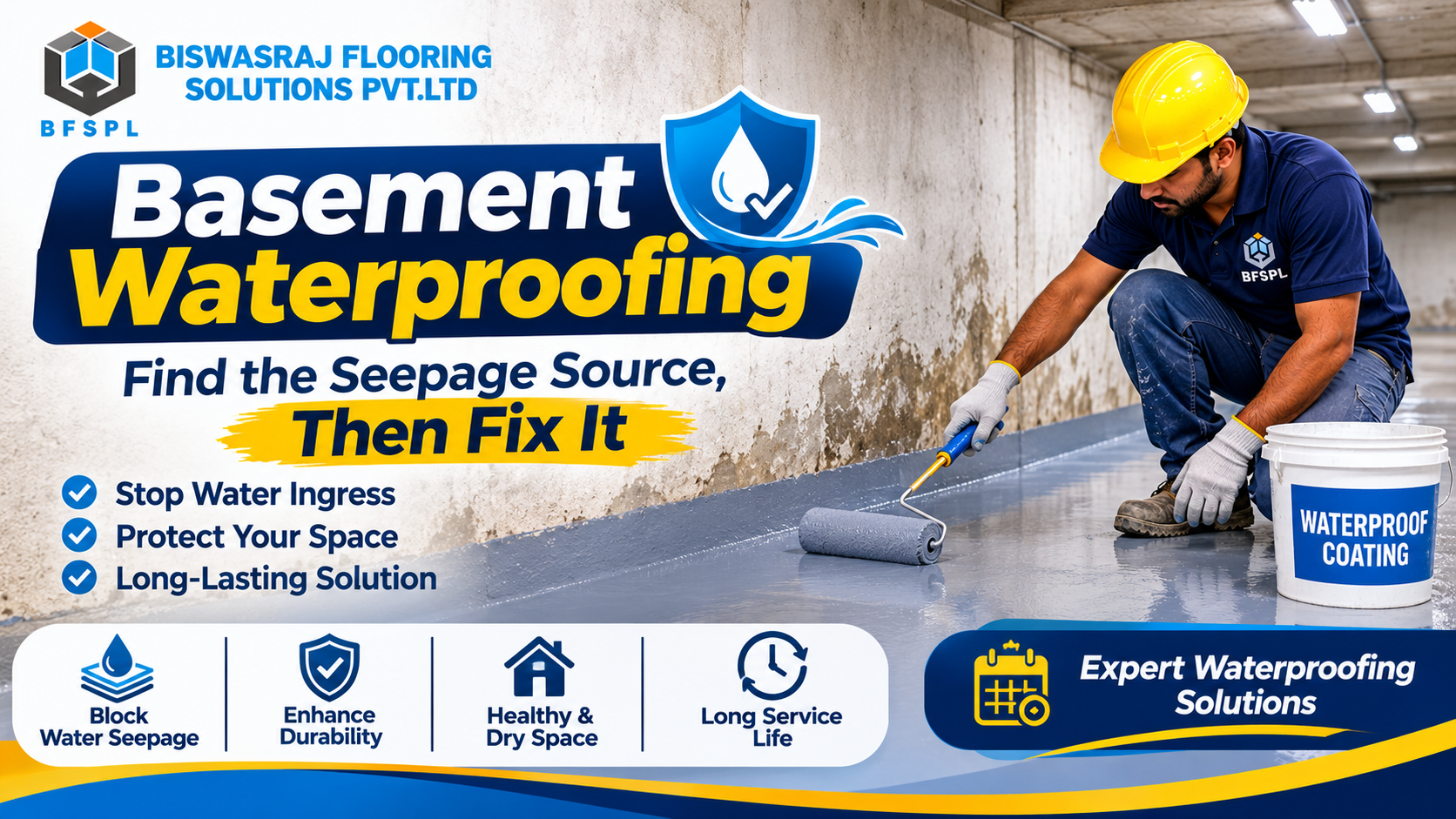
Basement Waterproofing: Find the Seepage Source, Then Fix It
Basement waterproofing keeps groundwater and rainwater out of below-ground walls, floors, and joints. Every metre of water standing against a basement adds about 9.81 kPa of pressure, so the system you choose must match how high the water table rises during the monsoon.
This guide explains why basements leak, how to read the warning signs, which treatment suits which problem, and what shapes the final quote. For other parts of a building, see our complete guide to building and floor waterproofing.
What causes basements to leak?
A practical basement waterproofing guide for homes, parking levels, and factories: why basements leak, how to read seepage signs, which method fits which problem, and what really drives the cost of the job.
What are the key facts about our services?
- Price
- Quoted after a free site inspection
- Methods
- Membranes, liquid coatings, and injection grouting
- Best time
- Dry season, before the monsoon
- Areas covered
- Delhi NCR, Bangalore, Pune, and projects across India
Why Do Basements Leak In The First Place?
Basements leak because they sit inside wet soil. Rain and groundwater surround the walls and slab, then push through the weakest points in the concrete. Basement waterproofing only works when it seals every one of those entry routes, not just the damp patch you can see.
The problem is seasonal. India receives about 75% of its annual rainfall between June and September, according to the India Meteorological Department’s rainfall normals. That water soaks the ground around your basement for four straight months and lifts the local water table.
Water then looks for the easiest way in. These six routes account for most leaks we trace on site:
• Construction joints: the cold joint where the wall was poured on top of the slab
• Shrinkage and settlement cracks: hairline at first, wider after each wet season
• Pipe and cable entries: gaps around sleeves that were never sealed
• Honeycombed concrete: poorly compacted patches full of air voids
• Missing external membrane: skipped or damaged during construction
• Poor drainage outside: rainwater pooling against the retaining wall
Pressure grows with depth. A basement floor sitting 3 metres below the water table carries about 29 kPa of upward pressure, close to 3 tonnes on every square metre. A thin surface coating cannot hold that back on its own.
What Are The Warning Signs Of Basement Seepage?
The early signs of basement seepage are damp patches that grow after rain, white salt deposits on the walls, peeling paint, a musty smell, and water collecting where the wall meets the floor. Rust stains near a crack mean water has already reached the steel.
Each symptom points to a likely source. Reading them correctly saves you from paying for the wrong fix.
|
Symptom |
Likely source |
What it tells you |
|
Damp band along the wall base |
Wall to slab construction joint |
Water is under pressure at the lowest point |
|
Wet line following a crack |
Shrinkage or settlement crack |
A direct path through the concrete |
|
White powder on the plaster |
Salts carried by moving water |
Seepage is slow but constant |
|
Damp ring around a pipe |
Unsealed sleeve or entry point |
A local leak that grouting can close |
|
Water rising through the floor |
Failed slab membrane or high water table |
Pressure is acting from below |
|
Brown or orange streaks |
Corroding reinforcement |
Structural damage has begun |
Keep a simple log before you book basement waterproofing. Photos taken during two or three rain events, with dates, help a contractor tell a joint leak from a slab problem in minutes.
Some of these signs also appear above ground. Our post on treating damp walls and seepage problems covers rooms that are not below grade.
Which Waterproofing Method Suits Which Basement Problem?
The right method depends on where the water enters and whether you can reach the outside of the wall. Positive side systems block water before it touches the concrete, negative side systems hold it back from inside, and injection grouting seals active leaks at cracks and joints.
|
Method |
Applied from |
Best for |
Limitation |
Relative cost |
|
External membrane |
Outside of walls and under the slab |
New basements, high water table |
Needs excavation or open working space |
Medium when new, high as a retrofit |
|
Cementitious or crystalline coating |
Inside face of walls and floor |
Existing basements with damp, low to moderate pressure |
Cannot bridge moving cracks |
Low to medium |
|
Injection grouting |
Drilled ports into cracks and joints |
Active leaks at cracks, joints, and pipe entries |
Seals points, not whole surfaces |
Priced by crack and joint length |
|
Internal tanking with protective screed |
Inside walls and floor |
Buildings where the outside cannot be reached |
Needs a dry surface, raises floor level slightly |
Medium to high |
|
Perimeter drain and sump |
Inside or outside the footprint |
Persistent high water table |
Pump needs power and upkeep |
Medium |
Most basement waterproofing jobs combine two of these. Grouting stops the active leaks first, then a coating or tanking layer protects the whole surface so water does not simply move to the next weak spot.
If water is rising through the slab rather than the walls, our guide to protecting concrete floors from moisture explains the floor treatments in more detail.
Can You Waterproof A Basement From The Inside?
Yes. When the outside wall is buried against a road or a neighbouring plot, the work is done from inside. Inside treatment must resist water pushing it off the wall, so surface preparation and bonding matter more than the brand on the bucket.
Outside treatment is still the stronger choice where it is possible. Water pressure presses an external membrane against the wall, while the same pressure tries to peel an internal one away.
For existing buildings, a well-executed internal system still works. It needs three things:
• Active leaks closed by injection grouting before any coating goes on
• Sound, clean concrete with all loose plaster and salt removed
• A protective plaster or screed so racks and vehicles do not damage the layer
If the building is still under construction, treat the outside instead. IS 3067 calls for a working space of at least 600 mm around a basement so external treatment can be laid properly. Our industrial waterproofing guide for floors and basements sets out that detailing and how it fits under an industrial floor finish.
How Much Does It Cost To Waterproof A Basement?
There is no honest flat rate. Cost depends on the treated area, the water pressure, how many active leaks need grouting, whether the outside can be reached, and how much damaged plaster or screed must come off first. Get a written quote only after an inspection.
|
Cost factor |
Pushes the cost up when |
Keeps the cost down when |
|
Water pressure |
The water table sits above the floor level in monsoon |
The ground stays dry for most of the year |
|
Active leaks |
Many cracks and joints are flowing |
Damp is slow with no running water |
|
Access |
Work must be done from inside, around parked cars or racks |
The basement can be cleared in one go |
|
Surface condition |
Plaster is hollow and concrete is honeycombed |
The concrete is sound and only needs cleaning |
|
Timing |
Work runs into the rains and needs constant dewatering |
Work is done in the dry season |
A good quote reads like a method statement. Compare basement waterproofing quotes line by line, not on the total alone, and check that each one lists:
• The treated area in square feet, walls and floor separately
• The system and product names, with the number of coats
• Crack and joint length to be grouted
• Surface preparation and the protective layer on top
• A water test before handover, and the warranty terms in writing
How Does A Contractor Fix A Leaking Basement Step By Step?
A sound basement waterproofing job moves from diagnosis to testing in a fixed order. Skipping a step, especially drying and surface preparation, is the most common reason a new treatment fails within its first monsoon.
1. Inspect and map: take moisture readings, mark every leak, and check drainage outside.
2. Dewater and dry: pump out standing water and let the surface dry.
3. Stop active leaks: inject grout into flowing cracks, joints, and pipe entries.
4. Prepare the surface: remove loose plaster, paint, and salt, then repair honeycombed patches.
5. Treat joints and corners: form a fillet at the wall to floor junction and seal construction joints.
6. Apply the main system: lay the coating, membrane, or tanking in the specified coats.
7. Protect the layer: finish with plaster on the walls and a screed on the floor.
8. Test and hand over: observe the area through a wet spell and record moisture readings.
Owners asking how to stop water seepage in basement walls often jump straight to step 6 with a waterproof paint. That hides the damp for a few months at most, because nothing has dealt with the water pressure behind it.
Timing matters as much as method. Use our monsoon proofing checklist for warehouse floors to plan the work in the dry window before the rains.
What is basement waterproofing?
What is basement waterproofing?
Basement waterproofing is a process that keeps groundwater and rainwater out of below-ground walls, floors, and joints. It is essential to prevent water damage and maintain the structural integrity of a building.
How do I know if my basement has seepage?
Signs of basement seepage include damp patches that grow after rain, white salt deposits on walls, peeling paint, and a musty smell. Observing these symptoms can help identify the source of the problem.
What methods do you use for waterproofing basements?
We use various methods for basement waterproofing, including membranes, liquid coatings, and injection grouting. The method chosen depends on the specific seepage issue and the accessibility of the area.
When is the best time to waterproof my basement?
The best time to waterproof a basement is during the dry season, before the monsoon. This timing allows for effective application and ensures the materials can properly adhere and cure.
Do you provide waterproofing services outside of New Delhi?
Yes, we provide basement waterproofing services in various locations across India, including Delhi NCR, Bangalore, and Pune. We also handle projects in other regions as needed.
What do the statistics reveal?
- 75% Share of India's annual rainfall that falls between June and September India Meteorological Department, Updated Rainfall Normal 1971-2020
- 600 mm Working space IS 3067 calls for around a basement so external treatment can be laid BiswasRaj Flooring, Industrial Waterproofing Services guide
Ready To Dry Out Your Basement For Good?
Start with a site inspection before anyone quotes a product. Our team traces the water source first, then recommends basement waterproofing that fits your structure and the pressure it faces. Book a free inspection through our waterproofing services page or call +91 9555559829.
Serving India and nearby: Bangalore, Karnataka, New Delhi, Delhi.