
• Phone:
  • 9555559829
  • Phone:
  • 9555212898

Jointless Flooring

Jointless Flooring

Jointless Flooring

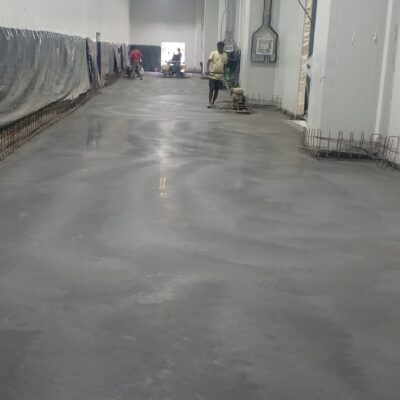
BiswasRaj Jointless Flooring delivers large, continuous concrete panels with virtually no saw-cut joints. Using Steel Fiber Reinforced Concrete (SFRC) and a shrinkage-controlled mix design, we build floors that stand up to forklifts, VNA racking, and round-the-clock plant operations, with less maintenance and a longer service life.

If your business runs on heavy machinery, high-rack storage, or strict hygiene standards, a jointless floor isn't a luxury. It's the floor your operation needs.

Get a Free Site Assessment

Why Choose BiswasRaj Jointless Flooring

  • SFRC Technology: steel fiber reinforced concrete instead of traditional mesh, for stronger, crack-resistant panels
  • Large Panel Construction: continuous slabs up to 2,000+ sq. m, with far fewer joints than standard flooring
  • VNA & MHE Ready: built to the flatness tolerances your racking and forklifts demand
  • Standards-Backed: designed to TR34, DIN, and ASTM/ACI benchmarks, with FM1/FM2 grade execution available
  • Lower Lifetime Cost: fewer joints, fewer repairs, less downtime over the life of the floor
  • End-to-End Execution: subbase assessment, mix design, laser-guided placement, and handover, all under one roof

Industries We Serve

  • Warehouses & Distribution Centers: high-rack storage, constant forklift traffic
  • E-commerce & 3PL Logistics Hubs: smooth, durable floors for high-speed sorting
  • Manufacturing Plants: floors built for vibration, heavy machinery, and 24/7 operation
  • Cold Storage & Food Processing Units: seamless, hygienic surfaces that resist moisture and bacteria
  • Hospitals & Laboratories: joint-free surfaces that are easy to clean and sanitize
  • Aircraft Hangars & Large Industrial Sheds: uninterrupted floor areas for heavy point loads

Quality You Can Verify

Every BiswasRaj jointless floor is designed and executed against recognized industrial flooring standards, including TR34, DIN, and ASTM/ACI flatness and load criteria, with FM1/FM2 grade execution available where your project demands it. As an ISO 9001:2015 certified company, we back every floor with verified engineering, not guesswork.

Key Benefits

Engineering Benefits That Matter to Your Bottom Line

  • High load-bearing capacity, built for heavy machinery, multi-tier racking, and constant traffic
  • Smoother movement for forklifts and reach trucks, with fewer impact points across the floor
  • VNA-ready flatness, suited for Very Narrow Aisle racking and high-bay storage
  • Controlled crack width, keeping any minor cracking within a guaranteed tolerance
  • Reduced curling at panel edges, even across large floor areas
  • Optimized slab thickness, lowering concrete usage and overall project cost
  • Lower lifetime maintenance, with far fewer joints to repair or replace
  • Hygienic, easy-to-clean surface, ideal for hospitals, labs, and food processing units
  • Designed to recognized standards including TR34, DIN, and ASTM/AC

Our Process

  1. Site & Subbase Assessment: We evaluate ground conditions, load requirements, and racking layout before any design work begins.
  2. Mix Design & Engineering: Our team finalizes the SFRC mix, panel sizing, and slab thickness based on your specific operational loads.
  3. Laser-Guided Placement: Concrete is placed and leveled using laser-guided screeding for precise flatness across large panels.
  4. Joint & Edge Detailing: Panel edges are finished with steel-armoured joint detailing to handle movement without compromising the seamless surface.
  5. Curing & Quality Checks: The floor is cured under controlled conditions and checked against TR34/DIN flatness and load tolerances.
  6. Handover: You receive a finished, tested floor, with FM1/FM2 grade certification available where required.

Frequently Asked Questions

What is the difference between jointless flooring and normal concrete flooring?

Normal concrete floors use steel mesh and need saw-cut joints every few meters to control shrinkage cracking. Jointless flooring uses SFRC instead, allowing much larger panels with far fewer joints.

Is jointless flooring suitable for forklifts and VNA racking?

Yes. It's widely used in warehouses and distribution centers because its flat, continuous surface reduces wear on forklifts and reach trucks, and supports Very Narrow Aisle (VNA) racking requirements.

Does jointless flooring crack?

All concrete can develop minor cracking, but SFRC keeps crack width within a designed, guaranteed tolerance, so it stays tight and doesn't affect structural performance.

How thick does a jointless concrete floor need to be?

It depends on the load, subgrade conditions, and racking layout. Steel fibers improve load distribution, so jointless floors can often be built thinner than mesh-reinforced slabs for the same load rating.

Which industries use jointless flooring the most?

Warehouses, 3PL and logistics centers, manufacturing plants, cold storage facilities, and hospitals, anywhere heavy traffic, hygiene, or both are a priority.

Interested in Jointless Flooring?

Get a free consultation and quote for your project. Our experts are ready to help.

Get a Free Quote