


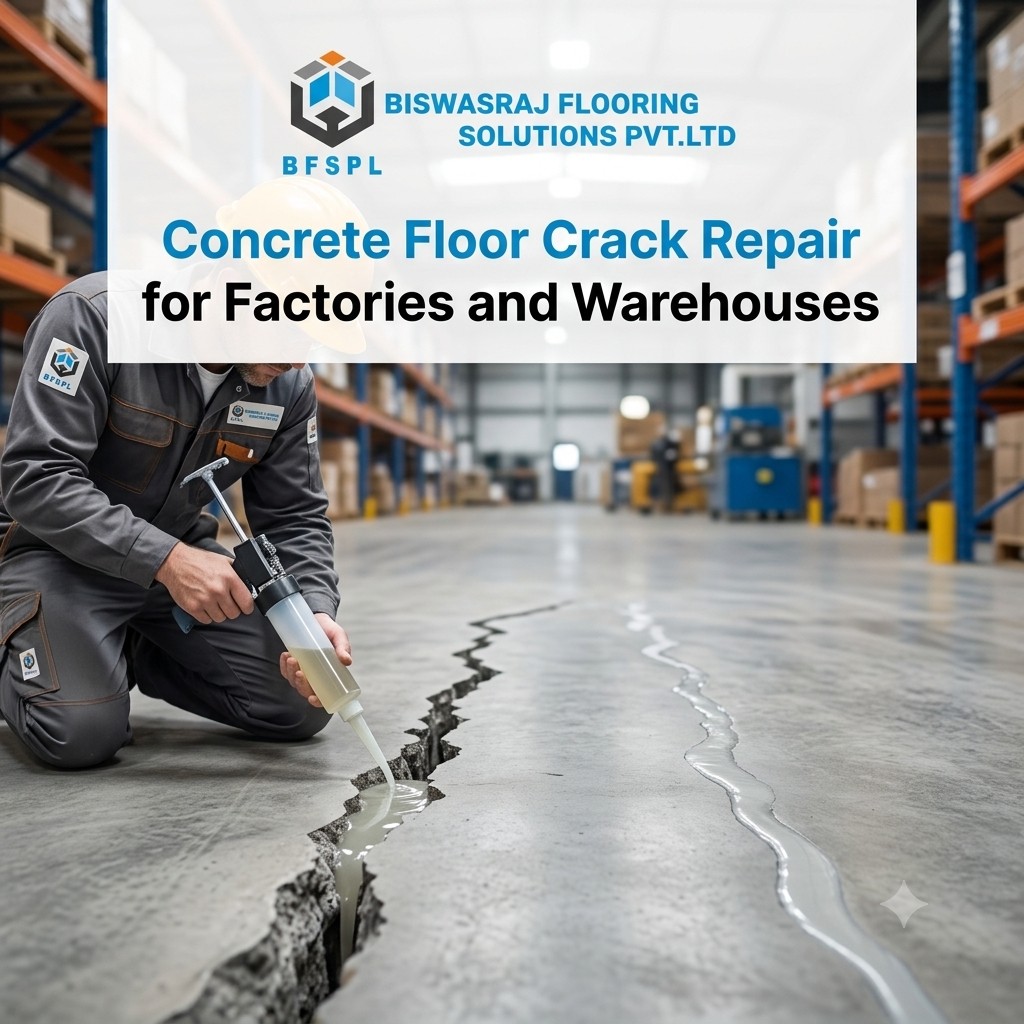
Concrete Floor Crack Repair for Factories and Warehouses
Short answer: Concrete floor crack repair involves identifying the cause, preparing the damaged area, and applying a suitable filler. Static cracks may require rigid epoxy, while moving cracks need flexible materials like polyurea or polyurethane. Proper crack and joint repairs help reduce edge damage, protect floor coatings, and maintain smooth, durable surfaces for forklifts and heavy equipment in factories and warehouses.
A crack in a factory slab rarely stays small. Forklift wheels hammer the edges; moisture creeps in, and a hairline can turn into a spalled trench within a season.
This guide to concrete floor crack repair shows you how to read the crack, choose a filler that suits its movement, and finish the job, so it holds under load.
The Short Version
Static cracks take rigid fillers. Moving cracks need flexible ones.
Open every crack with a grinder before filling it.
Sawn joints need a semi-rigid filler of at least Shore A 80.
A coating over an unrepaired crack lets the crack reflect straight through.
Delay joint filling until the slab has finished most of its shrinkage.
Why Do Industrial Concrete Floors Crack?
Concrete shrinks as it dries, and a slab held back by its base, columns, or poor jointing cracks as it shrinks. Overloading, weak subgrade support, temperature swings, and repeated impact add to the damage over the years.
Most cracks trace back to one of these causes:
Drying shrinkage: shows up in the first weeks, often as fine, shallow lines.
Late or missing joint cuts: the slab chooses its own crack line instead of yours.
Weak subgrade: racking and machines settle the ground, and the slab follows.
Overload and impact: heavy wheels and dropped loads break edges and open cracks.
Thermal and moisture movement: cracks widen and close with the seasons.
The shape of a crack often points to its cause. A straight line that follows a saw cut suggests shrinkage at a joint, while a long meandering crack across a bay suggests the slab found its own weak line.
A web of fine surface lines points to surface drying, not structural trouble. A crack with one side sitting lower than the other points to settlement or lost support.
If you want a deeper look at causes and crack types, read our guide to concrete floor cracks.
Which Cracks Are Static and Which Are Moving?
A static crack has stopped moving and keeps the same width, which is typical of shrinkage. A dynamic crack still opens and closes with load or temperature. The difference decides the filler, because a rigid repair snaps when the crack moves.
To check, mark both ends of the crack and measure its width at several points. Measure again after a few weeks and after heavy truck movement. A width that changes tell you the crack is alive.
How Do You Pick The Right Filler For Each Crack?
Match the filler to the crack’s movement and the traffic above it. Low viscosity resins seal hairlines, epoxy gel or sand blends fill stable cracks, and flexible polyurea or polyurethane handles cracks that keep moving. Spalled edges need a repair mortar first.
Ask for the manufacturer’s data sheet before approving any material. It lists cure time, hardness, temperature limits, and the primer the system needs, and those details matter more than the brand on the bucket.
How Do You Fix A Cracked Slab Step By Step?
To repair concrete floor cracks, route the crack open, clean out all dust, prime it, fill it with a material matched to its movement, and finish flush. Most failures come from skipped preparation, not from the filler itself.
Diagnose first. Note the cause and measure movement. If the base is still settling, correct that before filling anything.
Open the crack. Route or grind a groove along the full length so the filler has depth and bonding area.
Clean thoroughly. Vacuum out dust and loose material, and let the groove dry.
Prime the edges. Apply the bonding agent or primer that the filler manufacturer specifies.
Fill the crack. Inject or trowel the filler in, leaving it slightly proud so it can be trimmed.
Trim and grind. Shave the cured filler flush with the slab so wheels roll across smoothly.
Recheck before coating. Inspect each repair, then densify or coat the floor only once the crack is stable.
Conditions matter as much as materials. Slab and air temperature, moisture in the groove, and cure time before traffic all change how a filler performs. Rest each bay for the full cure time, and keep forklifts off the area until the supplier’s stated period has passed.
What Role Do Sawn Joints Play In Cracking?
Control joints are deliberate cracks. A saw cut weakens the slab along a planned line so shrinkage cracking happens there instead of across the panel. Concrete joints also include construction and isolation types, and each has a different job.
Control joints: sawn into the top of the slab to guide shrinkage cracking.
Construction joints: formed where one day’s pour meets the next.
Isolation joints: placed around columns, walls, and machine bases so the slab can move independently.
Cut early, but fill late. Saw cuts go in soon after placement, yet the slab keeps shrinking and the joints keep widening for weeks. Industry guidance commonly suggests waiting roughly 60 to 90 days before filling, where the programme allows.
Filled joints protect the edges. Under hard-wheeled traffic an open joint chips, which is why warehouses fill them with a semi-rigid compound. Trade guidance puts the minimum hardness at Shore A 80, as explained in Concrete Decor’s comparison of epoxy and polyurea joint fillers.
Good installers deliberately overfill a sawn joint and then trim it flush with a floor razor. That keeps debris out of the joint and holds the edges in place under wheel impact.
When Is Repair Better Than Recasting The Slab?
Repair wins when the slab is structurally sound, the cracks are localised, and the cause is understood. Recasting is only worth the downtime when the concrete is crumbling through its depth, badly under-designed, or lifting across large areas.
Signs that point toward recasting include:
Concrete crumbling through its full depth, not only at the surface.
Cracks and settlements spread across most bays instead of a few.
Testing that shows the slab is under-designed for current racking and equipment.
Repairs failing again in the same places because the base keeps moving.
Our guide to industrial floor repair without recasting compares both paths, including cost drivers and downtime.
BiswasRaj covers routing and filling, joint rebuilding, spall patching, and resurfacing under its repair and refurbishment service, with diagnostics done before any material goes in.
What Mistakes Ruin A Crack Repair?
The most common mistakes are filling a moving crack with a rigid material, skipping the routing and cleaning, coating over the crack, and filling joints too early. Each one lets the crack reopen or the edges spall.
Rigid epoxy in a moving crack: it pulls away from the walls of the crack as the slab moves.
Smearing filler over the surface: without a routed groove, the repair sits on top and peels.
Coating over cracks: a coating alone does not fix a crack, so the line shows through again.
Filling expansion joints solid: these joints must keep moving, so never fill them with rigid epoxy.
Using household caulk: it is not built for forklift loads or hard wheels.
Prevention is cheaper than repetition. Re-inspect repairs a few weeks after the first loaded traffic, keep joints swept clear of grit, and spread point loads such as racking legs where possible. On new pours, cut joints on time and plan the panel layout so cracks have somewhere to go.
A good floor repair ends with the same discipline it began with. Recheck the filled crack, then protect the surface around it.
What Is The Fastest Way To Start?
Photograph the crack with a tape beside it, mark both ends, and note where the traffic runs. Then request a free quote and the BiswasRaj team will size up your concrete floor crack repair, from routing to joint refill.
- Choose the Right Filler
- Static concrete cracks generally need rigid fillers, while moving cracks require flexible materials such as polyurea or polyurethane.
- Prepare Before Repairing
- Route the crack, remove dust and loose material, and apply the recommended primer before filling.
- Protect Concrete Joints
- Properly filled joints help reduce edge chipping and damage caused by forklift traffic.
- Repair Before Coating
- Fill and repair cracks before applying a new floor coating to help prevent cracks from reappearing through the surface.
- of industrial flooring experience
- 14+ years BiswasRaj Flooring About page
- industrial flooring projects completed
- 125+ BiswasRaj Flooring homepage
- promised reply time on enquiries
- 24 hours BiswasRaj Flooring contact page
Areas we cover around Bangalore
- Whitefield
- Peenya
- Electronic City
- Bommasandra
- Nelamangala
Sources
- Repair and Refurbishment Flooring — BiswasRaj Flooring Solutions Pvt Ltd
- ACI PRC-546-23 Concrete Repair Guide — American Concrete Institute
- Contact BiswasRaj Flooring — BiswasRaj Flooring Solutions Pvt Ltd