


Anti Skid Flooring for Factories: Pick the Right Grip
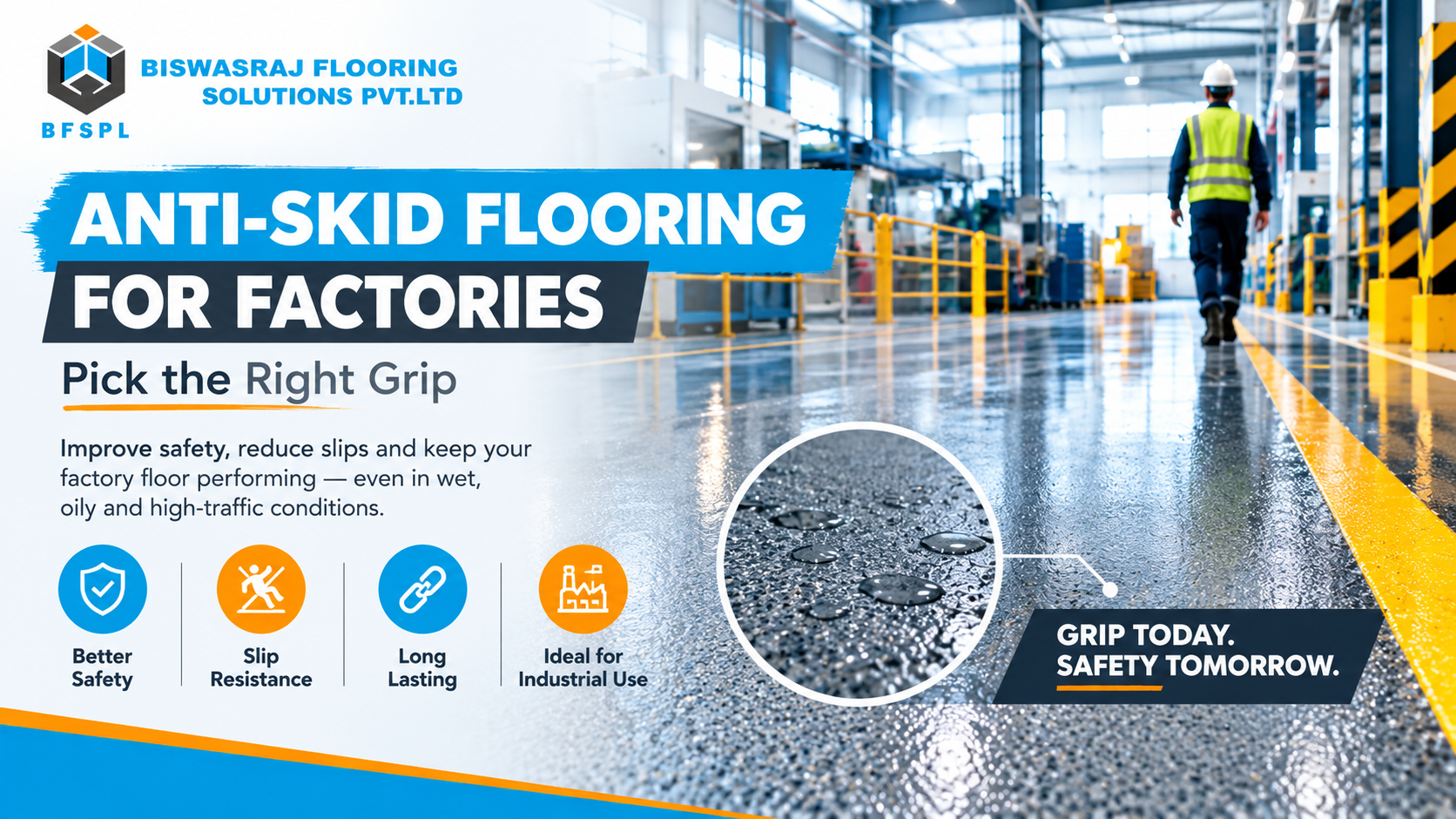 23 Oct 2026
Anti Skid Flooring for Factories: Pick the Right Grip
- Posted by Admin
Anti skid flooring for factories should reach a pendulum test value of 36 or above, the point where the UK Health and Safety Executive classes slip potential as low. Plain glossy epoxy and high polish concrete often fall short when wet.
Water, oil, coolant and wash-down chemicals each change how a floor grips. This guide shows how grip is measured, which finishes hold up and where to specify them. It pairs well with our monsoon proofing checklist for warehouse floors for entrances and docks.
At A Glance
• Pendulum pass mark: 36 or above
• Surface roughness: Rz 20 µm or more
• Duration: 3 to 7 days for epoxy
• Enquiry reply: within 24 hours
• Test the finished floor, wet, with the contaminant you really have.
Why Do Factory Floors Become Slippery?
Anti skid flooring for factories has to cope with contamination, because water, oil, coolant and fine dust turn smooth surfaces slippery. HSE research found that most slips happen on contaminated floors, so the finish and the cleaning routine both decide how safe a walkway really is.
HSE’s slip model lists the floor material, footwear, contamination, cleaning and environment as joint causes. In Indian plants the usual suspects are easy to spot:
• Monsoon rain tracked in on tyres and boots at docks and doorways
• Cutting oil, coolant and hydraulic leaks around machine bays
• Wash-down water in dairy, food and pharma areas
• Fine powder on dry process floors
• Glossy topcoats, high polish concrete and textures worn smooth
Wear is the quiet cause. A texture that tested well on day one can polish flat under forklift wheels. That is why our industrial floor maintenance checklist schedules a quarterly slip check in wash areas, kitchens and chemical zones.
How Is Floor Slip Resistance Measured?
Slip resistance is read with a pendulum, a roughness meter or a ramp test. A pendulum test value of 36 or above is low slip potential, 25 to 35 is moderate and 0 to 24 is high, according to the HSE technical sheet on assessing flooring.
The pendulum swings a standard rubber heel across the surface and is HSE’s preferred method for dry and contaminated floors. A trained operator must run it, and profiled floors need readings in several directions.
Roughness is the quick check. On water-wet floors an Rz below 10 µm is high risk, 10 to 20 µm is moderate and 20 µm or more is low. Oil and other thick contaminants need more roughness than water.
Footwear changes the answer. HSE uses a standard rubber slider for shod pedestrians and a different one for barefoot zones such as changing rooms and wash areas. Tell the tester which shoes your staff actually wear.
|
Method |
What it reads |
Low risk result |
Watch out for |
|
Pendulum test |
Friction of a swinging rubber heel |
36 or above |
Needs a trained operator |
|
Roughness (Rz) |
Peak to valley depth of the surface |
20 µm or more |
Valid for water-wet floors only |
|
Ramp test (DIN 51130) |
Slip angle with oil and cleated boots |
R11 to R13, our target for wet zones |
HSE questions how R ratings are applied |
R ratings need care. HSE notes that R10 covers a friction range of 0.18 to 0.34, so two R10 floors can behave very differently. Specifying anti skid flooring for factories on a rating alone leaves too much to chance, so ask for pendulum data on the finished floor.
Which Anti Skid Systems Work On Industrial Floors?
The right anti skid flooring for factories pairs texture with the contaminant: broadcast epoxy for oil and wash-down, low gloss ground concrete for dry traffic lanes, and broom finishes for external ramps. Strips and mats only patch problems.
Slip resistant industrial flooring is a trade off between grip and cleaning effort. A coarse texture grips well but traps dirt, so hygiene zones need a finer finish and a stricter wash routine.
|
System |
Grip |
Cleaning effort |
Best for |
Watch out for |
|
Broadcast aggregate epoxy |
High |
High |
Oily bays, ramps, wash-down |
Coarse texture traps dirt |
|
Epoxy with anti skid additive |
Medium |
Medium |
Walkways, washrooms |
Additive wears in wheel lanes |
|
Ground concrete, satin or matte |
Medium |
Low |
Dry traffic lanes, showrooms |
Slick if polished to high gloss and wet |
|
Broom or tined concrete |
Medium |
Medium |
External ramps, yards |
Open texture collects grit |
|
Strips, tapes and mats |
Local only |
Low |
Quick fix at a stair or door |
Edges lift under wheels |
Texture only grips if it stays bonded. For epoxy, that means shot blasting or diamond grinding the slab, priming it and locking the broadcast layer in with the base coat. A sealing topcoat then keeps the grit from shedding under wheels.
If your slab is sound but too glossy, our concrete grinding and polishing service offers finishes from matte to high gloss. You can specify a lower gloss for wet zones.
Where Do Factories Need The Highest Grip?
Anti skid flooring for factories earns its cost where contamination, slopes and turning wheels meet: wash-down bays, loading ramps, oil prone machine lines and monsoon exposed doorways. One uniform grade across the whole shed is rarely the smartest spend.
• Wash-down and food areas: medium texture epoxy with a defined cleaning routine
• Loading ramps and slopes: coarse broadcast finish, because the slope cuts your margin
• Machine bays with coolant: coarse texture plus drainage to the nearest channel
• Stairs and walkways: anti skid topcoat with contrasting edge marking
• Dry storage aisles: the least grip, so protect flatness and sweepability
Match grip to risk, not to the whole floor. A coarse finish in a forklift aisle is harder to sweep, so reserve it for the zones above.
Plan the change between grades as well. A trolley rolling from a smooth aisle onto a coarse wash-down zone feels the step in friction. Mark the boundary clearly and keep it away from turning points. Our epoxy flooring service includes anti skid grades for ramps, washrooms and walkways.
How Do You Keep An Anti Skid Floor Working After Installation?
Clean it correctly, measure it again and re-treat it before the texture wears flat. HSE warns that installation, cleaning, polishing and wear all change slip resistance, so a pass mark on day one does not last for years.
Build four habits into the routine:
• Remove oil and coolant within the shift, not at the weekend
• Use a neutral pH cleaner on coated floors, with a scrub rather than a mop alone
• Retest wear lanes and wet zones after each monsoon season
• Log every reading by bay, so a falling trend shows up early
Cleaning chemistry matters too. A product that leaves a film of residue can make a good floor slick, and a degreaser that is too harsh can dull a coating. Follow the finish supplier’s cleaner list and rinse where it says so.
Re-texturing a worn lane is far cheaper than treating an injury claim. When readings slip below your zone target, brief a contractor to recoat that lane rather than the whole floor.
How Do You Specify Anti Skid Flooring For Factories Step By Step?
To specify anti skid flooring for factories, map the contaminants first, set a target for each zone and demand test data from the finished floor. Brochure ratings alone do not tell you how the floor behaves under your oil, your water and your shoes.
1. Walk the plant and mark the wet, oily, dusty and sloped zones.
2. Name the contaminant in each zone, because oil needs more roughness than water.
3. Set a target per zone, such as a pendulum value of 36 or above.
4. Pick a system from the table and ask for a sample panel.
5. Test the sample wet, using the contaminant you actually have.
6. Install on a prepared slab. Most epoxy projects finish in 3 to 7 days.
7. Retest the finished floor and keep the readings as your baseline.
Write the target into the tender. Name the test method, the wet condition, the slider rubber and who carries out the test. A vague line such as “anti skid finish” lets almost any texture pass.
Frequently Asked Questions
What Is The Difference Between Anti Skid And Anti Slip Flooring?
In practice the terms mean the same thing: a surface with enough texture to resist slipping. Indian suppliers say anti skid, UK guidance says slip resistant, and both should be judged by tested values.
Does Epoxy Flooring Become Slippery?
Plain glossy epoxy can be slippery when wet. Textured finishes or anti skid additives fix this, which is why ramps, washrooms and walkways usually get a grip grade.
How Do You Test Slip Resistance On A Factory Floor?
Learn how to test floor slip resistance by hiring a trained operator for a pendulum test on the finished, wet floor. A roughness meter gives a quick supporting reading for water-wet areas.
Can Polished Concrete Be Made Safer When Wet?
Often yes, if you choose a lower gloss level during polishing and confirm it with a wet pendulum test. Very glossy, sealed polish tends to give the least grip.
How Long Does Anti Skid Epoxy Take To Install?
Most epoxy projects finish in three to seven days, depending on area, number of coats and cure time between layers. Shot blasting or diamond grinding comes first.
Do Anti Skid Floors Need Special Cleaning?
Yes. Anti skid flooring for factories holds dirt in its texture, so use a neutral pH cleaner on coated floors and scrub rather than only mop.
Who Should You Call Before You Choose A Finish?
Call a contractor who tests a wet sample before quoting. BiswasRaj Flooring is ISO 9001:2015 certified, has worked on industrial floors since 2010 and replies to enquiries within 24 hours. Book a free site visit and we will mark your high risk zones and recommend anti skid flooring for factories zone by zone.
Pendulum pass mark
36 or above
Surface roughness
Rz 20 µm or more
Duration
3 to 7 days for epoxy
Enquiry reply
within 24 hours
pendulum test value that HSE classes as low slip potential
36 or above UK Health and Safety Executive, GEIS2
Rz roughness that HSE classes as low slip potential on water-wet floors
20 µm or more UK Health and Safety Executive, GEIS2
typical installation time for an epoxy flooring project
3 to 7 days BiswasRaj Flooring, Epoxy Flooring service page
Areas we cover around India
- Bengaluru
- Pune
- Delhi
- Mumbai
- Maharashtra
- Karnataka
- India