

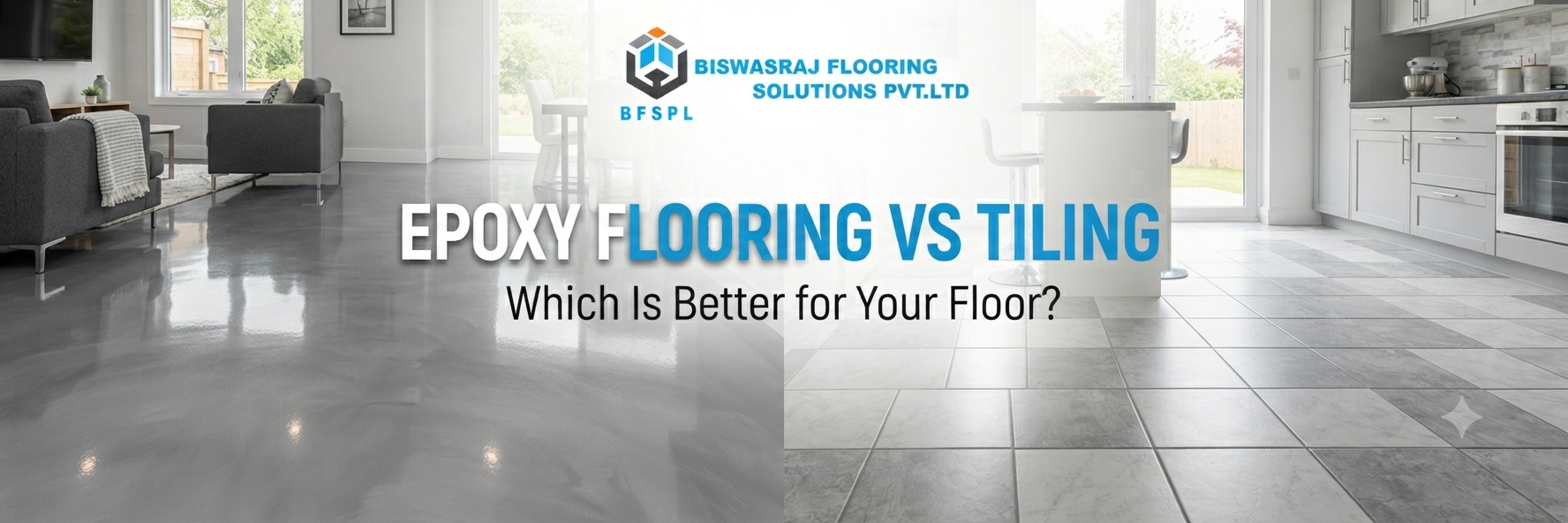
Epoxy Flooring vs Tiling: Which Is Better for Your Floor?
 09 Sep 2026
Epoxy Flooring vs Tiling: Which Is Better for Your Floor?
- Posted by Nagananda Udupa
Choosing a floor for a factory, warehouse, workshop, showroom or commercial facility is not simply a matter of picking a colour or finish. The floor has to work under the conditions of the building.
Will forklifts move across it every day? Will oil or chemicals be spilled? Does the area need frequent cleaning? Is dust a problem? Will heavy equipment be installed? How easy will it be to repair the floor if part of it becomes damaged?
These questions make the comparison between epoxy flooring and tiling more important than it may initially appear.
Both options can produce an attractive and functional floor, but they are built differently and respond differently to everyday use. The better choice depends on what you expect the floor to handle.
Start With the Job the Floor Has to Do
A useful way to compare epoxy and tiles is to forget the appearance for a moment.
Instead, ask:
What will happen on this floor every day?
A warehouse floor may experience forklifts, pallet trucks and heavy loads. A workshop may deal with oil and grease. A showroom may place greater importance on appearance and cleaning. A production facility may need a floor that withstands constant traffic and regular maintenance.
The flooring material should be selected according to these conditions.
Epoxy Flooring and Tiling Are Not the Same Type of Floor
An epoxy floor is generally a resin-based flooring system installed over a properly prepared substrate. Depending on the specification, it can consist of primers, epoxy layers, aggregates, decorative components and protective topcoats.
Tiling uses individual tiles installed over a prepared base with adhesive or mortar and normally includes grout joints.
That fundamental difference affects how the two floors behave.
An epoxy system can create a continuous surface, while a tiled floor is made up of individual units separated by joints.
The Joint Question: Small Detail or Major Difference?
Grout lines may not seem important when a new floor is installed.
But think about a busy facility several years later.
Dust, dirt, oil and other contaminants can accumulate around joints. Cleaning a large tiled area therefore involves maintaining not only the tile surface but also the grout.
An appropriately installed epoxy floor, by contrast, can provide a continuous surface with minimal joints.
This can be particularly useful in environments where routine cleaning and housekeeping are important.
However, this does not mean epoxy is automatically maintenance-free. The correct cleaning methods and maintenance schedule still depend on the flooring system and operating environment.
What Happens When Heavy Equipment Moves Across the Floor?
This is where application becomes important.
A residential tile may not be appropriate for a warehouse carrying forklifts. But industrial-grade tiles with suitable specifications may perform differently.
Similarly, not every epoxy system is designed for heavy industrial traffic.
The flooring specification should consider:
Forklift traffic
Pallet trucks
Vehicle movement
Machinery
Point loads
Impact
Abrasion
Frequency of use
For industrial applications, the question should therefore be:
Which flooring system is specified for the expected load and traffic?
Not simply:
Is epoxy stronger than tile?
What About Oil, Chemicals and Industrial Spills?
Factories and workshops can experience spills that ordinary floors do not encounter.
Oil, grease, cleaning chemicals, solvents and other substances can affect flooring materials differently.
Certain epoxy systems can be specified for chemical resistance, but the actual performance depends on the resin system, concentration of the chemical, temperature and exposure time.
Tiles also vary considerably. Ceramic, porcelain, quarry tiles, grout and other systems have different characteristics.
If chemical exposure is expected, identify the actual substances before selecting the floor.
A flooring contractor should evaluate the environment and recommend a system based on those conditions.
Which Floor Is Easier to Clean?
Cleaning is one of the areas where the construction of the floor matters.
A tiled floor has individual surfaces and grout lines. An epoxy floor can provide a continuous surface with fewer areas for dirt to collect.
This can make an epoxy floor attractive for:
Workshops
Warehouses
Manufacturing areas
Showrooms
Laboratories
Commercial spaces
However, the finish still matters. A textured or anti-skid system may require a different cleaning approach than a smooth finish.
The right balance is therefore between cleanability and the safety requirements of the space.
What Happens When Part of the Floor Gets Damaged?
This is an important difference that is sometimes overlooked.
With tiles, a damaged individual tile can potentially be removed and replaced without replacing the entire floor.
With epoxy, repairing a damaged area normally involves preparing the affected surface and applying compatible repair material.
The repair process depends on:
Size of the damaged area
Cause of damage
Depth of damage
Condition of the substrate
Type of epoxy system
Age of the existing floor
A good flooring system should therefore be selected not only for installation but also for how the facility will operate and maintain it over time.
What About Installation?
Epoxy flooring requires careful substrate preparation before application.
The concrete may need to be mechanically ground or otherwise prepared to remove contaminants and create a suitable surface profile. Cracks, weak areas and damaged sections may also need attention.
The typical process can include:
Inspection → Surface preparation → Repairs → Primer → Epoxy layers → Topcoat → Curing → Final inspection
Tiling also requires proper preparation.
The base must be suitable for tile installation, the appropriate adhesive or mortar must be selected and tiles need to be laid correctly with suitable joints and finishing.
In both cases, poor preparation can compromise the finished floor.
Epoxy Flooring vs Tiling: Practical Comparison
Epoxy should not be treated as the answer to every flooring requirement. Tiling may make sense when: Decorative appearance is a major priority A particular tile design is required Individual tile replacement is important The expected traffic is suitable for the selected tile The environment does not require a resin-based industrial system The project has specific architectural requirements For some commercial and residential applications, tiling may be the more appropriate choice. An epoxy floor can be worth considering when the project requires: A continuous surface Easy routine cleaning Resistance characteristics suited to the environment Heavy-duty flooring systems Industrial or commercial use Reduced dependence on grout joints A uniform and professional finish It can be particularly useful when the floor needs to balance durability, maintenance and appearance. There is another factor that can change the entire decision: the existing substrate. Before installing an epoxy system, the concrete should be assessed for issues such as: Cracks Moisture Weak surface layers Oil contamination Unevenness Previous coatings Surface strength A resin system cannot compensate for a structurally inadequate substrate. Likewise, tiles should not simply be installed over an unsuitable base and expected to perform indefinitely. The condition of the floor underneath should therefore be part of the flooring decision. If you're still unsure, start with the operating environment. → The floor experiences demanding industrial traffic → Decorative flexibility is the main priority And if neither option clearly fits the application, another industrial flooring system may be more appropriate. The cheapest material is not necessarily the cheapest flooring solution over the life of the facility. A proper comparison should consider: This is particularly important for factories and warehouses, where flooring problems can interfere with normal operations. A flooring system that performs well under the actual conditions of the facility may provide better value than a cheaper option that requires frequent repairs. Selecting between epoxy flooring and tiling should begin with the requirements of the site. BiswasRaj Floorings works with industrial and commercial flooring requirements, including epoxy flooring systems and other specialised flooring solutions. The existing substrate, expected traffic, operating environment and desired finish should all be considered before selecting the appropriate system. A site assessment can help determine whether epoxy flooring, tiling or another flooring approach is better suited to the project. Epoxy flooring can be a better choice for areas that need a seamless, durable and easy-to-clean surface, particularly factories, warehouses and commercial spaces. Epoxy flooring is a resin-based coating applied over a prepared concrete surface, creating a continuous floor without tile joints. Tiling uses individual tiles installed over a prepared substrate, with joints between them. In many commercial and industrial environments, epoxy flooring is easier to clean because its seamless surface has fewer places for dirt and contaminants to collect. The lifespan of either flooring system depends on installation quality, substrate condition, traffic and maintenance. Yes. Epoxy flooring can be suitable for warehouses because it provides a seamless and durable surface that can handle regular foot traffic, material movement and cleaning. Yes. Localized damage to an epoxy floor can often be repaired by removing the damaged section, preparing the substrate and applying a compatible repair system. Tiles can offer a wider variety of patterns, colours, textures and designs, making them attractive for many decorative applications. For many factories, epoxy flooring can be a practical option because of its seamless finish, durability and ease of maintenance. However, the final choice should consider factors such as chemical exposure, machinery, traffic, temperature and the condition of the existing concrete floor. Contact BiswasRaj Flooring Solutions today for expert guidance and the right flooring solution for your facility. When Does Tiling Make More Sense?
When Does Epoxy Flooring Make More Sense?
Don't Choose the Floor Before Checking the Concrete
A Simple Decision Guide
Choose or consider epoxy flooring when:
→ Easy routine cleaning is important
→ A continuous surface is preferred
→ Oil, chemicals or other contaminants may be present
→ The facility needs a durable commercial or industrial finishConsider tiling when:
→ Individual tile replacement is useful
→ The application is suitable for tiled flooring
→ A particular tile design or finish is requiredDon't Compare Flooring Only by Initial Price
Initial installation + substrate preparation + maintenance + cleaning + repairs + downtime + expected service conditions
How BiswasRaj Floorings Can Help
Frequently Asked Questions
1. Is epoxy flooring better than tiling?
2. What is the difference between epoxy flooring and tiling?
3. Is epoxy flooring easier to clean than tiles?
4. Which lasts longer, epoxy flooring or tiles?
5. Is epoxy flooring suitable for warehouses?
6. Can epoxy flooring be repaired if it gets damaged?
7. Are tiles better than epoxy flooring for decorative spaces?
8. Which flooring is better for factories: epoxy or tiles?
Ready to choose between epoxy flooring and tiling?