


Car Parking Flooring: What Actually Survives Indian Decks
 07 Aug 2026
Car Parking Flooring: What Actually Survives Indian Decks
- Posted by Sathish K
A parking floor fails differently from a warehouse floor. Nothing very heavy sits on it, yet the surface wears out faster, because a turning tyre grinds at one spot while the driver is barely moving.
Add monsoon water dragged in on every wheel, oil drips, and a ramp that has to stay grippy when wet, and car parking flooring turns into a genuine specification problem rather than a finish chosen at the end of the job.
The Essentials
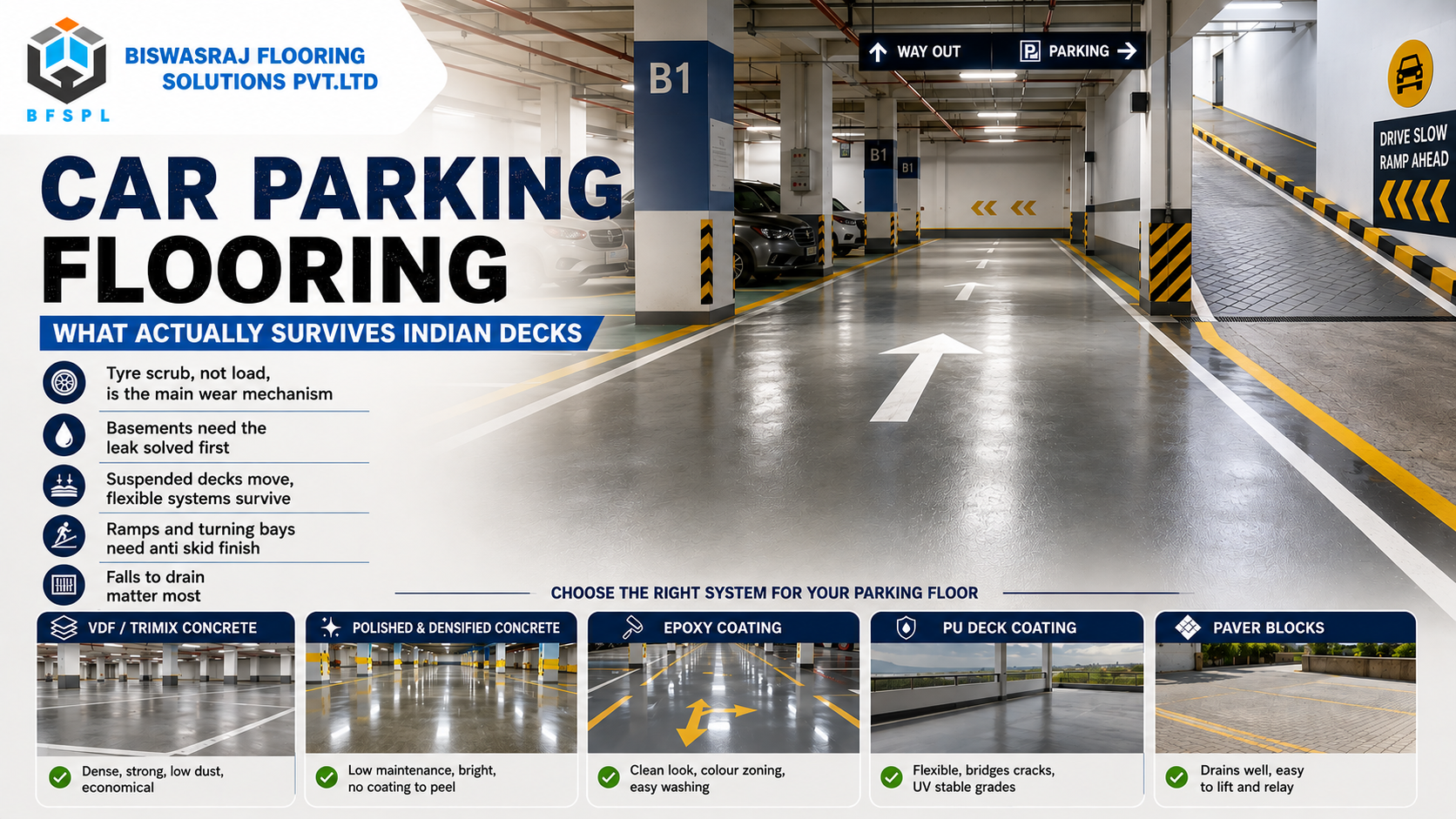
• Tyre scrub, not load, is the main wear mechanism on a parking slab
• Basements need the leak solved before any floor finish goes down
• Suspended decks move, so a rigid coating cracks where a flexible one survives
• Ramps and turning bays need a defined anti skid finish from day one
• Falls to drain matter more than the finish chosen above them
What Makes A Parking Floor Different From A Warehouse Floor?
A warehouse floor is designed for point loads and forklift wheels running in straight lines. Car parking flooring faces the opposite duty: light loads, constant low speed turning, and a power steered tyre twisting against the same square foot thousands of times a season.
That torsional scrubbing polishes and then tears at a weak surface layer. It is why a floor that looks fine in the aisles goes bald at bay entrances, ramp heads and turning circles first.
The chemical picture differs too. Warehouses see dust and pallet damage, while parking decks see a slow accumulation of engine oil, coolant, brake fluid and rainwater.
• Turning tyres abrade the surface far more aggressively than rolling wheels
• Oil and fuel drips stain and soften unprotected concrete over time
• Water arrives on every vehicle, so drainage falls decide how long the floor lasts
• Suspended decks flex and move, unlike a ground bearing warehouse slab
• Ramps combine slope, water and torque, which is where most complaints begin
Which Flooring Systems Suit Car Parking In India?
Five systems cover almost every car parking flooring project in India. The right one depends on whether the slab sits on ground or is suspended, whether the area is enclosed, and how much maintenance access you get once the building is occupied.
|
System |
Best suited to |
Strengths |
Watch out for |
|
Ground level and podium slabs |
Dense, strong, low dust, economical |
Needs joints planned and cut properly |
|
|
Polished and densified concrete |
Enclosed basements |
Low maintenance, bright, no coating to peel |
Can be slippery if over polished |
|
Premium basements, showroom parking |
Clean look, colour zoning, easy washing |
Rigid film, needs anti skid on ramps |
|
|
PU deck coating |
Suspended and exposed decks |
Flexible, bridges hairline cracks, UV stable grades |
Higher rate per square foot |
|
Paver blocks |
Open surface parking |
Drains well, easy to lift and relay |
Settles if the base is poorly compacted |
For most Indian basements and podiums, a vacuum dewatered slab finished with a hardener is the sensible default, with a coating added only where appearance or cleaning standards demand it.
What Does The Slab Under The Finish Need?
Nothing you lay on top will outperform what sits underneath. Car parking flooring on ground needs a properly compacted sub base, and the Indian code is specific about it: where wheeled traffic runs over the floor, the usual 100 mm sand layer gets an added 100 mm of well compacted hard core.
On suspended decks the priorities change. There the slab has to shed water to drains, carry movement joints through the finish, and stay protected from chloride laden water that would otherwise reach the reinforcement.
• Build falls into the structural slab, not into the topping thickness
• Carry every structural movement joint straight through the wearing surface
• Cut and seal contraction joints early, then fill them with a semi rigid filler
• Protect joint edges at ramp heads, where wheel impact does the most damage
• Check drain outlet levels before laying, since a drain set too high traps water forever
How Do You Stop A Basement Parking Floor From Leaking?
Solve the water before you choose the finish. Basement parking flooring sits below the water table in much of urban India, and a coating applied over a damp slab will blister and peel within a season no matter how good the product was.
The sequence that works is simple and rarely followed. Investigate the source, treat the structure, then lay the floor.
1. Trace where water actually enters, which is often a construction joint rather than the visible damp patch
2. Treat the structure with injection grouting or a membrane system as a waterproofing job
3. Test the treated area with water and confirm it holds before flooring starts
4. Measure slab moisture and let it come down to the level the finish needs
5. Prepare mechanically, then lay the chosen system
Skipping straight to the coating is the most common and most expensive mistake in car parking flooring work, and the one we are most often called back to correct.
How Much Does Car Parking Flooring Cost In India?
Car parking flooring cost usually lands between the price of a plain concrete finish and a full industrial resin floor. The bigger swing comes from slab condition, access and whether the area can be closed in phases, because a basement worked in halves costs more per square foot than an empty one.
Treat the figures below as planning bands. A firm rate needs a site visit and a look at the drainage.
|
System |
Indicative rate per sq ft |
Typical life before major attention |
|
Paver blocks, open parking |
Rs 90 to Rs 180 |
8 to 12 years |
|
VDF or trimix with hardener |
Rs 120 to Rs 220 |
10 to 15 years |
|
Polished and densified concrete |
Rs 130 to Rs 250 |
10 to 15 years |
|
Epoxy coating, 2 to 3 mm |
Rs 150 to Rs 300 |
5 to 8 years |
|
PU deck coating on suspended slab |
Rs 250 to Rs 450 |
8 to 12 years |
Three things push a quote up that owners rarely budget for: removing an old failed coating, repairing spalled joint edges, and correcting falls where water currently ponds.
How Should Ramps And Markings Be Finished?
Ramps decide whether the floor is safe. A smooth finish that performs well on a flat basement level becomes a hazard on a wet slope, so the ramp surface is specified separately from the rest of the car parking flooring on almost every project we run.
The Indian code makes the point directly. IS 2571, the code for in situ cement concrete flooring, requires that floor finishes over ramps and stairs, particularly where they are liable to get wet, are finished in a chequered pattern to make them non slip.
In practice that means one of a few approaches, chosen to suit the finish above the slab.
• Chequered or grooved concrete on bare ramps, cut while the surface is still workable
• Aggregate broadcast into a resin coat where the ramp carries an epoxy or PU system
• A defined change of texture at the ramp head so drivers feel the transition
• Line marking in a two component paint rather than a road marking paint, which wears fast indoors
• Yellow or white bay lines, arrows and headroom warnings applied after full cure, never before
Good marking also earns its keep operationally. Clear bays, arrows and pedestrian walkways cut down bumper damage claims, and repainting lines every few years is far cheaper than repairing the floor they protect.
Frequently Asked Questions
Which Flooring Is Best For Car Parking?
For most Indian basements and podiums, vacuum dewatered concrete with a surface hardener gives the best balance of strength, dust control and cost. Coatings suit premium or heavily washed areas.
Is Epoxy A Good Choice For A Basement Parking Deck?
It works well on a dry, stable, ground bearing slab. On a suspended deck that moves, or over a damp basement floor, a flexible PU system or a densified concrete finish is safer.
How Long Does A Parking Floor Take To Complete?
A typical basement level takes one to three weeks depending on area, repairs and cure times. Phased work in an occupied building takes longer because each section needs its own cure.
Can The Floor Be Done Without Closing The Whole Basement?
Yes. Work is normally sequenced level by level or bay by bay, with barricades and a marked diversion route so part of the parking stays in use throughout.
Why Do Parking Floors Get Bald Patches Near Entrances?
Those are the spots where vehicles turn while nearly stationary. The tyre twists against one area repeatedly, which grinds down a weak surface layer faster than anywhere else on the deck.
Does A Concrete Parking Floor Need Sealing?
It benefits from it. A silicate densifier hardens the surface and cuts dusting, while a penetrating sealer helps resist oil staining without adding a film that can peel later.
Who Should You Call First?
Before you compare rates, get someone to walk the deck and check drainage, slab moisture and joint condition. Those three findings decide which car parking flooring system is worth quoting for and which would be money wasted.
Our team carries out free site visits across India for basements, podiums and open parking areas. Share your layout and levels through the enquiry form and we will come back with a specification and a phased programme.