


Industrial Flooring: VDF vs Concrete Floor Polishing
 17 Sep 2026
Industrial Flooring: VDF vs Concrete Floor Polishing
- Posted by Nagananda Udupa
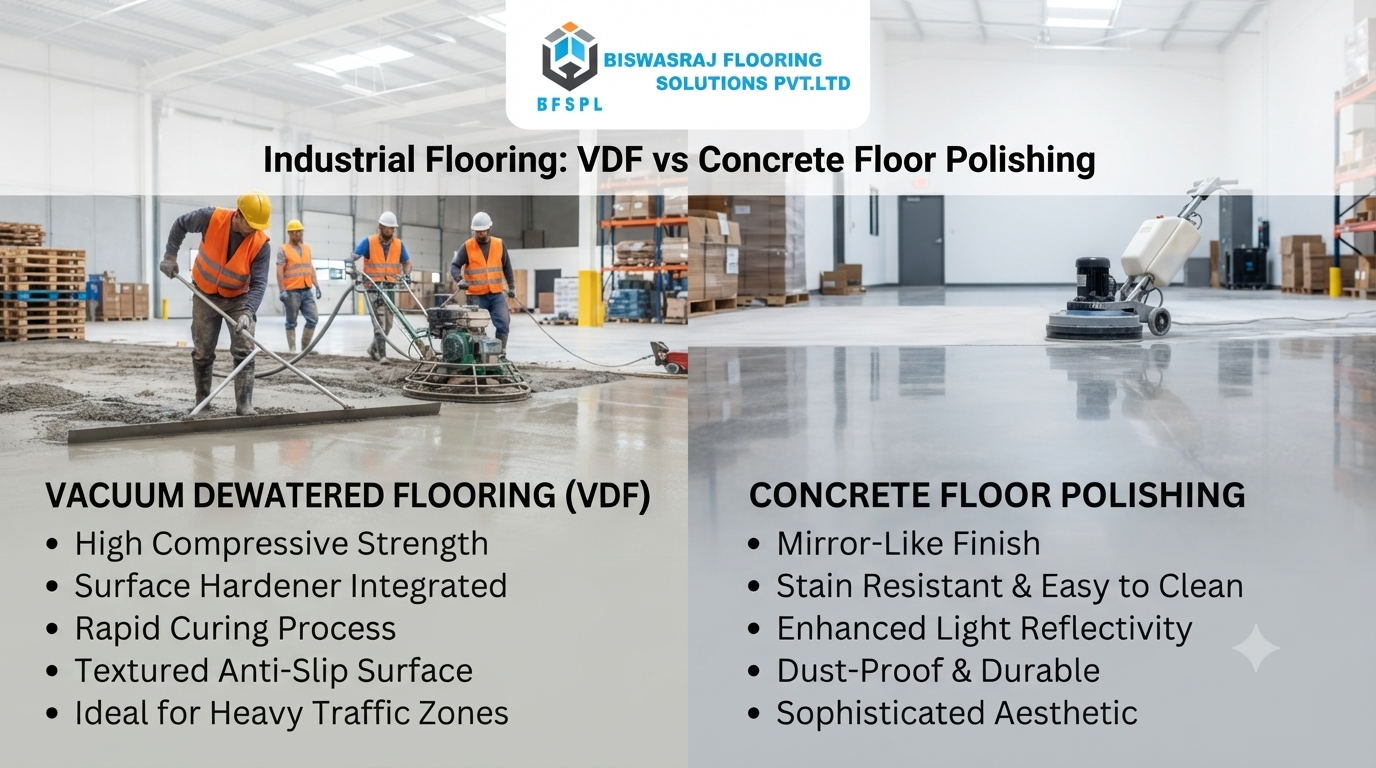
Selecting the right kind of flooring solution for a warehouse, factory workshop, production unit and other commercial premises is critical. It has to last through the operations performed on a daily basis and accommodate all kinds of traffic, storage, cleaning, and other activities. The systems of VDF flooring and concrete floor polishing are often confused since they both deal with concrete.
However, they are two completely different procedures. VDF flooring is a process of concrete construction while concrete polishing is a mechanical method of finishing concrete.
Knowing the key differences between the two will help property owners and managers make the right choice based on their current situation.
What Is the Difference Between VDF Flooring and Concrete Floor Polishing?
There is one fundamental difference between the two flooring solutions.
VDF flooring is a construction method used to obtain a dense concrete floor while concrete polishing is a mechanical process used to finish the concrete floor.
With that being said, the two concrete treatments are not mutually exclusive.
Depending on the situation, they can be used in unison or complement each other. A new building may require VDF flooring as a part of the construction process while an existing facility may want to consider concrete polishing for its renovation or refurbishment. VDF flooring is suitable for situations that involve the necessity of new concrete flooring construction. It is applicable to new building projects or building refurbishments that involve a concrete floor. VDF flooring is the preferred choice for: Warehouses Manufacturing units Workshops Industrial production areas Logistics facilities Storage facilities The areas that have regular traffic of vehicles or forklifts As with almost any construction project, the location, design, and other factors have to be taken into account before a project is launched. The traffic, loading, floor levelness and slab requirements as well as the surrounding environment should be evaluated. It could be that a particular warehouse requires greater floor loading capacity compared to a small workshop. That is why VDF flooring should not be automatically applied to any concrete project but considered based on the architectural specifications. Unlike VDF flooring, concrete polishing is primarily a finishing procedure for concrete. It is performed on a solid concrete slab when an owner wants to improve its appearance and provide it with a new surface. Concrete polishing can be considered for: Existing warehouses Factories that require refurbishment Some commercial buildings Showrooms Workshops Offices with concrete floors Industrial spaces that need a resurfaced concrete solution However, not all slabs are suitable for concrete polishing. Damage, dusting, levelness, coatings, and other similar imperfections could disqualify a slab from polishing. In many ways, it is similar to what was recommended by the BiswasRaj guide. Before proceeding with concrete polishing, a site inspection should be made to ensure that the slab is up to the task. For a deeper understanding of the process, read our guide topolished concrete floorsand the factors to consider before polishing. Based on the information from the previous section, a table was created to distinguish between VDF flooring and concrete floor polishing. As could be seen from the table, VDF flooring and concrete floor polishing differ in almost every respect. When selecting the industrial flooring option for a commercial or industrial building, it is necessary to take several key factors into account. This is probably the most apparent factor that determines which flooring solution will be better. If the building is under construction, VDF flooring may be considered as an option. If the building is already constructed and requires new flooring, concrete polishing may be more appropriate. However, VDF floor installation is not mandatory in new buildings. If the architect has chosen a different flooring material, it should be respected. The same goes for concrete polishing. For additional guidance on cement concrete flooring practices, refer to the Bureau of Indian Standards (BIS) and its relevant flooring standards. This is closely related to the previous factor. It is necessary to evaluate the intensity and type of traffic that the floor will be subjected to. While forklifts, trucks, or other vehicles may be driven on floors in logistics facilities, showrooms, or commercial buildings traffic will be more limited. This factor is especially relevant for concrete polishing and VDF flooring since both are not compatible with regular concrete floors in some instances. This evaluation is relevant only for projects that involve concrete polishing. Prior to developing a plan for resurfacing, a thorough inspection of the slab should be performed. Some aspects to consider are: Cracks Spalling Surface dusting Unevenness Previous surface coatings Oil contamination Moisture problems Damaged joints Concrete polishing may not always be an option depending on the integrity of the slab. Structural repairs should always be considered before concrete polishing is contemplated. In many cases, industrial buildings require a utilitarian but attractive appearance for their interiors. For some structures, a strictly utilitarian approach is acceptable. Concrete polishing may offer a variety of finishes depending on the process. It is better to discuss and determine the expectations prior to proceeding with concrete polishing. Depending on the environment, some buildings are exposed to contaminants like chemicals or oil. Such conditions are typical for workshops or manufacturing facilities. When such exposure is present, it is necessary to consider a protective treatment. This consideration applies to VDF flooring and concrete polishing. The choice of the surface treatment should be made depending on the traffic and the type of contaminants that the floor is exposed to. VDF flooring and concrete polishing can be used for different stages of the same project. For example, a building under construction can use VDF flooring as the primary method of flooring installation followed by concrete polishing at a later date if needed. The reverse option is also possible since an existing VDF floor could potentially be polished depending on its condition. As could be seen, VDF flooring and concrete polishing are completely different processes. The former deals with constructing a dense concrete floor while the latter involves mechanical refinement of an existing concrete surface. It is necessary to be aware of these differences in order to avoid selecting an inappropriate flooring system. It is not possible to say which option is better for a building without taking into account other factors. Rather than comparing the advantages of one system over the other, it is better to ask a few questions first. The following questions can be used as a guideline: 1. Is the floor being built or refurbished? 2. What type of traffic will it receive? 3. Will forklifts or vehicles be driven on the floor? 4. What traffic and other requirements should be considered? 5. Is the existing concrete suitable for resurfacing? 6. Is the appearance of the floor important? 7. Will the floor be exposed to oil, chemicals or other substances? 8. What maintenance requirements should be considered? 9. What finish or flatness requirements should be considered? 10. Does the floor require an additional treatment? After these questions are considered, it will be easier to identify the solution that will be appropriate for the project. For projects that involve new construction, the primary concerns will be the requirements of the building. For existing buildings, the evaluation of the current floor is even more important. Depending on the building and its location, different flooring solutions might be considered. One of the most common mistakes is to select flooring based on price alone. Another common mistake is to overlook the condition of the existing concrete. Mistake 1: Ignoring the requirements of the building. Mistake 2: Using only price as a selection criterion. Mistake 3: Overlooking the condition of the existing slab. Mistake 4: Assuming that all factory floors are the same. Mistake 5: Thinking that appearance is the only important characteristic. Mistake 6: Failing to provide a detailed site assessment. When it comes to industrial flooring, the location and the condition of the slab are two of the most important factors that determine the potential solution. For new construction projects, VDF flooring is the preferred method of obtaining a dense concrete floor. For renovation projects, concrete polishing is a viable option if the condition of the existing slab is satisfactory. There are other methods of flooring that could be considered depending on the traffic, contamination, maintenance requirements, and other factors. With that being said, it is apparent that VDF flooring and concrete polishing are two different procedures that should not be used interchangeably. VDF flooring is primarily used in new construction projects while concrete polishing is used in renovation projects. It is always better to keep in mind the requirements of the building rather than focusing on a specific flooring system. Frequently Asked Questions VDF flooring can be considered for warehouses that require a dense concrete floor that will be subjected to traffic and other activities. However, it should be designed in accordance with the requirements of the building. Concrete polishing can be considered for factories if the condition of the slab is satisfactory and the performance requirements are compatible with concrete polishing. No, they are not. Whether it can or cannot will depend on the condition of the slab. It will depend on the traffic, loading, floor requirements, environment, maintenance, and other similar factors. By taking into consideration the application, traffic, loading, environment, maintenance, and finish requirements. For professional guidance on industrial flooring, VDF flooring, or concrete floor polishing, contact BiswasRaj Flooring Solutions to discuss your project requirements. When Is VDF Flooring Suitable?
When Is Concrete Floor Polishing a Better Option?
VDF Flooring vs Concrete Floor Polishing
What Should You Consider Before Choosing Industrial Flooring?
1. Is the Project New or Existing?
2. What Type of Traffic Will the Floor Receive?
3. What Is the Condition of the Existing Concrete?
4. What Surface Appearance Is Required?
5. Will the Floor Face Chemicals or Contamination?
Can VDF Flooring and Concrete Polishing Be Used Together?
How Do You Choose the Right Industrial Flooring Solution?
Common Mistakes When Selecting Industrial Flooring
Industrial Flooring for New Construction and Renovation
Is VDF flooring suitable for warehouses?
Is concrete floor polishing suitable for factories?
Are VDF flooring and polished concrete the same?
Can an existing VDF floor be polished?
Which flooring is suitable for a new industrial building?
How do I choose the right industrial flooring system?
Need Expert Industrial Flooring Guidance? Contact BiswasRaj Floorings