


Laser Screed Concrete: Mix, Pour And Finishing Guide
 27 Oct 2026
Laser Screed Concrete: Mix, Pour And Finishing Guide
- Posted by Admin
Laser screed concrete needs one consistent, workable mix delivered without gaps, because the machine can only level what the trucks keep supplying. Control 4 things: slump, aggregate, truck spacing and finishing time.
Our laser screed flooring service covers the machine work. This guide covers what the machine cannot fix, which is the concrete you feed it and the hours after it passes.
At A Glance
• Best for: large open slabs on grade
• Mix controls: slump, aggregate size, truck spacing, finishing time
• Superflat range: FF 50 to FF 125 for ACI Class 9 floors
• Duration: 7 days minimum moist curing for ordinary cement
What Is Laser Screed Concrete?
Laser screed concrete is ordinary structural concrete placed and struck off by a laser-guided machine instead of by hand. The laser fixes the level, while the mix, delivery and finishing decide whether that level survives until the slab hardens.
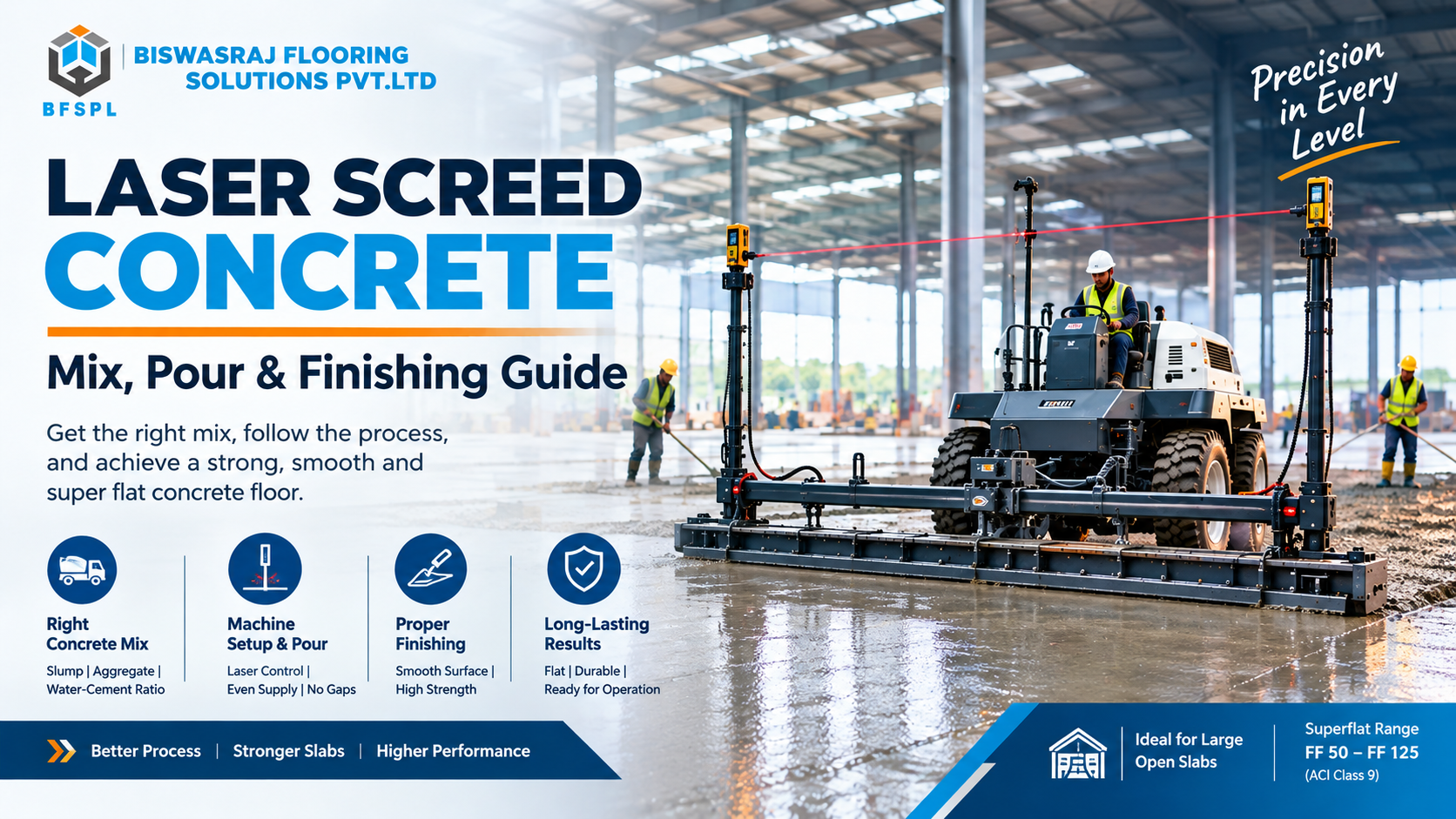
A laser screed machine carries a boom with an auger, a plow and a vibrating head. A laser receiver keeps the head on a fixed reference plane, so the head follows the design level as the boom pulls back across the wet concrete.
The level matters most where wheels are precise. ACI 302.1R puts superflat Class 9 floors at FF 50 to FF 125, the range used for narrow-aisle, high-bay and robotic operations.
Walk-behind machines handle smaller bays, and ride-on machines cover large open slabs. Either way, the machine strikes off, spreads and compacts. For flatness classes and racking, read our guide to super flat laser screed floors.
Which Concrete Mix For Laser Screeding Works Best?
The best concrete mix for laser screeding is a plastic, cohesive mix that spreads under the auger and compacts under the vibrator without segregating. Agree slump, maximum aggregate size and water-cement ratio in the contract before the first truck is ordered.
ACI 302.1R lists those same items for the preconstruction meeting. It also gives recommended maximum slump at the point of placement, so the number that counts is the slump at the machine, not at the batching plant.
Laser screed concrete also has to behave the same from the first truck to the last. If cement, admixture dose or water vary, the finishers meet bays that set at different speeds. ACI calls this differential set time.
|
Mix property |
Why the machine cares |
Agree before the pour |
|
Slump at placement |
Too stiff and the head drags; too wet and the slab bleeds |
A maximum slump at the point of placement |
|
Maximum aggregate size |
Stone size affects spreading and how the surface closes |
The size, plus fibre dose if fibres are used |
|
Water-cement ratio |
It governs strength, shrinkage and finishing time |
A fixed ratio, with no unapproved water on site |
|
Cement and admixtures |
Set time must match from truck to truck |
One source, one mix, dose logged per truck |
Machine makers also adapt to harder mixes. One manufacturer’s literature describes a roller option that pushes larger stone and fibres down while the cream rises, which helps with very low slump.
How Does Concrete Slump For Laser Screeding Affect The Slab?
Concrete slump for laser screeding is a balance. Too stiff and the head drags and tears the surface; too wet and the slab bleeds and settles. ACI ties higher-than-required slump to settlement cracking over steel, so aim for the lowest slump the machine places cleanly.
Slump control on site comes down to four habits:
• Test the first truck, then at an agreed frequency
• Record slump with the truck number and time
• Stop unapproved water at the pump or chute
• Reject loads outside the limit rather than placing them and hoping
Slump alone does not guarantee a finishable floor. Two mixes with the same slump can bleed and set differently, so ask the supplier for the full mix design, not just the slump figure.
What Does The Sub-Base Need Before The Machine Arrives?
A laser can level the concrete but not the ground under it. ACI 302.1R says proof-rolling tells you more about the soil support than moisture or density tests do, so a sub-base should be proof-rolled and signed off before any concrete is ordered.
ACI also describes a thin layer of graded, compactible fine-grading material over the base. It helps control slab thickness and reduces friction between the base and the slab, which matters when the slab starts to shrink.
Check these before pour day:
• Proof-rolling done and any soft spots reworked
• Fine grading checked against the design level
• Vapour retarder laid, lapped and sealed at joints and penetrations
• Edge forms and embedded items fixed and protected
How Should A Laser Screed Pour Be Planned?
A laser screed concrete pour is planned backwards from the machine. Fix bay size, joint layout, truck spacing and crew numbers first, so concrete arrives at the pace the machine and the finishers can handle.
ACI 302.1R strongly recommends a preconstruction meeting for floor work. Its agenda covers joints, slump, strike-off method and how and when flatness will be measured. Our guide to concrete floor flatness testing explains the survey side.
1. Mark bay widths, joint lines and transmitter positions on the drawing
2. Check sub-base levels before the machine arrives
3. Plan the chute or pump route so concrete is placed ahead of the machine
4. Set the truck schedule so the next load is always waiting
5. Line up finishers and power floats against the expected set time
6. Agree what happens if the pour stops, including where a joint goes
For unreinforced slabs, ACI reports acceptable results with joint spacing of 24 to 36 times the slab thickness, up to 5.5 m. It prefers near-square panels, allows 1.5 to 1 at most, and advises avoiding L-shaped and T-shaped panels.
If delivery stops long enough for placed concrete to harden, ACI says a construction joint is needed. It suggests keeping that joint 1.5 m or more from any parallel joint, so choose the location before you need it.
What Happens After The Laser Screed Passes?
After the laser screed machine strikes off the slab, the job becomes one of timing. Bleed water must leave before power floating starts, and ACI’s window of finishability, the time before final troweling, sets how long the finishers have.
Because laser screed concrete is struck off quickly, the slab can reach the finishers before it is ready. Floating too early traps bleed water and spoils the surface the machine just levelled.
Where a dry shake hardener is specified, it goes on during this window. ACI defines dry shake as a metallic or mineral hardener mixed with cement and applied dry during finishing, so the mix, the delay and the shake must fit together.
Curing starts as soon as the surface can take cover. IS 456 sets a minimum of 7 days of moist curing for ordinary Portland cement, and our industrial floor curing guide covers methods, blended cement and traffic release.
Why Do Laser Screeded Floors Still Crack Or Curl?
Laser screeding controls level, not shrinkage. ACI 302.1R states that every concrete floor shrinks, and that some cracking and curling should be expected even with the best design and construction.
As a guide, ACI describes random visible cracks in 0 to 3% of the panels formed by joints as a reasonable level. The aim is narrow, tight cracks in the right places, not a floor that never moves. Wider or misplaced cracks point to a problem with joints, base or curing rather than the screed.
Pouring directly onto a vapour retarder adds its own risk. ACI notes that such concrete stiffens more slowly, can crust over while the layer below stays soft, and can lose flatness or blister if machines start too early.
ACI also recommends a retarder of no less than 10 mils (0.25 mm). For how to read and treat the cracks that do appear, see our guide to stopping concrete floor cracks in your factory.
What Should You Check Before Pour Day?
Before any laser screed concrete pour, confirm the mix, slump limit, truck schedule, sub-base levels, finishing crew and curing materials in writing. Gaps found on pour day cannot be fixed with the machine.
• Approved mix design with slump limit and aggregate size
• Truck schedule with spacing and a named plant contact
• Sub-base and membrane checked and signed off
• Transmitter positions and benchmark levels confirmed
• Finishing crew, power floats and shake material on site
• Curing method and materials ready, with a start time
• Flatness survey booked against the pour
Frequently Asked Questions
What concrete grade is used for laser screed floors?
The structural design sets the grade, not the machine. The contract fixes strength, slump limit and aggregate size, and the machine places the approved mix.
Can a laser screed machine place steel fibre concrete?
Yes. Some machine makers offer a roller option for very low slump, large stone or fibres, so confirm the fibre dose and machine set-up with your contractor before the pour.
Does laser screed concrete still need power floating?
Yes, on most industrial floors. Laser screed concrete is struck off and compacted by the machine, then power floating and troweling close the surface once bleed water has gone.
Can laser screeding be used on small bays?
Yes. Walk-behind machines suit smaller bays and ride-on machines suit large open slabs, so match machine size to bay width, access and pour volume.
Does laser screeding remove the need for joints?
Usually not, because the machine sets level and does not stop shrinkage. ACI says joints can be reduced with at least 0.5% continuous reinforcement or post-tensioning, but that is a design decision made before the pour.
How soon can a laser screeded floor take traffic?
There is no single day count. Foot traffic can start once the surface can take it without marking, while loaded trucks wait for the engineer to confirm strength.
How Do You Plan Your Next Pour?
Send us your drawings, racking layout and target flatness class, and we will tell you which mix controls and pour plan the slab needs. To go through your pour sequence on site, book a free site visit.
Good laser screed concrete work is decided in the meetings before the pour, not by the machine on the day.
Sources
- https://concrete.org/Portals/0/Files/PDF/3021R_04Ch3.pdf
- https://biswasrajflooring.in/blogdetail/concrete-floor-flatness-testing
Written by BiswasRaj Flooring Team, Industrial flooring specialists · Last updated 27 October 2026