

Industrial Flooring: Types, Benefits and Application
 28 Aug 2026
Industrial Flooring: Types, Benefits and Application
- Posted by Nagananda Udupa
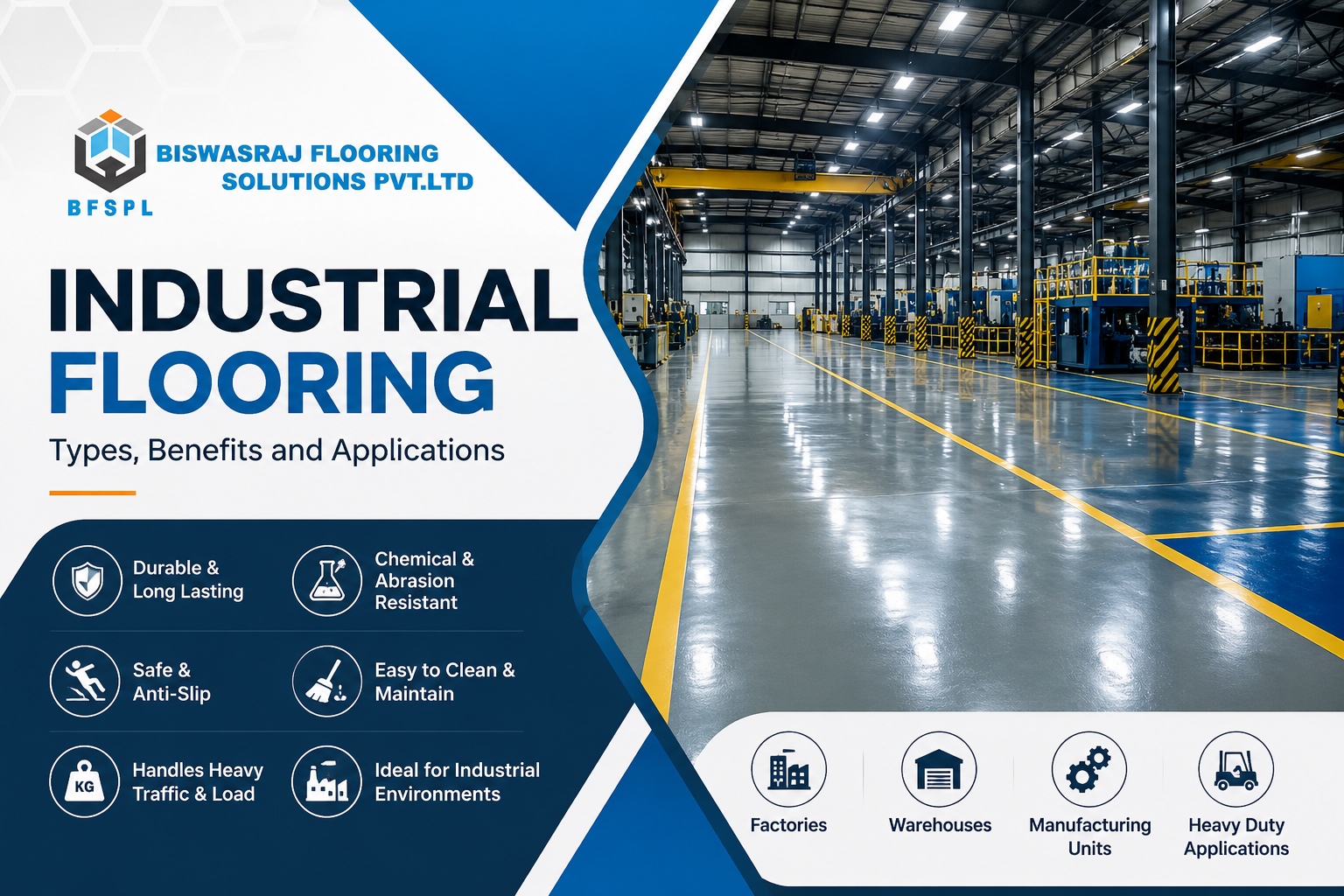
Industrial flooring refers to a wide variety of systems utilised in factories, warehouses, manufacturing, workshops, laboratories, food-processing facilities and other commercial environments. Unlike normal residential flooring systems, industrial flooring is subjected to heavier traffic, forklifts, machinery and exposure to chemicals and impact.
Selecting the right industrial flooring solutions can provide a safer working environment, reduce maintenance and provide a highly durable surface for everyday operations. A suitable system should be selected according to traffic, load, temperature, moisture, chemical exposure, hygiene and the floor condition.
What Is Industrial Flooring?
Industrial flooring refers to special floor systems utilised by environments where the floor is subjected to demanding working conditions. Industrial systems can include concrete-based floors, epoxy systems, polyurethane flooring, floor hardeners and other protective surfaces.
A suitable floor should provide the required combination of strength, durability, chemical and abrasion resistance, and slip resistance. There is no one-size-fits-all system for industrial flooring, the floor should therefore be selected according to the conditions of the environment.
For example, a dry warehouse requires a different system to a food-processing plant where the floor is exposed to water, cleaning chemicals and temperature variations.
Why Is Industrial Flooring Important?
Factories and warehouses are subjected to much more wear than normal residential or office floors. Forklifts, pallet trucks, machinery, heavy materials, oils, chemicals and regular foot traffic can gradually impact on an ordinary concrete surface.
A properly selected flooring system can provide the following benefits:
Durability: Selected to ensure the floor is able to withstand normal traffic and industrial conditions.
Abrasion resistant: Can reduce surface wear from vehicles and equipment.
Easy maintenance: Smooth and seamless systems can be simpler to clean.
Safety: Can be provided via anti-slip finishes.
Chemical resistance: Some systems are designed to protect concrete from oils and selected chemicals.
Dust reduction: Coatings and treatments can reduce dust generation from concrete surfaces.
Professional appearance: Clean floors can present a neater overall appearance to a facility.
The actual performance of a floor will depend on the flooring material, thickness, method of installation, floor preparation and operating conditions.
Types of Industrial Flooring
There are a wide range of flooring systems suitable for industrial environments. The various options are briefly discussed below.
1. Epoxy Industrial Flooring
Epoxy is a popular choice for many indoor applications and forms a hard, seamless surface when applied to properly prepared concrete, offering abrasion and chemical resistance.
Epoxy industrial flooring can be utilised in warehousing, workshops, manufacturing, laboratories, garages and other spaces where a durable and cleanable surface is desired.
However, epoxy is not always the most appropriate system for the environment. Standard epoxy has limitations where there are large temperature fluctuations, UV exposure outdoors or other demanding chemical conditions. The formulation and system build-up should therefore be selected according to the application.
3. Heavy-Duty Industrial Flooring
Forklifts, heavy machinery, pallet movement and point loads may require heavy-duty industrial flooring solutions.
In such cases, simply specifying a product labelled "epoxy" will not suffice, the thickness, substrate condition, aggregate reinforcement, traffic level and loads should all be considered.
For instance, a thin coating for light pedestrian traffic will not perform the same as a thick aggregate-reinforced system for demanding industrial traffic. 4. Concrete Floor Hardening Concrete-based systems can be selected where the primary requirements are abrasion resistance and dust reduction. These systems can be utilised in warehousing, logistics and manufacturing where a resin coating is not required. The existing concrete slab will still need to be assessed prior to system selection. Industrial Floor Coating: What You Should Know An industrial floor coating is a protective layer applied to a prepared floor surface. These coatings can improve resistance to wear, chemicals, staining and normal traffic. Epoxy and polyurethane are two common coating technologies, but the performance of a coating will depend on much more than its name. Before specifying, consider: Traffic and weight: What types of traffic and weight will be present? Forklifts and Pallet Trucks: Are these likely to be utilised? Exposure to oils and/or chemicals: What substances may come into contact with the floor? Temperature and moisture: What temperature and moisture conditions will the floor be exposed to? Slip resistance: Is slip resistance required in any areas? Floor thickness: What thickness is required? Maintenance and downtime: What maintenance and downtime schedule is possible? Concrete substrate condition: What condition is the existing concrete in? Preparation of the floor surface is particularly important. Even an excellent coating can fail prematurely if the concrete is contaminated, weak, very moist or inadequately prepared. Industrial Flooring vs Factory Flooring The terms industrial flooring and factory flooring are often used interchangeably but are not always utilised in exactly the same way Industrial flooring is a broad term that covers floors utilised in factories, warehouses, workshops, manufacturing plants, logistics facilities and other industrial environments. Factory flooring specifically refers to flooring utilised inside manufacturing and production facilities. Therefore, factory flooring is a type of industrial flooring. When considering flooring for a factory, the production process should be taken into account. A dry manufacturing area, chemical-processing section, loading zone and wash-down area all require different flooring specifications. The final choice should always be based on the actual site conditions rather than simply selecting a system because it is popular. Applications of Industrial Flooring Industrial flooring solutions can be utilised in a wide range of facilities including: 1.Manufacturing plants 2.Engineering industries 3.Warehouses 4.Logistics centres 5.Automobile workshops 6.Food-processing facilities 7.Pharmaceutical facilities 8.Garages 9.Commercial kitchens 10.Laboratories 11.Loading and storage areas Each application has different requirements. A warehouse may have stricter forklift requirements and durability whereas a food-processing facility may place a greater emphasis on hygiene, cleaning, moisture and thermal resistance. How to Choose the Right Industrial Flooring Prior to installing an industrial floor, consider the following factors Comparison of Common Flooring Systems
Traffic and Load
Will the surface be subject to pedestrian traffic, trolleys, forklifts, heavy machinery or concentrated loads?
Chemical Exposure
What oils, solvents, acids, alkalis, cleaning chemicals and other substances may come into contact with the floor? The selected system should be checked for compatibility with the chemicals used.
Moisture and Temperature
Moisture in the concrete and temperature variations can impact on flooring performance. Wet processing areas will require a different system to dry production areas.
Safety
Where water, oil or liquid exposure is present, an appropriate anti-slip finish may be required.
Maintenance
How frequently will the floor need to be cleaned, and what cleaning chemicals and equipment will be utilised?
Substrate Condition
The existing concrete should be inspected prior to installation. Cracks, damaged areas, contamination and moisture issues may need to be resolved prior to new flooring being installed.
Benefits of Professional Industrial Floor Installation
Professional installation can make a significant difference to the performance of a floor. Preparation, mixing, application, curing and finishing all impact the final result. A professional flooring team can assess the site and suggest an appropriate system, prepare the substrate, apply the required layers and provide suitable finishing options.
Rather than simply purchasing a flooring material on the basis of its initial price, businesses should consider performance, maintenance requirements, downtime, operating conditions and expected performance. There is no one-size-fits-all system. The best option will depend on traffic, load, chemicals, moisture, temperature, hygiene requirements and the condition of the concrete. Yes. Epoxy can be suitable for many indoor factory applications, particularly where a hard, seamless and easy-to-clean floor is required. The system should match the expected traffic and operating conditions. 3. What is industrial floor coating? An industrial floor coating is a protective layer that can improve the durability and cleanability of a floor. Industrial floor coatings are often applied using materials such as epoxy or polyurethane. 4. Is PU flooring better than epoxy? Neither is universally better. While epoxy is often specified for its hardness and adhesion, PU systems can provide greater flexibility and performance in certain demanding environments. The application should dictate the choice. 5. How long does industrial flooring last? The service life will depend on the flooring system, thickness, substrate, traffic, chemical exposure, installation quality and maintenance. A properly specified system will outperform a system selected solely on initial cost. 6. Can industrial flooring be used in warehouses? Yes. Warehouse flooring can include epoxy, concrete hardeners, polished concrete or other systems according to forklift traffic, storage loads, dust requirements and the condition of the concrete floor. The choice of the right industrial flooring is an important consideration for factories, warehouses, workshops and manufacturing facilities. A suitable solution should be selected according to the actual operating environment rather than simply the most popular flooring material. From epoxy industrial flooring and industrial floor coating to PU systems and heavy-duty flooring, a range of options are available for different requirements. Correct surface preparation, system choice, thickness and professional installation will all impact the performance of a floor system. Biswasraj Flooring can help you identify a suitable flooring solution based on your facility's requirements and operating conditions.Frequently Asked Questions
2. Is epoxy suitable for factory flooring?