


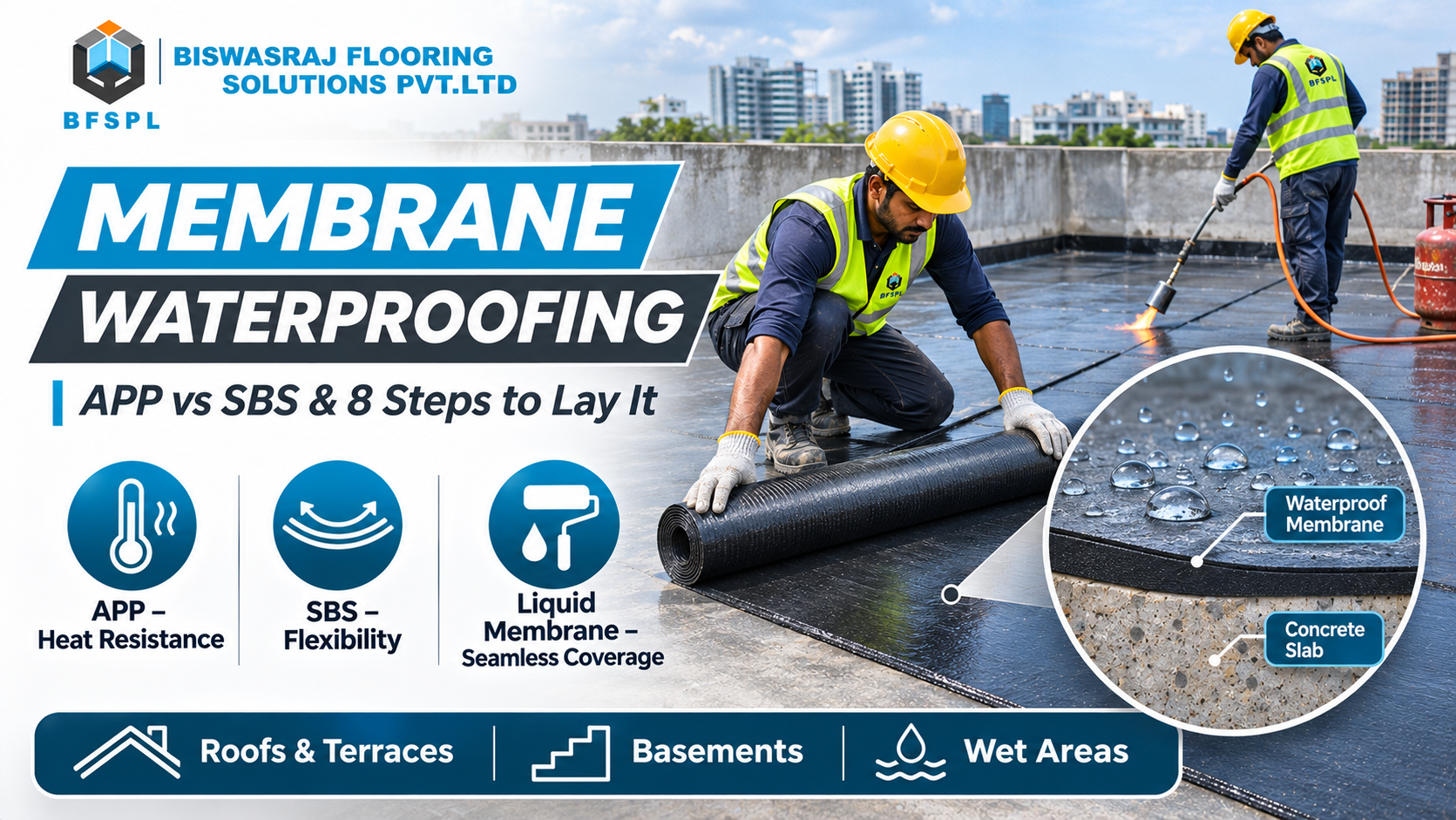
Membrane waterproofing lays a continuous sheet or liquid layer over a roof, terrace, basement, or wet area so water cannot reach the structure below. It must go onto a dry surface: one US federal specification bars laying modified bitumen within 12 hours of rain.
Roofs and terraces are where most membranes go in India. For slope, drainage, and the other details a roof needs before any membrane is laid, see our terrace waterproofing guide.
At A Glance
- Types
- Sheet membranes and liquid-applied membranes
- Common sheets
- APP and SBS modified bitumen, PVC, TPO, and HDPE
- Surface
- Dry, primed, smooth, and free of sharp edges
- Critical details
- Laps, upstands, drains, and pipe penetrations
Most membrane failures start at a detail, not in the middle of the sheet.
What Is Membrane Waterproofing?
Membrane waterproofing creates a separate, continuous barrier between water and the structure. Unlike treatments that work inside the concrete, a membrane sits on the surface and stops water before it reaches the slab or wall, as long as every joint and edge is sealed.
Membranes come in two broad forms:
- Sheet membranes: factory-made rolls of modified bitumen, PVC, TPO, or HDPE, laid and joined on site
- Liquid membranes: polyurethane, acrylic, or polymer-cement coatings that cure into a seamless skin
Sheets give a consistent, factory-controlled thickness. Liquids follow awkward shapes and leave no seams, but their thickness depends on how carefully they are applied.
A membrane is only as good as its weakest point. Laps, corners, upstands at parapets, drain outlets, and pipe penetrations need more care than the open field of the roof.
What Are The Main Types Of Waterproofing Membranes?
The right material depends on exposure, movement, and how the membrane will be laid. Bitumen sheets dominate Indian roofs and terraces, while plastic sheets and liquids suit specific jobs. Choosing membrane waterproofing by type, rather than by brand, keeps the comparison fair.
| Membrane type | How it is laid | Best for | Watch out for |
|---|---|---|---|
| APP modified bitumen | Torch-applied | Exposed roofs in hot, sunny climates | Open flame on site, stiffer sheet |
| SBS modified bitumen | Torch, hot bitumen, cold adhesive, or self-adhered | Roofs and decks with more movement | Needs UV protection if left exposed |
| PVC or TPO sheet | Mechanically fixed or bonded, seams heat-welded | Large flat roofs | Skilled welding crew needed |
| HDPE or self-adhesive sheet | Bonded or loose-laid with sealed laps | Basements and below-ground walls | Must be protected during backfill |
| Liquid PU or acrylic | Brushed, rolled, or sprayed | Complex roofs, details, wet areas | Thickness control on site |
Both of the bitumen types appear side by side in the US Unified Facilities Guide Specification for modified bituminous membrane roofing, which covers torch, hot, and cold application. It also calls for primer at 3 litres per 10 square metres before the sheet goes down.
APP Or SBS: Which Bitumen Membrane Should You Choose?
Both are bitumen sheets reinforced with polyester or glass mat. APP is modified with atactic polypropylene, which makes it stiffer and tolerant of heat and sun. An SBS membrane is modified with a rubber-like polymer, which keeps it more elastic, especially when the surface moves.
Choose based on the roof, not the label:
- Pick APP for exposed roofs in strong sun, where heat resistance matters most
- Pick SBS where the deck moves more, such as large spans or decks with many joints
- Pick SBS when an open flame is not acceptable, since it can also be cold-applied or self-adhered
A torch applied membrane needs trained hands. The torch softens the underside so it bonds to the primed surface, but too little heat leaves a weak bond and too much burns the reinforcement.
Fire safety is not optional. The same US specification restricts torch application because of the fire risk during roofing work, and bars it entirely where the deck or other materials are combustible.
Where Does Membrane Waterproofing Work Best?
Membranes suit surfaces that face direct rain, standing water, or soil moisture: roofs, terraces, podium decks, balconies, planters, basements, and wet areas. In each case the membrane must be continuous, protected from damage, and turned up at every edge.
Typical locations include:
- Roofs and terraces: with protection screed or tiles on top if people walk on them
- Podium decks and car parks: below a wearing course that takes traffic
- Basements: on the outside face, before backfilling
- Planters and green roofs: with a root-resistant layer
- Bathrooms and wet areas: liquid membranes under tiles
Below ground, a membrane works best on the positive side, where water pressure presses it against the wall. Our basement waterproofing guide explains why inside-only treatments face a harder job.
Where the outside cannot be reached, membrane waterproofing on the inner face can be pushed off by water pressure. Treatments that work within the concrete, injection, or drained systems are usually better there.
How Do You Apply A Waterproofing Membrane Step By Step?
Membrane waterproofing is mostly preparation and detailing. The surface must be sound, dry, and primed, the slope must drain water away, and every upstand, drain, and penetration must be finished before the main sheet goes down.
If you are planning how to apply waterproofing membrane on a roof or terrace, follow this order:
- Inspect and repair: fix cracks, hollow screed, and broken parapet plaster.
- Correct the slope: make sure water runs to outlets without ponding.
- Round the corners: form fillets where the slab meets parapets and upstands.
- Dry and clean: remove dust and loose material; never lay on a wet surface.
- Prime: apply the primer the membrane maker specifies and let it dry.
- Detail first: treat drains, pipe penetrations, and upstands before the field.
- Lay the membrane: start at the lowest point and lap sheets so water runs over the joints.
- Protect and test: add protection or a wearing layer, then water test before handover.
Laps decide whether sheets act as one barrier. The US specification gives 76 mm side laps and 152 mm end laps for ventilating base sheets, and each product’s data sheet sets the laps for its own system.
Why Do Membranes Fail And How Can You Prevent It?
Most membrane failures come from poor detailing, a damp or dusty surface, or damage after laying. The middle of a well-laid sheet rarely leaks; the edges, laps, and penetrations do. Each failure below has a clear cause and fix.
| Failure | Likely cause | Prevention |
|---|---|---|
| Blisters and bubbles | Moisture trapped under the sheet | Lay only on a dry, primed surface |
| Lap leaks | Laps too narrow or poorly bonded | Follow lap widths and seal every joint |
| Leaks at parapets | Upstand too low or not terminated | Turn up the membrane and fix a termination bar |
| Leaks at drains and pipes | No collar or flashing | Detail every penetration before the field |
| Punctures and tears | Foot traffic, tools, or backfill | Add a protection screed or board |
| Cracking and brittleness | UV exposure on an unprotected sheet | Use a mineral-surfaced sheet or protective coat |
Inspection keeps a good membrane working. Check laps, upstands, and drains every year before the monsoon, and clear outlets so water never ponds on the roof. Our monsoon proofing checklist shows how to plan that work in the dry season.
How Does It Compare With Other Waterproofing Methods?
Membrane waterproofing is one option among several. Coatings, crystalline treatments, and injection each have their place, and many projects use two together. The right choice depends on access, movement, exposure, and whether the water pushes from outside or inside.
| Method | Where it sits | Strength | Limitation |
|---|---|---|---|
| Sheet membrane | On the surface | Factory-controlled thickness, bridges movement | Seams and details need skill |
| Liquid membrane | On the surface | Seamless, follows complex shapes | Thickness depends on the applicator |
| Crystalline treatment | Inside the concrete | Works from the inside face | Cannot bridge moving cracks |
| Injection grouting | Inside cracks and joints | Stops active leaks at points | Treats points, not whole surfaces |
On industrial sites, a common pattern is a membrane or coating on roofs, crystalline or injection work in basements and pits, and flexible sealants at every movement joint.
Frequently Asked Questions
How long does a waterproofing membrane last?
It depends on the type, the exposure, and the protection on top. A well-laid membrane under a protective layer generally lasts far longer than one left exposed to sun and traffic.
Can you lay a membrane over old waterproofing?
Sometimes, if the old layer is sound and well bonded. Loose, blistered, or cracked layers must come off first, or the new membrane will fail with them.
Is torch-applied membrane safe on every roof?
No. Torching is unsafe near combustible decks, insulation, or stored materials, so self-adhered or cold-applied systems avoid the open flame on such roofs.
Do you need a protection layer over the membrane?
Usually yes, wherever people walk, vehicles drive, or soil is backfilled. Membrane waterproofing left exposed needs a UV-resistant or mineral-surfaced top layer.
Can membranes be laid during the monsoon?
Only in dry spells. The surface must be dry before laying, so plan the work in the dry season and keep sheets protected from rain until sealed.
Is a liquid membrane better than a sheet?
Neither is better everywhere. Liquids suit complex shapes and details, while sheets give consistent thickness on large, open areas.
What Do The Numbers Say?
- 12 hours Minimum wait after rain before laying modified bitumen membrane on a surface UFGS 07 52 00, Modified Bituminous Membrane Roofing
- 3 litres per 10 m² Primer application rate before a modified bitumen membrane UFGS 07 52 00, Modified Bituminous Membrane Roofing
- 76 mm Side lap for ventilating base sheets, with 152 mm end laps UFGS 07 52 00, Modified Bituminous Membrane Roofing
Which Membrane Is Right For Your Roof Or Basement?
Start with the surface, the slope, and how the area is used, not with a product name. Our team inspects the structure and recommends membrane waterproofing, a coating, or a combination that suits it. Explore our waterproofing services to arrange a site visit.
Sources
- UFGS 07 52 00 Modified Bituminous Membrane Roofing (Unified Facilities Guide Specifications (USACE, NAVFAC, AFCEC))
- Terrace Waterproofing (BiswasRaj Flooring Solutions Pvt. Ltd.)
- Waterproofing Services in India (BiswasRaj Flooring Solutions Pvt. Ltd.)