


Choosing A Concrete Floor Hardener For Industrial Floors
 19 Aug 2026
Choosing A Concrete Floor Hardener For Industrial Floors
- Posted by Sathish K
Sweep a plant floor twice a day and still find grey powder on the boxes. That surface is not dirty. It is wearing away under your feet.
A concrete floor hardener fixes that at the source, either by building a tougher wearing layer into the fresh slab or by chemically closing the pores of an existing one. Picking the wrong type wastes the whole spend.
The Essentials
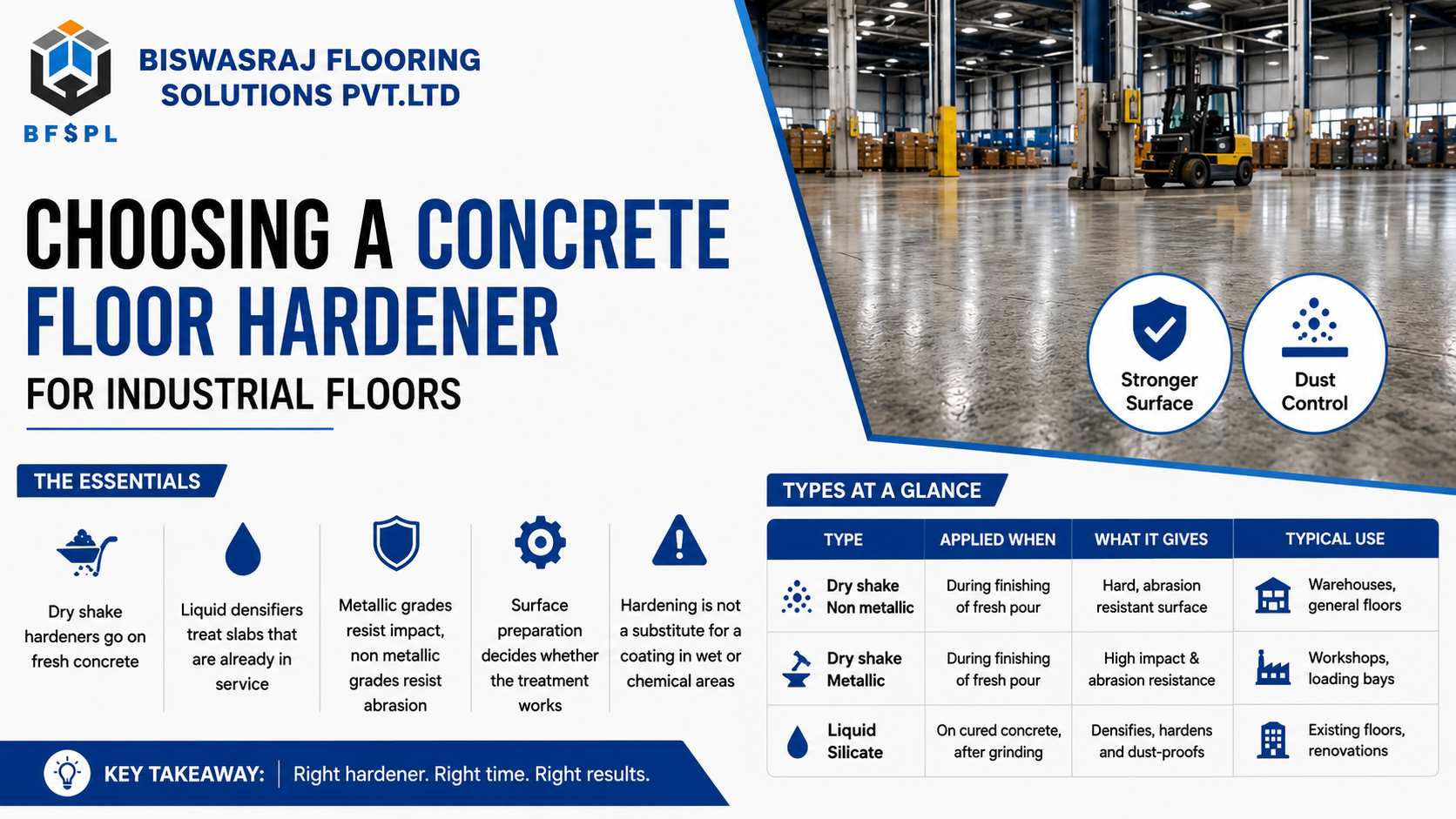
• Dry shake hardeners go on fresh concrete during finishing
• Liquid densifiers treat slabs that are already in service
• Metallic grades resist impact, non metallic grades resist abrasion
• Surface preparation decides whether the treatment works
• Hardening is not a substitute for a coating in wet or chemical areas
What Does A Concrete Floor Hardener Actually Do?
It makes the top few millimetres of the slab denser and harder to wear. A dry shake product adds graded aggregate and cement to the surface during finishing. A liquid concrete floor hardener reacts with free lime inside cured concrete and fills the pores that release dust.
That difference matters because the two products solve different problems:
• Dry shake builds a new wearing course, so it only works on a fresh pour
• Liquid densifiers strengthen what is already there, so they suit floors in use
• Neither adds thickness you can see, and neither levels an uneven floor
• Neither will hold on a surface that is soft, oily, or already breaking up
If the slab is shedding powder because bleed water was worked into the top layer during finishing, hardening alone will not fix it. That weak skin has to be ground off first.
Which Type Suits A New Pour Or An Existing Floor?
Match the product to the age of the slab. A new pour takes a dry shake floor hardener applied during power floating, while a floor already carrying traffic takes a liquid silicate densifier applied after grinding. Using either in the wrong situation is the most common mistake we see.
|
Type |
Applied when |
What it gives |
Typical use |
|
Dry shake, non metallic |
During finishing of a fresh pour |
Hard, abrasion resistant wearing course |
Warehouses, general plant floors |
|
Dry shake, metallic |
During finishing of a fresh pour |
High impact and abrasion resistance |
Foundries, workshops, loading bays |
|
Liquid sodium or lithium silicate |
On cured concrete, after grinding |
Denser surface, far less dusting |
Existing plants, godowns, garages |
|
Coloured dry shake |
During finishing of a fresh pour |
Hard surface plus a marked colour |
Aisles, showrooms, parking decks |
The liquid route is the only option once a building is running, which is why most hardener enquiries we receive are really enquiries about densifying a slab that is already in use.
What Is The Difference Between Metallic And Non Metallic Grades?
The filler aggregate is the difference. A non metallic floor hardener uses hard mineral aggregate such as quartz or emery and resists sliding abrasion. A metallic grade uses graded iron particles and takes heavy impact, dropped tools, and steel wheeled trolleys without spalling.
Non metallic grades cover most Indian applications and cost noticeably less. Metallic grades earn their price only where impact is genuinely severe, such as a forging shop, a scrap handling bay, or a dock where steel skids are dragged across the slab.
One caution on metallic grades. The iron content can rust and stain if the floor stays wet, so they are a poor choice for washdown areas, open yards, and anywhere with standing water.
Coverage rate matters as much as the grade. A dry shake concrete floor hardener is specified in kilograms per square metre, and a light broadcast on a heavy duty bay will wear through to plain concrete within a couple of years.
Ask any contractor to state the product, the rate, and the number of floating passes in the quotation. Two prices that look far apart usually differ on exactly those three lines.
How Is A Concrete Floor Hardener Applied?
The method depends on the type, but preparation decides the result in both cases. On a fresh pour the shake goes on during floating, at the moment the bleed water has gone. On an old slab, a concrete floor hardener only works once the weak surface layer has been ground away.
For an existing floor, the sequence runs like this:
1. Survey the slab, checking for dusting, soft patches, cracks, and oil contamination
2. Remove oil and old coatings, since a densifier cannot penetrate through them
3. Grind the surface to take off laitance and open the pores
4. Repair cracks and spalled joint edges before treatment
5. Flood the surface evenly with the silicate densifier and keep it wet for the stated reaction time
6. Remove any residue before it dries into a white film
7. Burnish or polish the treated floor to close the surface further
8. Check hardness and dust generation before handover
NRMCA guidance on dusting concrete surfaces makes the same two points: blast or grind away the weak layer first, then apply the chemical hardener to thoroughly dried concrete. Skipping the first step is why so many treatments fail within months.
Does A Hardener Stop Concrete Dusting For Good?
On a sound slab, yes, for years. Densification is a chemical reaction inside the concrete rather than a film on top, so there is nothing to peel or wear off. Heavily trafficked lanes may need a light re-treatment in time, but the floor does not go back to raw concrete.
Where a concrete floor hardener does not deliver is on a slab whose problems run deeper than the surface. Look for these signs before spending:
• The floor sounds hollow when tapped, which suggests delamination
• Aggregate is already exposed across large areas
• The surface is soaked with oil or chemical spills
• Water is rising through the slab from below
The last one needs a moisture check and often waterproofing work rather than a surface treatment. Any hardener applied over rising damp will simply be pushed off.
A quick test costs nothing. Tape a half metre square of polythene to the slab, leave it overnight, and look for condensation underneath in the morning. Moisture there means the slab needs attention from below before a concrete floor hardener goes anywhere near it.
When Is Grinding Or A Coating The Better Answer?
Choose by what the floor has to survive. Hardening suits dry, mechanical wear. Grinding and polishing suits floors that also need a clean, reflective finish. A resin coating suits chemical spillage, hygiene requirements, and colour zoning that bare concrete cannot provide.
|
Requirement |
Hardener alone |
Grinding and polishing |
Epoxy or PU coating |
|
Stop dusting |
Yes |
Yes |
Yes |
|
Improve appearance |
Slight |
Strong |
Strong |
|
Resist oil and chemicals |
Limited |
Limited |
Strong |
|
Colour zoning or marking |
No |
No |
Yes |
|
Downtime needed |
Lowest |
Medium |
Highest |
In practice the three overlap. Concrete grinding and polishing includes a densifier as part of the process, and epoxy flooring needs the same mechanical preparation before the primer goes down.
Budget is usually what settles it. A densifier treatment costs a fraction of a resin system per square foot and needs far less downtime, so it wins wherever the floor is dry and the only complaint is dust.
For new construction, the cleanest result comes from combining a dense slab with a hardened surface. A VDF flooring pour finished with a dry shake gives a floor that starts strong instead of one that needs rescuing in year three.
Frequently Asked Questions
How long does a floor hardener last?
A dry shake wearing course lasts the life of the slab under normal traffic. A liquid concrete floor hardener lasts several years, with busy lanes benefiting from periodic re-treatment.
Can a hardener be applied to an old, dusty floor?
Yes, provided the weak surface layer is ground off first. Applying it over loose powder wastes the material and the shutdown.
Does floor hardening change the colour of the concrete?
Plain hardeners leave a natural grey finish with a slight sheen after burnishing. Coloured dry shake products are available if a specific shade is required.
What thickness does a dry shake add?
Very little. It is broadcast at a rate per square metre during finishing and becomes part of the top two to three millimetres of the slab.
Is a hardener enough for a food or pharma plant?
Usually not on its own. Those facilities normally need a seamless resin or PU system for cleanability and chemical resistance.
How soon can we use the floor after treatment?
Most densified floors take foot traffic the same day and full vehicle traffic within 24 to 48 hours, depending on the product and site conditions.
What Is The Fastest Way To Start?
Walk your floor and note where the dust is worst, whether it sounds hollow, and how much oil has soaked in. Those three observations decide between densification, grinding, and a coating faster than any brochure will.
Our engineers do that check on site at no cost and put the recommendation in writing, including whether a concrete floor hardener is the right spend at all. Request a free site visit and quote with your floor area and industry, and we will come back with a plan you can budget against.