

How Do You Choose Between VDF, Trimix and IPS Flooring?
 09 Oct 2026
How Do You Choose Between VDF, Trimix and IPS Flooring?
- Posted by Nagananda Udupa
Choosing the right floor is an important part of planning an industrial, commercial, or warehouse facility. The floor must support the activities performed in the space, withstand expected loads, and provide a surface that suits daily operations.
However, different facilities have different requirements. A warehouse with material-handling equipment may need a different concrete floor specification from a commercial utility area or a general-purpose workspace. Selecting a flooring system without considering these differences can lead to unnecessary maintenance, surface deterioration, or operational difficulties.
VDF flooring, Trimix flooring, and IPS flooring are options worth evaluating for suitable projects. Each has different construction characteristics and potential applications, so the right choice depends on your facility's purpose, expected traffic, load conditions, surface requirements, and budget.
This guide explains the main considerations to help you discuss your project requirements with a professional flooring contractor.
What Should You Consider Before Choosing a Flooring System?
Before selecting a floor, assess how the facility will be used after construction. This gives your contractor a clearer understanding of the performance requirements.
Expected loads: Identify the weight of machinery, stored materials, racks, and vehicles. The floor design must account for these loads and the condition of the supporting base.
Traffic patterns: Consider whether the area will experience pedestrian movement, hand trolleys, forklifts, or heavy vehicles. Different traffic patterns can place different demands on the concrete surface and joints.
Surface finish: Some operations require a smooth and level surface, while others may prioritize a practical finish for general-purpose use. Specify the required surface characteristics before construction begins.
Environmental conditions: Moisture, oils, cleaning chemicals, and temperature variations may affect flooring performance. The selected system and its protective treatments should suit the actual exposure conditions.
Maintenance requirements: Consider how frequently the floor will be cleaned and whether repairs could interrupt daily operations.
Installation budget: Compare quotations based on the complete scope of work, including base preparation, concrete specifications, finishing, joints, curing, and quality checks.
These factors help you evaluate flooring options based on suitability rather than choosing solely by name or initial cost.
What Is VDF Flooring and Where Is It Used?
VDF stands for vacuum dewatering flooring, referring to a process that removes excess water from freshly placed concrete using vacuum equipment. When properly specified and executed, the process can help achieve the intended concrete properties and finish.
This method may be considered for warehouses, factories, workshops, and other industrial spaces where concrete floor performance is important. Its suitability depends on the project design, concrete mix, slab thickness, base preparation, finishing, and curing.
For facilities that use forklifts or heavy equipment, discuss the expected wheel loads, traffic frequency, and surface requirements with the project engineer. The dewatering process alone does not guarantee a particular load capacity, flatness level, or service life.
You should also ask how the contractor plans to manage construction joints and movement joints. These details are important because even a well-finished concrete surface can develop problems if the floor design does not account for loading and movement.
BiswasRaj Flooring offers a dedicatedVDF flooring service that you can review when exploring options for your project.
When Should You Consider Trimix Flooring?
Trimix flooring is a term commonly used for concrete floor construction involving vacuum dewatering and mechanical finishing. The exact scope can vary, so confirm the construction method and specifications included in your contractor's quotation.
It is commonly considered for large floor areas, warehouses, factories, and other facilities where the finished concrete surface must support regular operational activity.
Before selecting this system, determine whether your facility requires particular surface tolerances, heavy-load support, resistance to regular traffic, or specific maintenance characteristics. Your contractor should explain how the proposed concrete mix, slab design, finishing method, joints, and curing plan address those requirements.
For example, a distribution warehouse with frequent forklift movement may require a different specification from a small workshop with lighter equipment. The appropriate design should reflect the actual operating conditions.
Do not assume that every floor described as Trimix will provide identical results. The quality of the finished floor depends on the materials, equipment, construction process, workmanship, and quality-control measures used on site.
You can also read BiswasRaj Flooring's existingTrimix flooring and VDF concrete guidefor more information about the related construction methods.
Is IPS Flooring Suitable for Your Facility?
IPS flooring, commonly known as Indian Patent Stone flooring, is a cement-based flooring option used in various residential, commercial, utility, and selected industrial applications.
It may be suitable for areas where a cement-based finish meets the project's functional and durability requirements. However, the required thickness, base condition, surface finish, workmanship, and curing must be considered before installation.
For a general-purpose utility area, the flooring requirements may be relatively straightforward. A manufacturing facility with heavy machinery or frequent vehicle movement, on the other hand, needs a careful assessment of loads, traffic, and exposure conditions.
Before choosing this option, clarify whether the floor will be exposed to regular moisture, chemical spills, abrasive materials, or demanding cleaning routines. These conditions may influence the finish and additional protection required.
IPS flooring should not automatically be treated as a replacement for a purpose-designed heavy-duty industrial concrete floor. Ask a qualified professional to confirm that the proposed construction meets the intended use.
For further details, visit the existingIPS flooring guideon the BiswasRaj Flooring website.
How Do You Compare These Flooring Options?
The most useful comparison focuses on construction methods and project requirements rather than assuming that one option is always better.
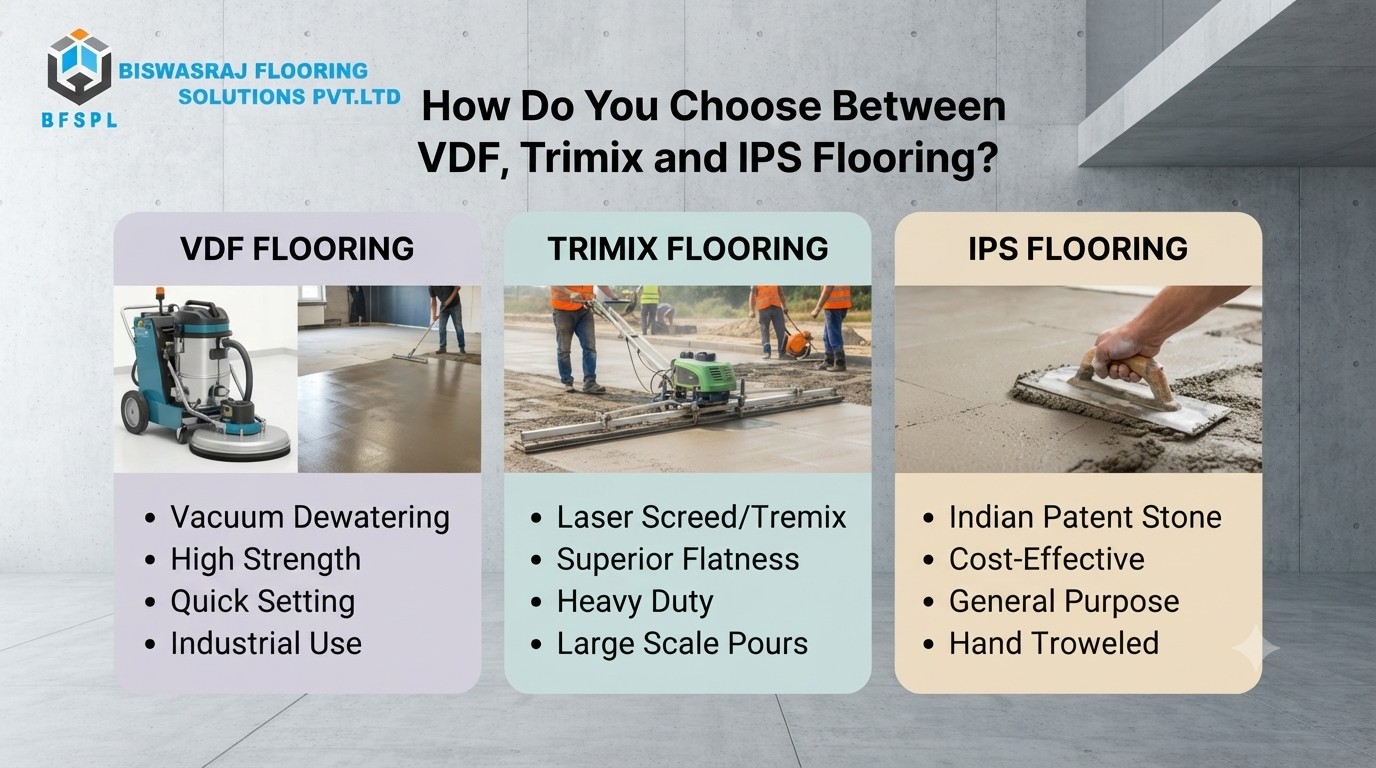
Construction process: VDF uses vacuum dewatering during concrete placement. Trimix is commonly associated with dewatering and mechanical finishing, although the exact specification can differ. IPS refers to a cement-based flooring finish or system whose construction details should be confirmed.
Facility requirements: Warehouses and factories may require careful consideration of heavy loads, vehicle movement, joint performance, and surface tolerances. General commercial or utility areas may have different requirements.
Surface performance: The final finish depends on the design, materials, workmanship, and curing. The flooring name alone does not guarantee smoothness, flatness, abrasion resistance, or durability.
Maintenance: Cleaning methods, exposure to moisture or chemicals, traffic, and construction quality all affect maintenance needs. Ask the contractor for a maintenance plan suitable for the intended use.
Project cost: Costs depend on the floor area, slab thickness, concrete specification, base preparation, reinforcement where required, finishing process, site access, and project schedule. Obtain a quotation based on the actual site conditions.
Comparing these factors helps you evaluate whether the proposed system fits your facility's operational needs.
How Can You Select the Right Flooring for a Warehouse or Factory?
Start by documenting the facility's main activities. This allows the design team to identify the performance requirements before recommending a construction method.
For a warehouse, record the types of storage racks, expected loads, forklift routes, and frequency of vehicle movement. For a factory, include machinery loads, vibration concerns, production processes, and any exposure to oils or chemicals.
Next, specify the required floor finish and surface tolerances. If equipment movement depends on floor regularity, explain those needs to the contractor instead of relying on a general description such as smooth concrete.
Review the construction drawings and confirm the slab design, base preparation, joints, curing procedures, and quality checks. Request written specifications so you can compare quotations fairly.
You should also discuss the planned maintenance routine and the potential effect of repairs on operations. These considerations can help you assess long-term suitability alongside the installation cost.
Finally, ask the contractor to explain why the recommended system fits the site's actual requirements. A clear recommendation should be supported by the project specifications, not simply by the popularity of a flooring method.
For general workplace walking-surface safety considerations, you can consult theU.S. Occupational Safety and Health Administration's walking-working surface requirements. For Indian projects, consult applicable local regulations and relevant Indian Standards.
What Should You Ask a Flooring Contractor Before Installation?
Before approving a flooring proposal, ask the contractor to explain the complete scope of work.
What concrete grade and slab thickness are specified?
How will the base be prepared and inspected?
Have the expected equipment and vehicle loads been considered?
What surface finish and flatness tolerances are required?
How will joints and potential movement be managed?
What curing and quality-control procedures will be followed?
Which maintenance activities will be necessary after installation?
What is included in the quotation, and which items may cost extra?
These questions help you understand what you are paying for and whether the proposed system meets the facility's needs.
Avoid comparing contractors on price alone. A lower quotation may exclude important preparation work, testing, finishing requirements, or other items needed to meet the project specification.
Frequently Asked Questions
What Is the Main Difference Between VDF Flooring and Trimix Flooring?
VDF refers to vacuum dewatering, a process used during concrete placement. Trimix is commonly used to describe concrete floor construction involving dewatering and mechanical finishing. Because terminology can vary between contractors, confirm the exact construction method and specification.
Where Can IPS Flooring Be Used?
IPS flooring may be suitable for selected residential, commercial, utility, and industrial areas when its construction and finish meet the intended use. Load conditions, moisture exposure, base preparation, and maintenance requirements should be evaluated before installation.
Is VDF Flooring Suitable for Warehouses?
It may be suitable for warehouses when the concrete floor is properly designed for the expected loads, traffic, surface requirements, and site conditions. The vacuum dewatering process alone does not establish the floor's load capacity or flatness.
Is Trimix Flooring Suitable for Heavy Machinery?
It can be considered for industrial projects, but suitability depends on the slab design, machinery loads, supporting base, joint details, and construction quality. A qualified engineer should assess the actual requirements.
Which Flooring Option Is More Affordable?
There is no universally cheapest option. The total price depends on floor area, concrete specifications, thickness, preparation, finishing, labour, site access, and other project requirements. Request comparable quotations before deciding.
How Do You Maintain an Industrial Concrete Floor?
Follow a maintenance plan suited to the facility. This may include regular cleaning, prompt attention to spills, inspection of joints, and timely repairs. The correct procedure depends on the concrete finish and the conditions in which the floor operates.
How Can You Maintain and Choose the Right Flooring System?
Selecting a floor requires a clear understanding of the facility's purpose, expected loads, traffic, surface requirements, environmental conditions, and maintenance needs. VDF, Trimix, and IPS systems each have potential applications, but their suitability depends on the actual construction specification.
Before making a decision, consult a qualified flooring contractor and compare proposals based on technical requirements as well as cost. This helps you choose a system that supports your operations and provides a practical foundation for long-term use.
Need Expert Advice on Choosing the Right Flooring System?
For expert guidance on selecting and maintaining VDF, Trimix, or IPS flooring, contact BiswasRaj Flooring to discuss your facility’s requirements and find a suitable flooring solution.