


Concrete Flooring: Choose the Right System for Your Job
 31 Aug 2026
Concrete Flooring: Choose the Right System for Your Job
- Posted by Nagananda Udupa
Choosing the right concrete flooring system is an important decision for industrial, commercial and high-traffic spaces. A floor is not simply a surface to walk or drive on. It must support the activities taking place above it, including machinery movement, storage, forklifts, vehicles, heavy loads and continuous foot traffic.
Different projects have different flooring requirements. A warehouse may need a highly durable and flat surface for material-handling equipment, while a showroom may prioritise appearance and ease of maintenance.
Why Is Concrete Flooring Used for Industrial and Commercial Spaces?
Concrete is widely used as a flooring material because it can be designed to provide a strong and stable surface for demanding environments.
When properly specified and installed, it can support heavy loads and regular traffic while providing a suitable base for different finishing and treatment methods.
Another advantage is flexibility. A concrete floor can be finished or treated according to the requirements of the facility. Depending on the project, this can include VDF or Trimix systems, specialised flatness requirements, densification, grinding and polishing, or protective coatings.
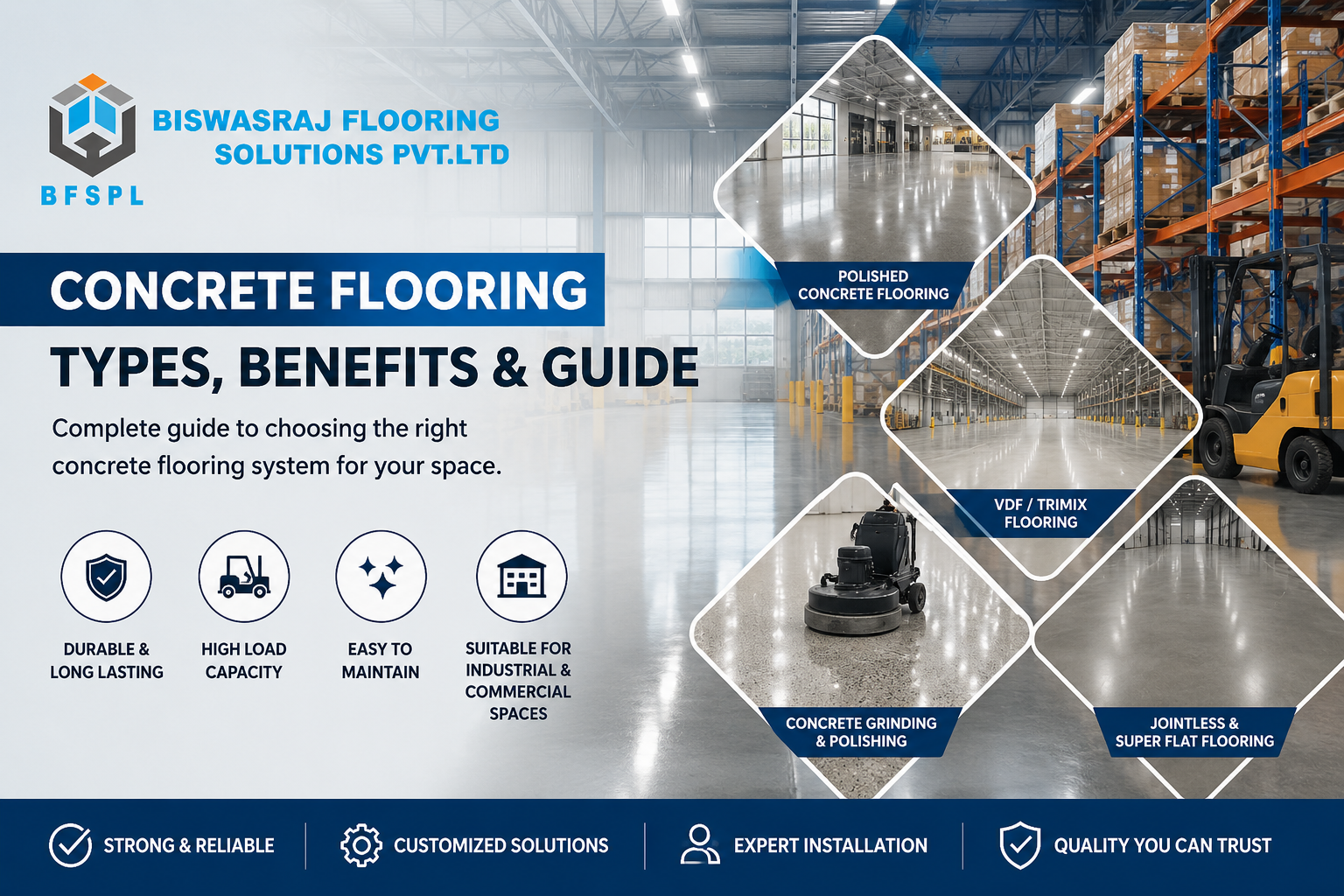
BiswasRaj Flooring lists several concrete-related flooring solutions, including VDF flooring, FM flooring, jointless flooring, super-flat flooring, concrete grinding and polishing, and floor densification and dust-proofing.
What Are the Main Concrete Flooring Types?
The term concrete flooring types covers several systems and finishing methods. The right choice depends on factors such as traffic, loading conditions, required flatness, surface appearance and the operational environment.
VDF or Trimix Flooring
Vacuum Dewatered Flooring, commonly called VDF or Trimix flooring, uses a vacuum dewatering process during concrete floor construction. Removing excess water from the concrete can help produce a denser and stronger surface when the system is properly designed and installed.
It can be considered for warehouses, manufacturing facilities, workshops and other industrial environments where the floor is exposed to substantial traffic and loading.
FM Flooring
FM flooring is associated with controlled floor flatness and levelness requirements. This can be important in facilities where forklifts, storage systems or other equipment need a consistent floor surface.
The appropriate FM classification should be selected according to the project's specific requirements rather than assuming that one specification suits every facility.
Large industrial floors can require careful planning of joints. Jointless flooring systems aim to reduce the number of visible construction joints across suitable floor areas.
The design still needs to account for the concrete's behaviour, structural requirements and construction conditions.
Super-Flat Flooring
Super-flat floors are designed for projects where particularly tight flatness requirements are necessary. Such floors can be useful in specialised industrial environments where equipment or vehicle movement depends on a highly controlled surface.
Polished Concrete Flooring
Polished concrete flooring is created by mechanically grinding and progressively refining an existing concrete surface to achieve the desired finish.
It can provide a smooth and attractive appearance while retaining the underlying concrete floor. Depending on the required finish, the surface can range from a relatively low sheen to a highly polished appearance.
BiswasRaj Flooring provides concrete grinding and polishing services for industrial, commercial and other applications.
How Should You Choose Between Different Concrete Flooring Types?
Choosing between different concrete flooring types requires more than comparing prices per square foot.
Consider the Expected Load
First, determine what the floor will carry. A facility used for heavy machinery or loaded storage requires different considerations from an office or light commercial space.
Consider Traffic
The type and frequency of traffic also matter. Forklifts, pallet trucks, cars and heavy machinery can subject a floor to repeated abrasion and impact.
Check Flatness Requirements
Some warehouses and industrial facilities need controlled flatness and levelness for equipment and material-handling operations.
If a project has strict tolerances, the flooring specification should address these requirements before installation.
Consider the Operating Environment
Moisture, chemicals, oil, temperature changes and cleaning practices can influence the choice of flooring system.
A floor exposed to chemical spills, for example, may require a different surface treatment from one used in a dry warehouse.
Think About Maintenance
The amount of cleaning and maintenance required should also be considered. A flooring system that suits the operational environment can make routine maintenance easier.
What Are the Benefits of Concrete Flooring?
A correctly designed concrete flooring system can offer several practical advantages.
Durability: Concrete can provide a strong base for industrial and commercial activities when properly designed and installed.
Load-bearing capability: It can be engineered for areas exposed to substantial loads and equipment movement.
Versatility: Different systems and finishing methods can be selected depending on project requirements.
Long service potential: Proper preparation, installation, curing and maintenance can contribute to long-term floor performance.
Multiple finish options: Concrete can be finished in practical industrial styles or mechanically ground and polished for a more refined appearance.
How Does Polished Concrete Flooring Differ From a Basic Concrete Surface?
A standard concrete surface and polished concrete flooring are not necessarily the same.
A basic concrete floor may be finished for functional use, while polished concrete involves additional mechanical processing. Diamond grinding progressively refines the surface, and further polishing can create the desired level of smoothness and sheen.
Polishing can also be combined with densification as part of the finishing process. This can help improve surface hardness and reduce dusting.The final appearance depends on the existing slab, grinding depth, aggregate exposure and selected polishing stages.
The final appearance depends on the existing slab, grinding depth, aggregate exposure and selected polishing stages.
It is therefore important to assess the condition of the concrete before deciding that polishing is the appropriate solution. BiswasRaj's recent guide on concrete grinding and polishing also highlights the importance of slab condition, grinding stages and the desired gloss level.
What Factors Affect the Cost of Concrete Flooring?
There is no single price for every concrete flooring project. Several factors influence the overall cost.
These may include:
- Total floor area
- Concrete thickness and specification
- Ground and subgrade condition
- Reinforcement requirements
- Required floor flatness
- Selected flooring system
- Surface finishing requirements
- Existing floor condition
For an existing floor, preparation can be particularly important. Cracks, damaged areas, surface contamination or unevenness may need to be addressed before a finishing system is applied.
Therefore, comparing flooring contractors only by their quoted rate per square foot may not provide a complete picture of the project.
What Should Be Checked Before Installing Concrete Flooring?
Before beginning a project, the contractor should understand how the facility will be used.
Important questions include:
1. What type of vehicles or machinery will operate on the floor?
2. What loads will the floor carry?
3. How much daily traffic is expected?
4. Is a specific flatness tolerance required?
5. Will the surface be exposed to chemicals, oil or moisture?
6. Is the floor being constructed for a new building or renovated?
7. What type of surface finish is required?
8. How frequently will the floor be cleaned and maintained?
Answering these questions helps narrow down the appropriate flooring solution instead of choosing a system simply because it is popular. For additional guidance on concrete floor and slab considerations, you can refer to theAmerican Concrete Institute's guidance on slabs-on-ground.
Concrete Flooring vs Polished Concrete Flooring
Although the terms are sometimes used interchangeably, they describe different aspects of a floor.
The best option depends on the condition of the slab and the requirements of the facility rather than appearance alone.
Why Professional Installation Matters
The performance of a floor depends on much more than the concrete material itself.
Subgrade preparation, concrete placement, levelling, finishing, curing, joint planning and surface treatment can all influence the final result.
For specialised systems, the equipment and installation technique also matter. A poorly executed floor can develop problems even when suitable materials have been selected.
Professional assessment can therefore help determine the correct flooring specification and identify potential problems before installation begins.
Frequently Asked Questions
Is concrete flooring suitable for warehouses?
Yes. Concrete floors can be suitable for warehouses because they can be designed to handle storage loads, vehicle movement and regular industrial traffic. The specific system should be selected according to the warehouse's operational requirements.
What are the most common concrete flooring types?
Common options include VDF or Trimix flooring, FM flooring, jointless flooring, super-flat flooring and polished concrete flooring. The appropriate system depends on the project's requirements.
Is polished concrete flooring durable?
Yes, when the underlying slab is suitable and the grinding, densification and polishing process is properly carried out. It can provide a durable surface for many commercial and industrial applications.
Can an existing concrete floor be polished?
In many cases, yes. The existing slab should first be inspected to determine its condition, surface quality and suitability for grinding and polishing.
How do I choose the right concrete flooring system?
Consider the expected loads, traffic, flatness requirements, operating environment, surface finish, maintenance needs and project budget. A professional flooring assessment can help determine the appropriate system.
Does concrete flooring require regular maintenance?
Yes. Even durable concrete floors benefit from routine cleaning, inspection and timely attention to surface damage. The maintenance requirements depend on the flooring system and operating environment.
Conclusion
Choosing the right concrete flooring system starts with understanding the demands placed on the floor. Warehouses, manufacturing facilities, workshops and commercial spaces can have very different requirements, so there is no universal solution for every project.
From VDF and FM systems to jointless, super-flat and polished concrete flooring, different solutions are available for different applications.
Instead of selecting a floor based only on appearance or initial price, consider load, traffic, flatness, operating conditions, maintenance and expected service requirements.
For industrial and commercial projects, BiswasRaj Flooring can assess the site requirements and help identify a suitable flooring solution based on the intended application.