


Epoxy Flooring Problems: Why Floors Peel, Bubble and Fail
 03 Aug 2026
Epoxy Flooring Problems: Why Floors Peel, Bubble and Fail
- Posted by Sathish K
A new epoxy floor should outlast the machinery standing on it. When it lifts at the edges after eight months, the resin is rarely the culprit.
Almost all epoxy flooring problems trace back to what happened before the first coat went down. A damp slab, a rushed grinding job, or a coating chosen for the wrong duty. Here are the seven causes we see most often on Indian factory and warehouse sites, and what stops each one.
The Short Version
• Slab moisture causes most peeling and blistering, not defective resin
• Surface preparation decides adhesion, so grinding or shot blasting is never optional
• Bubbles usually mean trapped air or vapour, not a bad batch of material
• Most failed floors can be reclaimed without breaking out the slab
What Causes Epoxy Flooring Problems Most Often?
Most epoxy flooring problems come from four sources: moisture rising through the slab, weak or contaminated surface preparation, a coating chosen for the wrong traffic and chemical load, and application outside the product’s temperature window. Genuine material defects are rare by comparison.
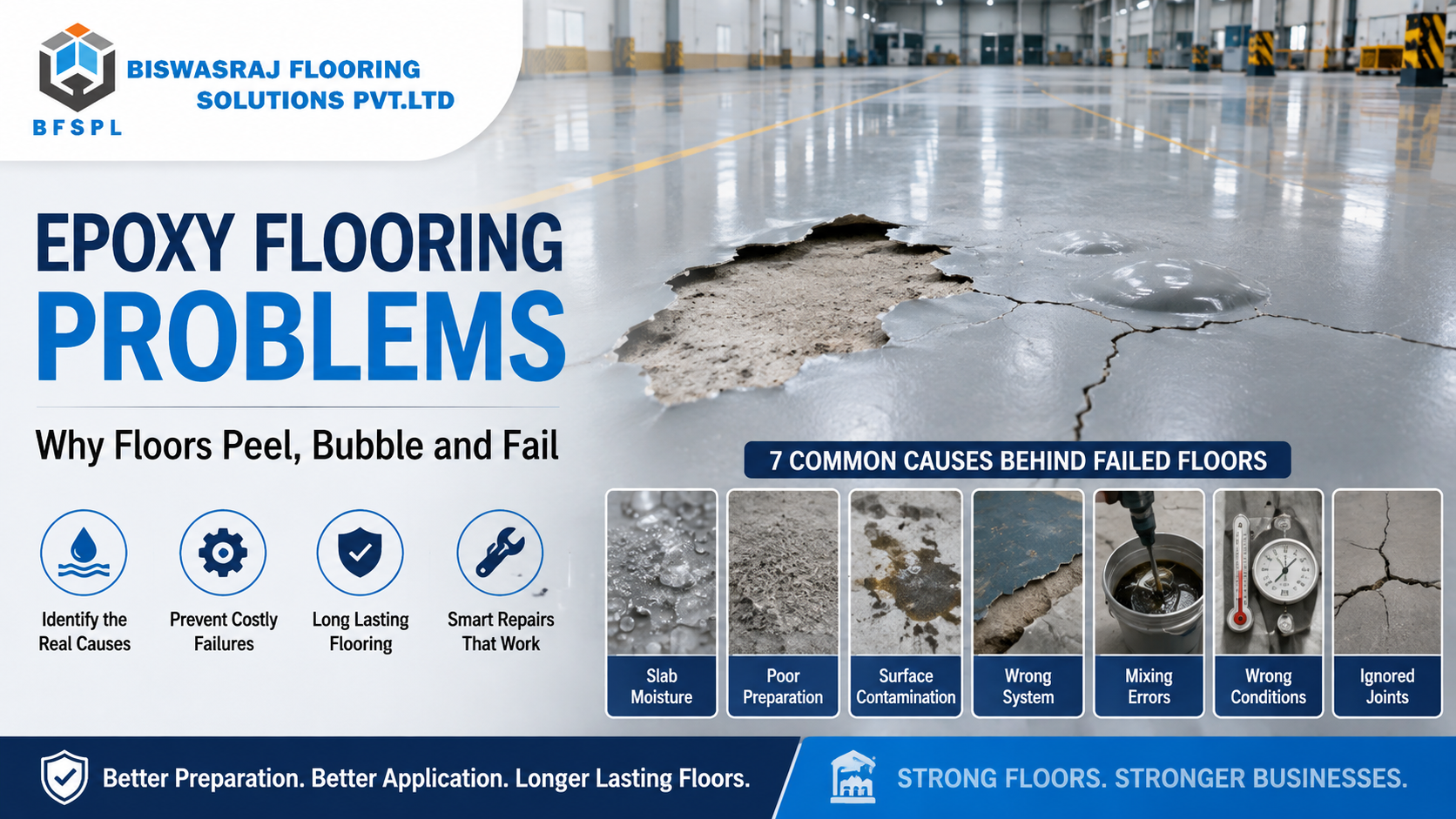
Broken down further, these are the seven causes behind almost every failed floor we are called to inspect:
• Slab moisture. Vapour rising through green or damp concrete breaks the bond from underneath.
• Poor preparation. Laitance, dust and old sealers left in place give the resin nothing to grip.
• Contamination. Oil, grease and chemicals soaked into the concrete block adhesion in patches.
• Wrong system. A thin roller coat under forklift traffic wears through within a season.
• Mixing errors. Off ratio or under mixed resin never cures to full hardness.
• Wrong conditions. Coating applied in high humidity or on a cold slab cures badly.
• Ignored joints. Coating over live joints without treatment tears as the slab moves.
Five of the seven sit in the preparation stage. That is why a good contractor spends more time on the concrete than on the coating.
How Does Slab Moisture Destroy Adhesion?
Slab moisture is the single biggest driver of epoxy flooring problems in India. Water vapour rises through the concrete, collects under the sealed coating, and forces it away from the surface. The floor blisters first, then peels, usually in patches rather than all at once.
This is a documented failure mode, not a trade rumour. ASTM publishes a standard test method for measuring relative humidity inside concrete slabs precisely because excess moisture under a floor covering is a recognised cause of debonding and coating breakdown.
Moisture reaches the underside of a coating in four common ways:
• The slab was coated before it had dried enough, often under project deadline pressure
• No damp proof membrane was laid under the slab during construction
• Ground water rises during monsoon in low lying or basement level units
• The floor was washed down shortly before coating and never fully dried
A new slab needs time. As a working rule, allow at least 28 days of curing before coating, and test rather than assume. On older floors, a plastic sheet taped down overnight will show condensation if vapour is still moving through.
If the slab is permanently damp, and many ground floor units in Mumbai, Kolkata and coastal Gujarat are, the answer is not a thicker coat. It is a moisture tolerant primer or a damp proof epoxy membrane laid before the build coats, which gives the vapour somewhere to go instead of pushing against the finish.
Why Does Surface Preparation Decide Whether The Coating Holds?
Preparation creates the mechanical key that epoxy needs. Fresh concrete carries a weak, dusty layer called laitance on top, and resin bonded to that layer takes the layer with it when it fails. Mechanical preparation removes it and opens the pores.
Two methods work on industrial floors. Shot blasting is faster over large open areas and leaves an aggressive profile. Diamond grinding is more controlled, better in occupied units, and the same equipment used for concrete grinding and polishing does the job cleanly with dust extraction.
Acid etching is still sold as a shortcut in India. It softens the surface without removing enough laitance, and it leaves salts behind that interfere with the primer. Skip it on any floor that will carry real traffic.
Preparation is also the stage where epoxy flooring problems are cheapest to prevent. Grinding a bay twice costs a fraction of stripping a failed coating and rebuilding it eight months later, with production stopped while you do it.
|
Preparation method |
Suits |
Speed over 5,000 sq ft |
Risk if skipped |
|
Shot blasting |
Large open bays, new slabs |
Fast |
Coating lifts in wide sheets |
|
Diamond grinding |
Occupied units, smaller bays, patch repairs |
Moderate |
Weak bond at edges and corners |
|
Acid etching |
Not recommended for industrial duty |
Fast but shallow |
Salt residue, early delamination |
|
No preparation |
Nothing |
Immediate |
Failure within months, guaranteed |
What Do The Common Failure Types Actually Look Like?
Reading the symptom tells you the cause, and the cause decides the repair. These six patterns cover the epoxy flooring problems reported on almost every site, from a godown floor in Bhiwandi to a pharma unit in Baddi.
|
What you see |
Likely cause |
Usual remedy |
|
Peeling in sheets or strips |
Laitance left on, or slab moisture |
Strip back, prepare properly, recoat |
|
Small blisters and bubbles |
Trapped air or vapour under the film |
Grind out affected zones, prime, patch |
|
Chalky powder on the surface |
Under cured resin or wrong mix ratio |
Remove the weak layer, apply fresh coats |
|
Cracks copying the slab below |
Live slab cracks or untreated joints |
Route and fill the crack, then recoat |
|
Soft or tacky patches |
Off ratio mixing, or moisture during cure |
Remove the soft area, recoat that bay |
|
Yellowing near skylights |
UV exposure on a standard epoxy |
Overcoat with a UV stable topcoat |
Yellowing is the one cosmetic entry on that list. The other five are adhesion or cure faults, and they spread if you leave them.
Speed matters here. A blister left alone gets crushed by a forklift wheel, water enters the break, and a patch repair turns into a bay repair. Marking and treating defects within a few weeks of spotting them keeps the cost in the low thousands rather than the lakhs.
Can A Failed Floor Be Repaired Or Must It Be Replaced?
In most cases, repair. Full replacement is only needed when the slab underneath has structurally failed. If the concrete is sound and only the coating has let go, an epoxy floor repair removes the failed film, corrects the cause, and rebuilds the system in the affected bays.
A sensible sequence looks like this:
• Map the failure with a tap test and mark every hollow or drummy area
• Test the slab for moisture before deciding on the replacement coating
• Strip the failed film mechanically, never with solvent alone
• Repair cracks, joints and spalls as part of the same visit
Where large sections have gone, a full floor repair and refurbishment is usually cheaper than a new slab, and it can often be phased bay by bay so production keeps running.
Replacement genuinely earns its cost in three situations: the slab is cracked through and rocking under load, the floor level has to change for new racking or machinery, or the concrete is so contaminated with oil that no coating will bond to it. Outside those three, repair is the rational call.
How Do You Prevent Epoxy Flooring Problems Before The First Coat?
Prevention is a specification exercise, not a site decision. Nearly every case of epoxy floor failure we investigate could have been avoided by checks made before anyone opened a tin. Write these six into the tender and most epoxy flooring problems never start.
1. Test slab moisture. Insist on a documented reading, not an opinion from the applicator.
2. Specify the preparation method. Name shot blasting or diamond grinding, and state the profile expected.
3. Match the system to the duty. A packing hall and an acid dosing area need different builds and thicknesses.
4. Set the site conditions. Agree the temperature and humidity limits for application, and stop work outside them.
5. Treat the joints. Decide in advance which joints stay live and how they will be detailed.
6. Hold a wet film check. Measure thickness during application rather than arguing about it afterwards.
Any competent contractor will welcome these clauses. Our own epoxy flooring service starts with a site visit that checks the slab, the moisture content and the chemical exposure before a system is proposed, because a quote written without that information is a guess.
Frequently Asked Questions
Why Is My Epoxy Floor Peeling After Less Than A Year?
Early peeling almost always means the bond failed, not the resin. The usual causes are slab moisture, laitance left on the concrete, or contamination that was never removed before priming.
How Long Should An Industrial Epoxy Floor Last?
A properly prepared industrial epoxy floor lasts eight to ten years or more under normal traffic. Thickness, preparation quality and the chemical load it faces decide where it lands in that range.
Do Bubbles Mean The Whole Floor Must Be Redone?
No, isolated blisters can be ground out, primed and patched. Widespread bubbling across several bays usually points to a slab moisture issue that has to be fixed before any recoating.
Can Epoxy Be Applied Over An Old Cracked Slab?
Yes, in most cases: cracks are routed and filled, spalls are repaired, and the surface is ground before coating. A structurally failed slab needs civil repair first.
How Do I Know If My Slab Is Too Wet To Coat?
Tape a one metre square plastic sheet to the floor overnight, and condensation underneath means vapour is still moving. For a real number, ask for an in situ relative humidity test.
Does Repairing A Failed Floor Cost More Than A New One?
Rarely. Repairing epoxy flooring problems in the affected bays costs a fraction of demolishing and recasting a slab, and it can be phased so the unit keeps operating.
Where Do You Go From Here?
Walk your floor this week and tap it with a steel rod, marking every hollow spot with chalk. If more than a few bays sound drummy, the cause sits under the coating, and recoating alone will not hold it.
Send us the photos and your slab details. Our team will assess the epoxy flooring problems on your site and quote a phased fix, starting with a free site visit and quotation.