


How Concrete Grinding and Polishing Creates a Dust-Free Shine
 12 Aug 2026
How Concrete Grinding and Polishing Creates a Dust-Free Shine
- Posted by Sathish K
A dull, dusty concrete floor drags down a warehouse, showroom or home, no matter how good the layout is.
Concrete grinding and polishing fixes that without tearing out the slab. Diamond tools grind, refine and polish the existing surface into a smooth, reflective floor that resists stains, dust and years of heavy traffic.
This guide covers the process, the gloss levels on offer, real costs in India and how to pick the right contractor, whether you run a factory floor or are renovating a home.
At A Glance
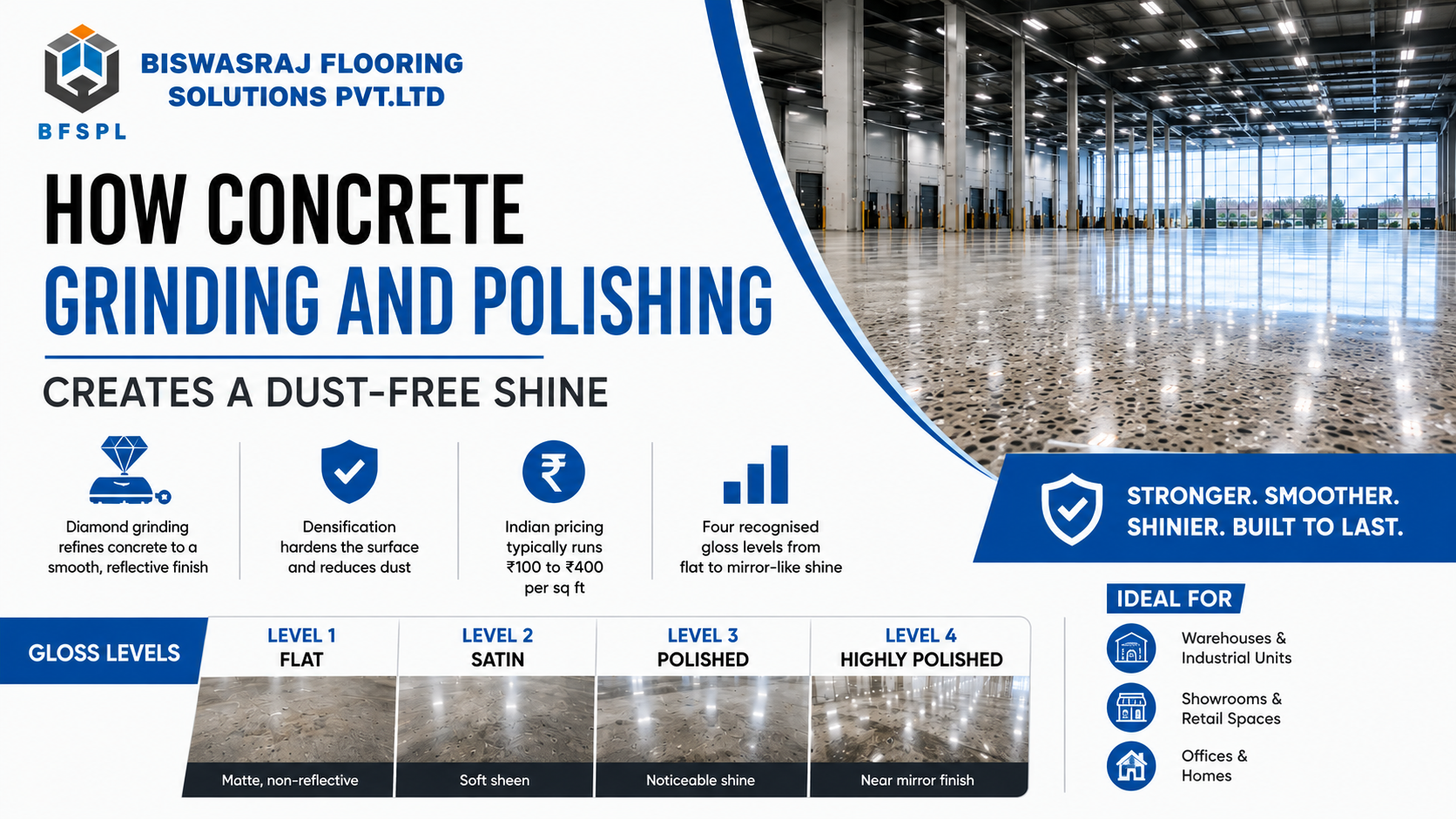
• Diamond grinding progressively refines concrete to a smooth, reflective finish without replacing the slab
• Densification during grinding hardens the surface and cuts down on dust
• Indian pricing typically runs 100 to 400 rupees per square foot depending on the finish
• Four recognised gloss levels range from a flat look to a mirror-like shine
• Suited to warehouses, showrooms, offices and homes alike
What Is Concrete Grinding And Polishing?
This process starts with coarse diamond grinding that removes the worn top layer of an existing slab, then moves through progressively finer grits that flatten and refine the surface. A chemical densifier is applied partway through to harden the concrete and close its surface pores.
BiswasRaj Flooring provides concrete grinding and polishing services for industrial plants, warehouses, showrooms and homes across India, using diamond equipment paired with an integrated dust suppression system on every site.
The finished look depends on how deep the grinding goes. A shallow cut leaves a smooth cream finish, while a deeper cut exposes sand or coarse aggregate for a more textured, natural stone look.
Choosing between these exposure levels is usually an aesthetic decision made during the site visit, based on the look you want and how the space will be lit.
Because the wearing surface is the original slab, there is no overlay to lift, crack or peel over time, which is why the technique suits both new industrial pours and older floors that have never been finished. Typical settings we work in include:
• Showrooms, retail stores and commercial office spaces
• Warehouses and manufacturing units that want a durable, low dust floor
• Hospitality spaces including hotels, restaurants and lobbies
• Residential homes, apartments and villas wanting a modern concrete look
• Educational institutions, healthcare facilities and automotive showrooms
Ask any contractor for photographs of a similar project, the grit sequence they plan to use and whether densification is included as standard. Those three answers tell you more about the likely finish than a quoted price on its own.
What Are The Benefits Of Polishing A Concrete Floor?
The biggest advantage of concrete grinding and polishing is durability. Because the process densifies the slab as it grinds, the finished floor resists abrasion, staining and dusting far longer than a coated or tiled surface, even under constant forklift and foot traffic.
• Transforms a dull, worn slab into a shiny, reflective surface without a full floor replacement
• Densifies and seals the concrete during grinding, improving durability and abrasion resistance
• Costs meaningfully less than granite, marble or vitrified tile over the life of the floor
• Improves light reflectivity, which helps visibility in warehouses and industrial units
• Cuts down on concrete dusting, so floors stay cleaner with less sweeping
• Needs little recoating compared with painted or epoxy coated finishes
• Comes in a range of finishes, from matte to high gloss, to suit the space
These gains matter most in facilities that already invest heavily in flooring performance. Our guide to industrial flooring services in India covers how polished concrete compares with other heavy duty flooring systems used in warehouses and factories.
Dust is a bigger issue in Indian plants than many facility managers expect, since untreated concrete keeps shedding fine particles under tyre and foot traffic long after a floor is poured. Densifying the surface during grinding closes those pores at the source, rather than masking the problem with a topical coating that eventually wears through.
Over a ten year horizon, the total cost of ownership usually favours polished concrete over tile or coated finishes, since there is no grout to replace and no recoating cycle to budget for. The upfront cost per square foot may sit close to a mid-range epoxy system, but the maintenance bill afterward is consistently lower.
What Gloss Levels Can You Choose For Polished Concrete?
Concrete grinding and polishing can be finished at several recognised gloss levels, so you can specify anything from a flat, low sheen look to a mirror-like shine depending on how the space is used and how much reflection you want.
|
Gloss Level |
Look |
Best For |
|
Flat (Level 1) |
Matte, non-reflective |
Warehouses wanting a practical, low sheen floor |
|
Satin (Level 2) |
Soft sheen, gentle reflection |
Offices and light industrial units |
|
Polished (Level 3) |
Clear reflections, noticeable shine |
Showrooms and retail spaces |
|
Highly Polished (Level 4) |
Near mirror finish |
Lobbies, automotive showrooms and feature areas |
The Concrete Polishing Council’s appearance chart sets out these four gloss levels using standard image clarity and haze measurements, giving contractors and clients a shared way to specify the finish before work starts.
Reaching a higher gloss level simply means running more grit stages, from a coarse metal bonded diamond through to fine resin bonded pads. There is no extra material cost involved, only additional machine time, which is one reason gloss level has a direct effect on the final quote.
How Much Does Concrete Floor Polishing Cost In India?
So how much does concrete floor polishing cost in India? Pricing for concrete grinding and polishing typically runs between 100 and 400 rupees per square foot, depending on the existing slab condition, the floor area and the gloss level you choose.
|
Factor |
Typical Effect |
Why It Matters |
|
Slab condition |
Adds 20 to 50 rupees per sq ft |
Cracks and old coatings need extra prep work |
|
Floor area |
Lower rate above 10,000 sq ft |
Larger jobs use bigger equipment efficiently |
|
Gloss level |
Higher grit stages cost more |
Level 4 finishes need more polishing passes |
|
Densification |
Usually included in the quote |
Adds hardness and dust resistance |
A free site visit is the only reliable way to get an accurate number, since slab thickness, existing coatings and site access all affect the labour and equipment time a project needs.
Ask any quote to spell out what is included: crack repair, densification, edge work along walls and columns, and dust disposal are sometimes billed separately by smaller contractors. A single, itemised quote makes it far easier to compare two proposals fairly, rather than comparing a bare per-square-foot number that hides the extras.
Is Polished Concrete Better Than Epoxy Flooring For Your Space?
Polished concrete suits spaces that want a permanent, low maintenance surface with minimal recoating, while epoxy flooring suits floors that need colour, chemical resistance or a seamless coating over a damaged slab.
|
Consideration |
Polished Concrete |
Epoxy Flooring |
|
Best for |
Sound slabs wanting a permanent finish |
Damaged, stained or oil exposed slabs |
|
Maintenance |
Damp mopping, no recoating needed |
Periodic recoating as the topcoat wears |
|
Colour options |
Limited to the slab’s natural tone |
Wide range of colours and flake patterns |
|
Chemical resistance |
Good, but lower than a resin coating |
Very high, suited to acid and oil spills |
If your existing concrete has heavy staining, deep cracks or oil exposure, our epoxy flooring systems may be the better starting point, since a coating can bridge surface damage that grinding alone cannot fully remove. Many facilities managers use both across one site, choosing whichever finish fits each zone’s traffic and chemical exposure.
How Do You Grind And Polish A Concrete Floor?
Getting a durable result from concrete grinding and polishing depends on following every grit stage in order. Skipping a step leaves scratch marks that the final polish stage cannot hide, no matter how long you buff it.
Crews use planetary or dual head grinders fitted with metal bonded diamonds for the early cuts, then switch to resin bonded pads once the surface is flat enough for honing. Each grit removes the scratch pattern left by the one before it, which is why the sequence matters more than any single tool.
1. Site assessment: inspect the slab and confirm the gloss level and traffic exposure
2. Surface preparation: strip existing coatings, sealers or contaminants that would block grinding
3. Coarse grinding: remove the top layer and correct minor surface irregularities
4. Crack and joint filling: fill cracks and joints for a continuous, seamless look
5. Progressive fine grinding: work through finer diamond grits to refine the surface
6. Densification: apply a chemical hardener, the same treatment used in our floor densification and dust proofing service on its own
7. Polishing: run additional grit stages until the target gloss level is reached
8. Final inspection: check consistency and gloss before handover
Frequently Asked Questions
What is concrete grinding and polishing?
It is a multi-stage diamond grinding process that removes the top layer of an existing concrete floor, then polishes it in stages to a smooth, glossy finish that resists stains and everyday wear.
How long does it take to grind and polish a warehouse floor?
Timelines depend on the floor area, slab condition and the number of grinding stages needed. Most mid-size warehouse floors are finished within a week after the site assessment.
Can you polish concrete floors inside homes and apartments?
Yes. Concrete grinding and polishing works well in homes and apartments, giving a modern, low maintenance surface that costs less than natural stone or vitrified tile.
Does polished concrete need sealing or resealing?
The densifier used during grinding seals the surface chemically, so no separate coating is applied. Very high traffic areas may benefit from occasional resealing every few years.
Is the process noisy or dusty for nearby work areas?
Modern diamond grinders run with an integrated dust suppression system, so airborne dust stays low. Some noise is unavoidable during the coarse grinding stage of the work.
What is the difference between grinding and honing concrete?
Grinding uses coarser diamonds to cut and level the surface and remove old coatings. Honing and polishing then use progressively finer grits to refine gloss and image clarity.
How Do You Get Started?
If you are comparing quotes, choosing an experienced concrete grinding and polishing contractor in India makes the biggest difference to how the finished floor performs. Book a free site visit and we will assess your slab and share an accurate quote.