


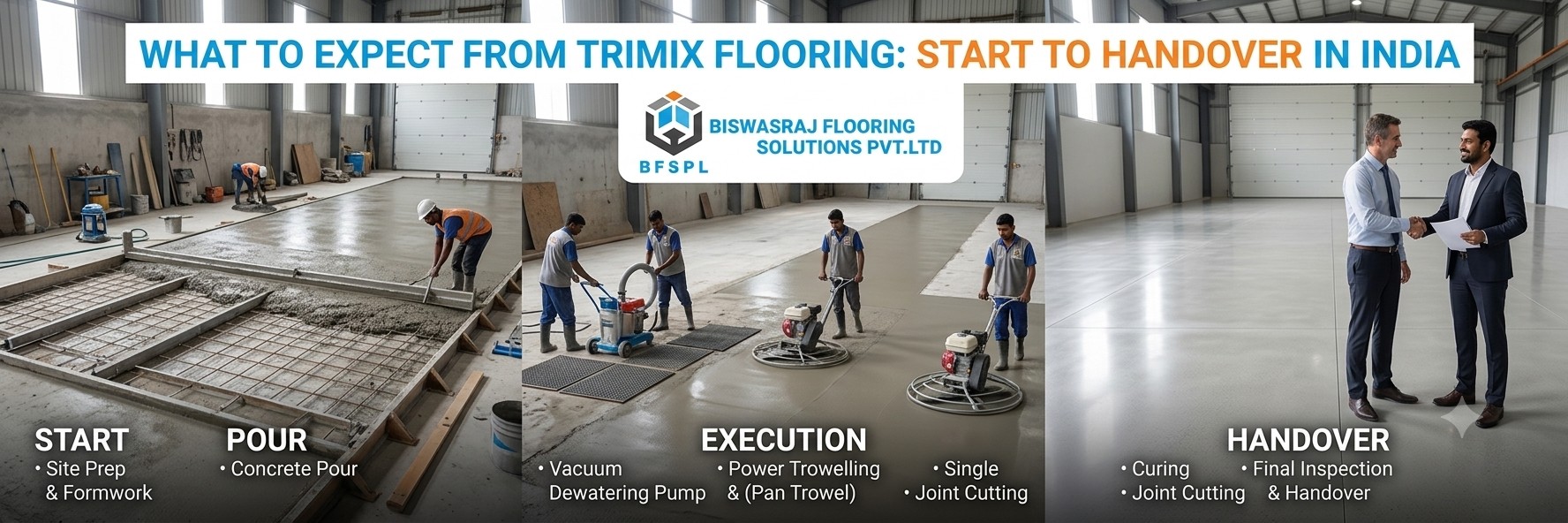
What To Expect from Trimix Flooring, Start to Handover
This guide explains what to expect from trimix flooring, from site survey and sub-base preparation to concrete placement, vacuum dewatering, joint cutting, curing, and final handover. Learn how to compare quotations, evaluate trimix flooring contractors, specify concrete grade and thickness, prevent common flooring defects, and ensure your warehouse floor meets operational requirements.
- Trimix and VDF Flooring
- oth terms refer to the vacuum dewatering method used on freshly placed concrete.
- Six Essential Phases
- A complete project includes site survey, sub-base preparation, concrete placement, dewatering and floating, curing and joint cutting, and handover inspection.
- 3. Load-Based Specifications
- Slab thickness, concrete grade, and reinforcement should be selected according to forklift wheel loads, rack loads, and sub-base conditions.
- Curing Prevents Defects
- Proper curing helps reduce surface crazing and shrinkage-related problems.
- Joint Cutting Matters
- Correct joint layout and timely cutting help control random cracking.
Most trimix floors fail on paperwork long before they fail on site. The vacuum pump gets the credit, but the scope, the mix, the joints and the curing plan decide whether a slab stays tight for years.
This guide explains what trimix flooring delivers from survey to handover, what to write into a quotation, and how to compare bids from different crews. It is written for plant heads, project managers, and warehouse owners who sign the work order.
The Short Version
Trimix and VDF describe the same vacuum dewatering method on fresh concrete.
A good scope covers survey, mix, joints, curing and handover tests.
Compare quotations line by line: thickness, grade, curing and joints.
Late joint cutting and short curing cause most cracking.
What Is Concrete Trimix and Why Do Warehouses Use It?
Trimix flooring is a concrete floor method in which a workable mix is placed, vibrated, and then dewatered under vacuum mats before it sets. The concrete trimix loses its surplus water, which leaves a denser surface for wheel loads and abrasion.
According to an American Concrete Institute abstract on vacuum-dewatered concrete, the process lowers the water content of a fresh slab by 15 to 25 percent. It also raises density and strength while reducing absorption, abrasion, and shrinkage.
That surface layer carries every forklift wheel and dragged pallet, so a tighter, harder top is where the practical gain shows. Dusting falls and wear slows, which cuts cleaning effort and repair visits.
Three machines give the method its name: a screed vibrator, a vacuum pump with mats, and a power float. In Indian tenders the same job is written as VDF, short for vacuum dewatered flooring, or simply as trimix, and the two names are used interchangeably.
What Do Trimix Flooring Services Include from Survey to Handover?
Complete trimix flooring services cover six phases: site survey, sub-base preparation, concrete placement with vacuum dewatering, curing and joint cutting, power floating, and handover inspection. Ask each phase to appear as a separate line in the quotation.
Our vacuum dewatered flooring service page lists the industries we serve and the process we follow on site. The table below turns that process into questions you can put to any bidder.
Phase | What the crew does | What to ask for |
Survey | Reviews load, levels, access and concrete supply | A written load assumption and pour plan |
Sub-base | Compacts and tests the base before shuttering | Compaction test results |
Placement | Pours, vibrates and strikes off in planned bays | Bay layout and pour sequence |
Dewatering and floating | Runs vacuum mats, then power floats and trowels | Dewatering time recorded for each bay |
Curing and joints | Keeps the slab moist and cuts control joints | Named method, number of days, cutting time |
Handover | Checks finish and surface quality before signing off | An agreed test and a remedy for failed bays |
Missing lines are where cost is quietly saved. A quotation that jumps from “supply and lay” to a single rate per square foot hides every row in that table.
What Should the Concrete Trimix Specification Say?
It should state slab thickness, concrete grade, reinforcement, dewatering method, joint layout and curing, all tied to your wheel loads and rack loads. A floor specified from assumptions instead of loads is a common source of disputes after handover.
Loads: forklift wheel loads, rack leg loads and static machinery loads, taken from the equipment supplier.
Thickness and grade: designed against those loads and the sub-base, not copied from a previous job.
Reinforcement: mesh or fibers, where the design calls for them.
Joint layout: drawn on a plan, with a stated cutting time after finishing.
Curing: the method, the duration and the person responsible.
Treat thickness as a design output, not a bidding variable. When two quotations differ, check thickness and grade first, because that gap usually explains the price difference.
The mix must also arrive consistently. Ask for continuous supply across the pour, because a stalled delivery leaves a weak seam that no finishing technique can hide.
Our eight step process guide walks through the pour sequence in more detail, including how long the vacuum stage runs for each slab thickness.
Which Jobs Suit A Trimix Floor, And Which Need Something Else?
Trimix flooring suits warehouses, workshops, plant floors, loading yards and parking decks where wear resistance and low dusting matter most. It does not suit existing slabs, and it does not replace a flatness class for tall racking.
Situation | Better fit | Why |
New ground slab with forklifts and pallet trucks | Trimix or VDF | Dense, hard surface at a sensible cost |
Very wide pours with a regular plan | Truss screed | Rail guided truss levels wide bays in continuous passes |
Tall racking with a defined flatness class | Laser screed or a flatness specification | Flatness is measured separately from density |
Existing worn slab | Grinding, densifier or coating | The vacuum only works on fresh concrete |
For very wide pours with a regular layout, compare the method with truss screed flooring. Many projects combine two methods, so ask the contractor to explain why one was chosen over the other for your building.
How Do You Choose Between Trimix Flooring Contractors?
Compare trimix flooring contractors on method and evidence, not on rate per square foot alone. Seven checks separate from a crew that has run the full sequence many times from one that only owns a power float.
Equipment on site: a working vacuum pump, filter cloth and mats, shown before the first pour.
Crew capacity: enough hands to float and trowel each bay inside the finishing window.
Dewatering record: time and extracted water noted for every bay.
Joint plan: control joints drawn, with a stated cutting time.
Curing commitment: method and number of days written into the quotation.
References: floors three or four years old that you can visit.
Handover test: an agreed check and a remedy for any failed bay.
When you visit a reference floor, look at the joints and the high traffic lanes first. Dust, chipped edges and random cracks show up there before anywhere else.
Put every bid onto the same lines before you compare rates, as explained in our guide to how VDF and Trimix quotations are compared.
Be careful with the listed prices. Public directory listings for trimix work show rates from single digits to well past ninety rupees per square foot, which only makes sense if they describe different scopes.
Why Do Trimix Floors Fail, And Who Can Prevent It?
Most trimix flooring failures trace to late finishing, short curing, late joint cutting or a weak sub-base, and the crew and the specification control all four. A dewatered slab still needs careful curing, because early strength does not remove shrinkage risk.
Defect | Usual cause | Prevention |
Random cracking | Late joint cutting, short curing, weak sub-base | Drawn joint plan, named curing, tested base |
Surface dusting | Weak surface paste, late or poor finishing | Timely floating and troweling, plus a densifier where needed |
Crazing | Rapid surface drying | Prompt covering or wet curing |
Uneven finish | Stalled pour, inconsistent concrete supply | Continuous supply and a planned bay sequence |
Chipped joints | Poorly detailed joints | Joints detailed for traffic and sealed |
In hot weather, start curing as soon as the surface allows, because rapid drying of the top layer invites crazing and shrinkage cracks.
Write responsibility down before the pour. The contractor owns dewatering, finishing and joint cutting, while the client supplies accurate load information and clear site access.
How Do You Brief a Contractor Before Pour Day?
Send one written brief with loads, area, thickness, grade, joint plan and curing duration, then ask every bidder to price against it. Identical briefs make bids comparable and show who has actually read your drawings.
Collect the loads. Get wheels, racks, and machinery loads from the equipment suppliers.
Fix the area and levels. Share drawings, finished floor levels, and the pour sequence you expect.
Set thickness and grades. Have the design checked against the loads and the sub-base.
Define curing and joints. Name the method, the number of days, and the cutting time.
Agree for the test. Decide what is measured at handover and who pays if a bay fails.
Bidders who ask questions about loads and concrete supply are usually the ones who have run the sequence before. Share the brief at a site visit where possible. Walking the pour area surfaces, access, drainage and concrete supply issues that drawings often hide
Where Do You Go from Here?
Start with your loads and a clear scope, then ask for a site visit before anyone quotes a rate. If you want trimix flooring that is specified, dewatered and cured to a written plan, book a free site visit and quote and our team will walk the pour area with you.
Serving India and nearby: Kumaraswamy Layout, Bangalore, Kakrola, Dwaraka, Sonal Niwas Sawardari, Pune.
- 15–25% Reduction in concrete water content Concrete Institute (ACI), Vacuum-Dewatered Concrete, 1981.
- 533.1 Million Sq. ft. of warehousing stock in India JLL India, February 2025.
- 22% Annual growth in Grade A warehousing JLL India, January 2025.
- 63% Grade A share of warehouse transactions Knight Frank India, H1 2025.
Frequently asked questions
Is A Trimix Floor the Same as A VDF Floor?
Yes. Trimix and vacuum dewatered flooring (VDF) name the same vacuum method, and Indian tenders and quotations use both words for one job.
How Much Does Concrete Trimix Cost Per Square Foot?
Rates vary with area, slab thickness, concrete grade, curing and site access, so a single figure misleads. Get an itemized quotation after a site visit instead of relying on listed prices.
Can It Be Laid Over an Existing Slab?
No. The vacuum only works on freshly placed concrete, so an old slab needs grinding, a densifier, an overlay or a coating instead.
How Soon Can Forklifts Use the New Floor?
Early strength gain is faster than conventional concrete, but timing still depends on thickness, mix, and curing. Ask the contractor to state the loading date in writing.