


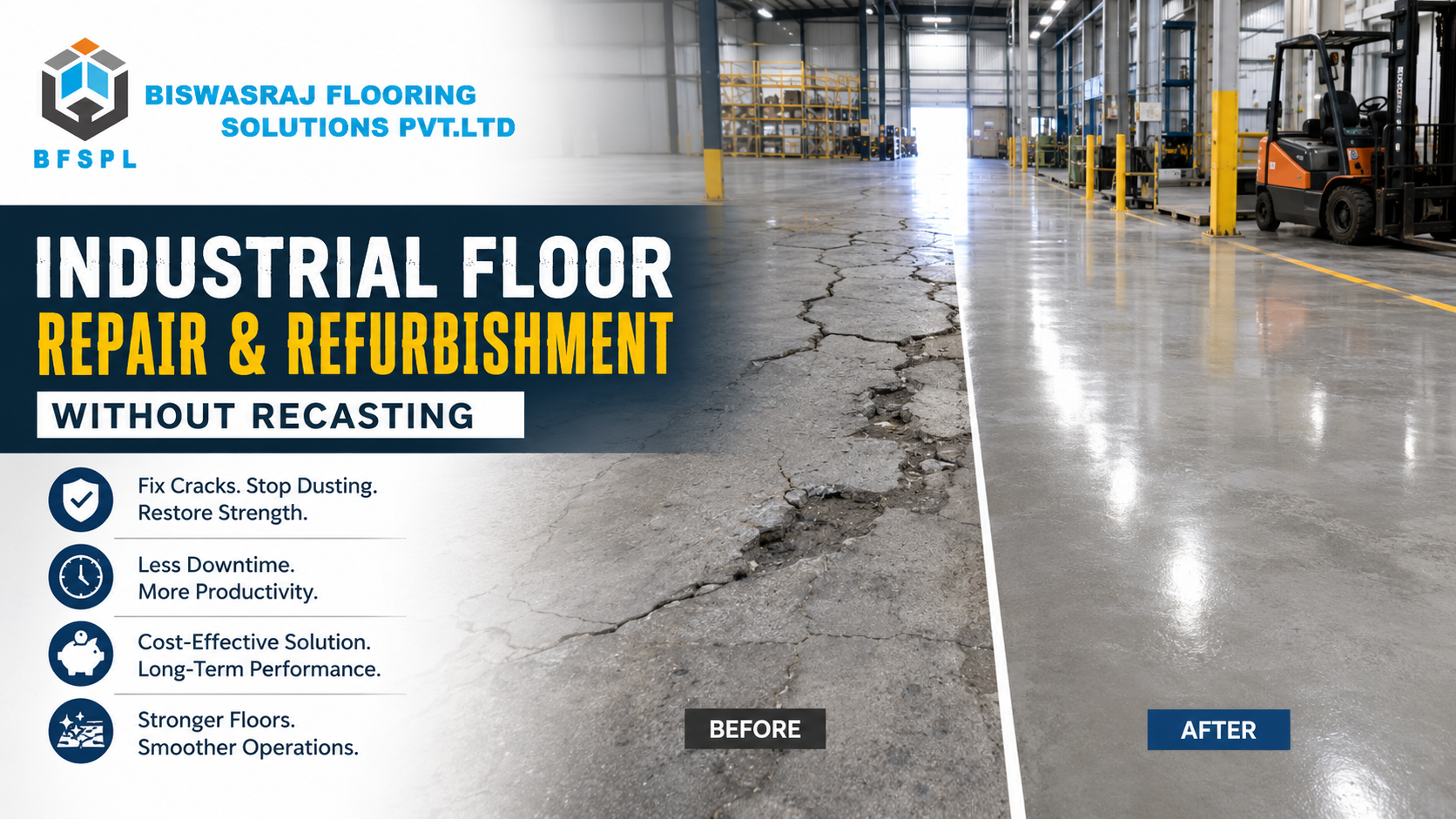
Industrial Floor Repair and Refurbishment
Without Recasting
 30 Jul 2026
Industrial Floor Repair and Refurbishment
Without Recasting
- Posted by Sathish K
A cracked, dusting factory floor rarely needs to be broken out and poured again. In most Indian plants and warehouses the slab below is still sound, and only the top few millimetres have failed.
That is the case for industrial floor repair. Done properly it saves the slab, cuts shutdown from weeks to days, and gives you back a surface that takes forklift traffic.
The Short Version
• Most cracked, dusting or spalled slabs can be saved without demolition
• Repair starts with finding the cause, not filling the crack
• Joint damage, potholes and dusting each need a different method
• Downtime is usually days per bay rather than weeks
• Recast only when the sub-base or the slab structure has failed
What Is Industrial Floor Repair And Refurbishment?
Industrial floor repair is the targeted restoration of a damaged concrete slab through crack stitching, joint edge rebuilding, patching, grinding and resealing. Refurbishment goes wider, treating the whole surface so an old floor performs like a new one, with the original concrete left in place.
The difference matters when you brief a contractor. A repair is a set of local interventions on defined areas. A refurbishment is a planned programme across a full bay or building.
• Repair: individual cracks, potholes, damaged joint arrises, isolated soft patches
• Refurbishment: full surface grinding, densifying, joint reinstatement and resealing
• Overlay: a new bonded topping where the surface is too worn to grind back
Most plants need a mix of all three. A good survey tells you which square metres fall into which bucket, so you are not paying overlay rates for a floor that only needs grinding.
It also protects you at tender stage. When a scope is written as areas and methods rather than as one lump sum, two contractors are finally quoting for the same work and the prices become comparable.
Which Floor Problems Can Be Fixed Without Recasting?
Almost all surface and joint defects can. Cracks, spalled joint edges, potholes, dusting, worn patches and minor unevenness all respond to industrial floor repair while the slab stays exactly where it is. The exceptions are failures that begin below the concrete.
|
Symptom you see |
Usual cause |
Typical fix |
Floor out of use |
|
Fine grey powder on stock and machines |
Weak, porous surface paste |
Grinding plus a chemical densifier |
1 to 2 days per bay |
|
Chipped, crumbling joint edges |
Forklift impact on unprotected arrises |
Cut back, epoxy mortar rebuild, resealing |
1 day per 40 to 60 running metres |
|
Random cracks across panels |
Shrinkage, thermal movement or overloading |
Resin injection or stitching with bars |
1 to 2 days |
|
Potholes and blown patches |
Delamination or point impact |
Saw cut, break out, rapid set patch mortar |
Same day to 24 hours |
|
Dull, scratched, stained surface |
Years of abrasion and spillage |
Diamond grinding and polishing |
2 to 4 days per bay |
Timings assume a working area is handed over clean and empty. Racking that has to be dismantled and reset is normally the longest single item on a repair programme, not the concrete work itself.
Why Does Finding The Cause Matter More Than Filling The Crack?
Because a crack is a symptom, not the fault. The American Concrete Institute repair guide states plainly that cracking can result from drying shrinkage, thermal cycling, overloading, corrosion of embedded steel or inadequate design. Industrial floor repair that skips diagnosis usually reopens.
Two cracks that look identical can need opposite treatments. A dormant shrinkage crack wants a rigid resin that welds the panel back together. A crack that still moves with temperature wants a flexible sealant and, often, a proper joint cut alongside it.
So a survey should establish four things before anyone mixes material:
• Whether the crack is still moving, checked over days rather than minutes
• Whether the slab sounds hollow, which points to delamination or a soft base
• What loads and traffic the floor actually carries today, not what it was designed for
• Whether water, oil or chemicals are reaching the concrete from above or below
None of this needs expensive instrumentation on a normal warehouse. A tape measure, a chain drag, a crack gauge left in place for a week and an honest conversation with the shift supervisor will settle most cases.
How Do You Repair A Cracked Slab Without Recasting?
Industrial floor repair follows the same sequence on almost every site, whether you are fixing ten metres of joint or refurbishing a whole warehouse. The steps below are the ones a competent contractor should walk you through before quoting.
1. Survey and mark up. Record every defect on a floor plan, test suspect areas for hollowness, and agree what is in scope.
2. Establish the cause. Separate moving cracks from dormant ones and check the sub-base where the slab sounds hollow.
3. Prepare the substrate. Saw cut, break out unsound concrete back to a sound edge, then grind or shot blast to give the repair material a key.
4. Prime and place. Apply the primer, then a resin, polymer mortar or micro concrete chosen for the load and the cure time you can afford.
5. Reinstate joints. Rebuild damaged arrises, reinstate the saw cut where it was lost, and reseal with the right hardness of sealant.
6. Grind flush. Bring the repair back level with the surrounding slab so wheels do not hit a lip.
7. Densify and seal. Treat the wider surface to reduce dusting and lock in abrasion resistance.
Rapid set materials let most bays reopen to traffic the same day or the next morning. That is the single biggest practical difference between repairing and recasting.
What Drives The Cost Of An Industrial Floor Refurbishment?
Area is the obvious driver, but it is rarely the one that moves the number most. Access, condition and the cure time you can allow usually decide whether a project runs at the cheap end or the expensive end of any quotation you receive.
• Defect density. Ten cracks in 1,000 square metres is a different job from a hundred.
• Material choice. Rapid set epoxy mortars cost more per kilogram but buy back production hours.
• Access windows. Night and weekend working, or short shutdown slots, add mobilisation cost.
• Racking and stock. Emptying and resetting racking is often the largest line item.
• Finish specification. A dust proofed floor and a polished floor are different scopes.
As a rule, a concrete floor repair programme runs at a fraction of the cost of demolishing and recasting the same area. It also avoids the lost production that a recast forces on you.
Ask any contractor to price the repair option and the recast option side by side, with downtime costed in both. The comparison is then visible rather than assumed.
When Should You Recast Instead Of Repair?
Recasting earns its cost when the problem is structural rather than superficial. If the sub-base has settled, if panels rock under load, or if reinforcement is corroding through the depth of the slab, industrial floor repair only buys time. The table below sets out the honest split.
|
Condition |
Repair works |
Recast is better |
|
Damage limited to the top layer |
Yes |
No |
|
Slab sounds solid when tapped |
Yes |
No |
|
Panels move or rock under a loaded truck |
No |
Yes |
|
Sub-base washed out or settled |
No |
Yes |
|
Widespread corrosion of reinforcement |
No |
Yes |
|
Floor level has to change for new racking |
Sometimes |
Usually |
A good contractor will tell you when a recast is the cheaper answer over ten years. If every survey you receive recommends the largest possible scope, get a second opinion before committing.
Frequently Asked Questions
How long does an industrial floor repair take?
Most bays are back in service within one to three days. Rapid set materials allow foot traffic within hours and forklift traffic the following shift on typical repairs.
Can the work be done without stopping production?
Usually yes. Repairs are normally phased bay by bay, or run on night shifts and weekends, so only a small part of the floor is fenced off at any time.
How to repair a cracked warehouse floor that keeps reopening?
The crack is almost certainly still moving. It needs a flexible sealant and often a properly cut joint alongside it, not another rigid filler that will fracture again.
Will the repaired area match the rest of the floor?
Colour will differ slightly because new material cures differently from decades old concrete. Grinding and a full surface treatment blend the finish and even out the tone considerably.
How long does a repaired floor last?
A correctly diagnosed and executed industrial floor repair lasts as long as the surrounding slab, often ten years or more. Repairs fail early when the cause was never identified.
Is an epoxy coating enough to fix a damaged floor?
No, a coating hides defects rather than fixing them and will crack or debond over unsound concrete. Repair the substrate first, then coat it if you need one.
Ready To Save Your Existing Slab?
Start with a survey rather than a quotation. A proper walk of your floor tells you which areas need patching, which need grinding, and which genuinely need replacing, and industrial floor repair is far cheaper when it is scoped from evidence.
Our team handles repair and refurbishment flooring for warehouses and factories across India, along with concrete grinding and polishing and industrial epoxy flooring where a coated finish is required.
Book a free site visit and quotation and we will mark up your floor plan before anyone quotes a number.