


Jointless Flooring Services in India: Smoother Floors With Fewer Joints
 17 Jul 2026
Jointless Flooring Services in India: Smoother Floors With Fewer Joints
- Posted by Gowtham K G
Every joint in a concrete floor is a weak line. Forklift wheels bang across it, the edges chip, dust collects, and over time you spend money filling and resealing those gaps. Jointless flooring removes most of that problem by laying large floor areas with very few joints.
Jointless flooring is a large panel concrete floor that uses steel fibre reinforcement and careful mix design to control cracking without the usual grid of saw cut joints. The result is a smoother, stronger, and lower maintenance floor that is ideal for busy warehouses and factories. This guide covers what it is, why it helps, what it costs in India, and how to choose the right team.
Table of Contents
• What is Jointless Flooring?
• Why Jointless Flooring is Important
• Types of Jointless Flooring Services Available
• Common Situations to Use Jointless Flooring
• Benefits of Professional Jointless Flooring
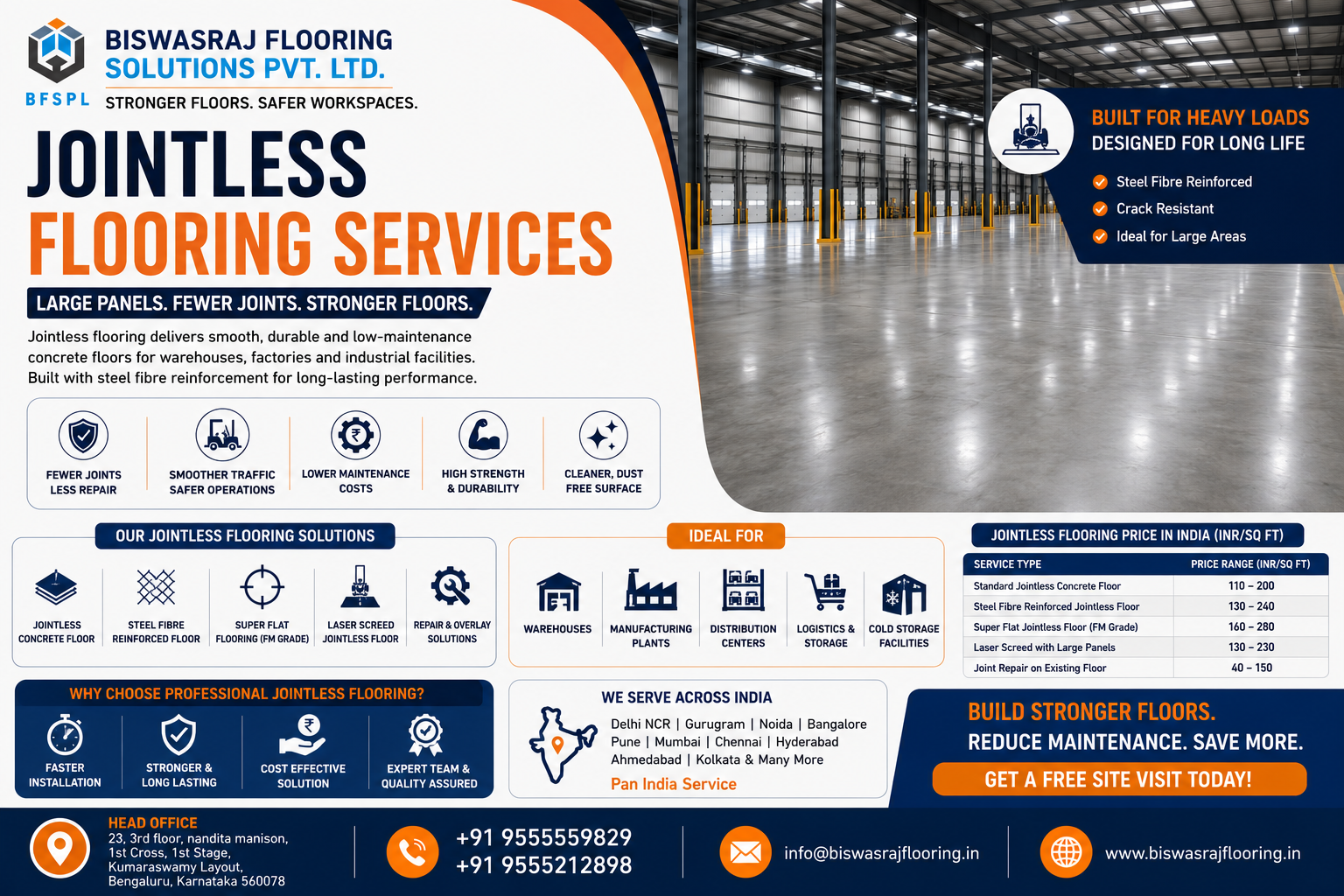
• Jointless Flooring Price in India
• Areas We Cover
• How to Choose the Best Jointless Flooring Contractor
• Safety Tips for Jointless Flooring
• Frequently Asked Questions
• Conclusion
What is Jointless Flooring?
Jointless flooring is a concrete floor laid in very large panels, sometimes over 1,000 square metres, with only a few joints instead of many. To stop the concrete from cracking, the mix uses steel fibres or shrinkage control methods that hold the slab together as it cures.
Because there are fewer joints, there are fewer weak points for machines to damage. This makes jointless floors a strong choice for high traffic industrial spaces. You can explore the full scope on our jointless flooring service page.
Why Jointless Flooring is Important
Joints may look small, but they cause many long term floor problems. Cutting down the number of joints directly cuts your repair bills and keeps operations smooth.
Here is why it matters:
• Fewer joints mean fewer chipped and cracked edges to repair.
• Forklifts and pallet trucks travel more smoothly and with less shock.
• Less dust is created at joint lines, which helps hygiene sensitive units.
• Maintenance and joint resealing costs drop over the life of the floor.
Real life example: A distribution centre near Pune was spending heavily every year filling and resealing hundreds of floor joints that kept breaking under forklift traffic. After moving to a large panel jointless floor in a new bay, joint repairs in that area nearly disappeared, and loading kept flowing without stops.
Types of Jointless Flooring Services Available
A good contractor should offer more than one solution and match the floor to your loads and layout.
Steel Fibre Reinforced Jointless Floors
Large panel floors built with steel fibre reinforced concrete (SFRC) that resist cracking and carry heavy point loads from racking legs.
Super Flat Jointless Floors
For very narrow aisle racking, a jointless base can be built to tight super flat flooring grades so tall stackers run safely with fewer surface breaks.
Laser Screed Jointless Floors
Combining laser flooring with large panel design gives you speed and flatness together, with fewer joints across the whole building.
Repair and Overlay Options
Where a full new floor is not possible, worn joints can be repaired or an overlay can reduce the joint problem on an existing slab.
Common Situations to Use Jointless Flooring
Jointless floors are a strong fit in many real settings:
• You run a large warehouse where forklifts cross the floor all day.
• Your current floor has many failing joints that keep breaking down.
• You store goods on tall racking that needs a smooth, stable base.
• You want to reduce yearly floor maintenance and downtime.
• You are planning a big new industrial shed and want a modern floor.
If joint repairs are eating your budget, a jointless floor is worth planning for.
Benefits of Professional Services
A skilled jointless floor team gives you a floor that stays strong and needs very little attention for years.
• Time saving: Large pours cover more area in less time, keeping your build on track.
• Verified experts: Correct fibre dosing and curing prevent random cracks and weak spots.
• Affordable in the long run: Far fewer joints to repair means big savings over the years.
• Quality work: A dense, well cured floor handles heavy loads without failing early.
Ready to cut your floor maintenance? Contact us today for a free site assessment.
Jointless Flooring Price in India
The price of a jointless floor depends on the area, slab thickness, the loads it must carry, and the reinforcement used. Bigger, well planned pours often bring the cost per square foot down.
These are indicative ranges only. Your final price depends on the site and loads, so a firm quote follows a site visit. Book a service now to get an exact estimate.
Areas We Cover
We deliver jointless flooring and other industrial floor services across India. If you are searching for a trusted jointless flooring contractor near me, our teams can reach most industrial hubs.
We cover Delhi NCR, Gurugram, Noida, Bangalore, Pune, Mumbai, Chennai, Hyderabad, Ahmedabad, Kolkata, and surrounding areas. With offices in Delhi, Bangalore, and Pune, we handle projects Pan India.
How to Choose the Best Jointless Flooring Contractor
Laying a crack free large panel floor takes real skill. Use these steps to choose well:
1. Look at past jointless projects and ask how the floors have held up.
2. Check that they use proper steel fibre or shrinkage control, not guesswork.
3. Ask how they plan pour sizes and control cracking during curing.
4. Read client reviews and request references you can contact.
5. Compare quotes on the full scope and reinforcement, not just the base rate.
For a wider view of every floor type, read our full industrial flooring guide before you decide.
Safety Tips for Jointless Flooring
A safe pour protects your crew and your new floor:
• Keep the pour area clear and organised, since large pours move fast.
• Make sure workers wear boots, gloves, and eye protection around wet concrete.
• Allow full curing before heavy racking or forklifts return to the slab.
• Follow the planned fibre dosage exactly to avoid weak or cracking areas.
• Always hire a certified contractor with a clear method and quality plan.
Jointless industrial floors rely on well made, reinforced concrete, and the basics of durable bare concrete floor finishes are described in this BiswajRaj Flooring.
Frequently Asked Questions
1. What is jointless flooring?
It is a concrete floor laid in very large panels with very few joints. Steel fibre or shrinkage control keeps the slab from cracking, giving a smoother and stronger surface.
2. Why are fewer joints better for a warehouse?
Joints are weak lines where edges chip and forklifts get jolted. Fewer joints mean less damage, smoother travel, less dust, and lower yearly repair costs.
3. Are jointless floors really joint free?
Not fully. They use far fewer joints than normal floors, but some movement joints may still be needed depending on the building size and layout.
4. What does jointless flooring cost in India?
It usually ranges from about 110 to 280 rupees per square foot based on area, loads, and reinforcement. A site visit gives you an accurate quote.
5. Can jointless flooring carry heavy racking loads?
Yes. When built with steel fibre reinforced concrete and the right thickness, jointless floors carry heavy point loads from racking legs very well.
Conclusion
Joints are one of the biggest hidden costs in an industrial floor. Jointless flooring removes most of them, giving you a smoother, stronger surface that needs far less repair and keeps your building running.
BiswasRaj Flooring Solutions is an ISO certified team that designs and lays large panel jointless floors across India. If you are tired of repairing broken joints, contact our team today to book a free site visit and get help instantly.