

Types of Epoxy Flooring: Which System Suits Your Floor?
 04 Aug 2026
Types of Epoxy Flooring: Which System Suits Your Floor?
- Posted by Sathish K
Two contractors quote for the same shed and the prices differ by four times. Nothing is wrong. They have quoted different systems.
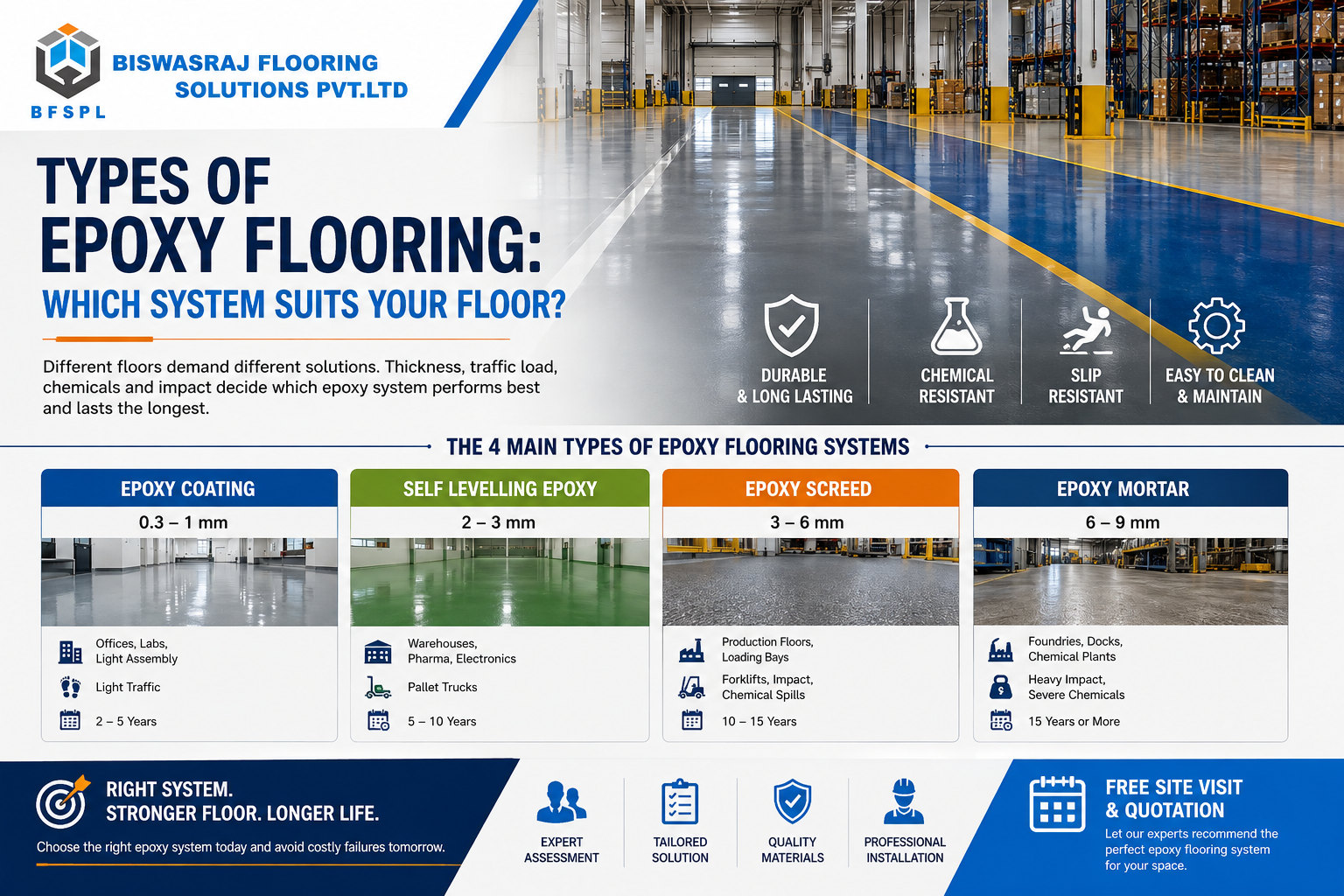
The four main types of epoxy flooring separate on one thing above all: thickness. A coating measured in fractions of a millimetre and a mortar laid at nine millimetres are not competing products, and comparing them on price alone is how buyers end up with a floor that fails inside a year.
At A Glance
• Epoxy coating runs 0.3 to 1 mm and suits light traffic and clean rooms
• Self levelling epoxy sits at 2 to 3 mm and handles pallet trucks well
• Epoxy screed at 3 to 6 mm takes forklifts, impact and chemical spills
• Epoxy mortar at 6 to 9 mm is the heaviest duty option available
What Are The Main Types Of Epoxy Flooring?
Four systems cover almost every industrial job in India. They share the same resin chemistry and differ in thickness, filler content and how they are applied. Thickness is what buys you impact resistance and working life, which is why the types of epoxy flooring rise steeply in price as they get thicker.
|
System |
Typical build |
Applied by |
Suits |
Indicative life |
|
Epoxy coating |
0.3 to 1 mm |
Roller or spray |
Offices, labs, light assembly, marking |
2 to 5 years |
|
Self levelling epoxy |
2 to 3 mm |
Poured and spiked |
Warehouses, pharma, electronics |
5 to 10 years |
|
Epoxy screed |
3 to 6 mm |
Trowel |
Production floors, loading bays |
10 to 15 years |
|
Epoxy mortar |
6 to 9 mm |
Trowel, heavily filled |
Foundries, docks, chemical plants |
15 years or more |
Working life assumes correct preparation and a slab in sound condition. A 6 mm screed on a badly ground floor will not outlast a 1 mm coating on a well prepared one.
When Is A Thin Epoxy Coating Enough?
An epoxy coating works where the floor needs sealing rather than armouring. At 0.3 to 1 mm it stops dusting, resists mild chemicals, and wipes clean, but it cannot bridge cracks or absorb impact. Two or three roller coats over a primer is the usual build.
It is the right call in these situations:
• Offices, showrooms, corridors and stores with foot traffic only
• Aisle marking, safety zoning and colour coding across a larger floor
• Labs and light assembly areas where hygiene matters more than load
• Tight budgets where the floor will be recoated on a planned cycle
Where it goes wrong is under forklifts. A thin film wears through at the wheel tracks first, and once the concrete is exposed, the damage spreads outward from that line every week.
Of all the types of epoxy flooring, this is the one most often bought for the wrong reason, because it is simply the cheapest line on the quote. Recoating a worn coating every three years usually costs more over a decade than laying the correct build once.
What Does A Self Levelling Epoxy Floor Give You?
Self levelling epoxy is poured at 2 to 3 mm and spread with a spiked roller, so it finds its own level and closes small surface defects. The result is the flattest and most seamless finish of the epoxy flooring systems available, which is why pharma, food and electronics units specify it.
Its real advantages are hygiene and appearance. There are no joints or grout lines to harbour bacteria, coving can be run up the wall to remove the floor to wall junction entirely, and the gloss level stays even across a large area.
It does have a limit. Self levelling epoxy handles pallet trucks and light forklifts comfortably, but it is not an impact floor. Drop a die or a steel bar on it and you get a chip, not a dent.
Among the types of epoxy flooring, this one is also the least forgiving of a poor slab. Because it flows to its own level rather than following the concrete, any hump or dip in the floor shows up as a thin patch that wears first.
Where Does Epoxy Screed Flooring Earn Its Cost?
Epoxy screed flooring is trowel applied at 3 to 6 mm with graded aggregate mixed into the resin. That filler is the point. It gives the floor compressive strength and impact resistance that a poured system cannot match, and it lets the finish be textured for slip resistance.
This is the system for real production environments:
• Manufacturing bays with forklift and pallet truck movement all shift
• Loading docks where goods are dropped rather than placed
• Areas with regular oil, coolant or acid spillage
• Wet process floors where an anti slip texture is a safety requirement
The trade off is finish and time. A trowelled screed reads as a working floor rather than a showroom one, and it takes longer to lay than a poured system over the same area.
Where the thinner types of epoxy flooring wear out, a screed keeps going, because the aggregate takes the abrasion instead of the resin. That is the whole reason it costs more per square foot and lasts two to three times as long.
Why Does Epoxy Mortar Handle What Others Cannot?
Epoxy mortar is the heaviest build in the family, laid at 6 to 9 mm and sometimes thicker. It carries so much aggregate that it is closer to a resin concrete than a coating, and it is placed by trowel in bays rather than poured.
Specify it where the floor takes genuine punishment: foundry floors, battery rooms, chemical dosing areas, dock levellers and anywhere steel is dragged. It will also rebuild a slab that has lost surface level, since the thickness can absorb a fair amount of correction.
Two cautions. Epoxy mortar sits at the top of the price range for the types of epoxy flooring, so it is specified zone by zone rather than across a whole unit. A common approach is mortar in the dock and dosing bays, screed across production, and a coating in the offices.
The second caution is heat. Where the floor faces steam cleaning or hot washdown, a polyurethane screed usually outperforms epoxy on thermal shock, and no amount of extra epoxy thickness changes that.
How Do You Choose Between Epoxy Flooring Systems?
Start from the heaviest thing that will touch the floor, not from the budget. Load, impact and chemical exposure decide the build, and the finish is chosen afterwards. Work through these six questions before you compare any two quotes.
1. What runs on it? Foot traffic, pallet trucks and 3 tonne forklifts need different builds.
2. What gets dropped? Impact drives thickness faster than weight does.
3. What gets spilled? Name the chemicals and their concentration, not just “oil and water”.
4. Is it wet? Wet areas need texture, falls to drain and often coving.
5. How flat is the slab now? Badly out of level floors may need concrete grinding and polishing or a levelling layer first.
6. How long must it last? A five year floor and a fifteen year floor are different specifications.
The types of epoxy flooring map onto sectors fairly predictably, so this table is a useful sanity check against any quote you receive.
|
Sector |
Usual system |
Why |
|
Warehousing and logistics |
Self levelling epoxy |
Pallet truck traffic, large areas, easy cleaning |
|
Pharma and food processing |
Self levelling with coving |
Hygiene, washdown, no joints to trap residue |
|
Heavy manufacturing |
Epoxy screed |
Forklifts, dropped tools, oil and coolant |
|
Chemical and foundry |
Epoxy mortar |
Impact, thermal load, aggressive spillage |
|
Offices and showrooms |
Epoxy coating |
Foot traffic only, appearance driven |
Surface preparation then follows the system, not the other way round. ICRI publishes a guideline for selecting and specifying concrete surface preparation with benchmark profiles, and the principle is simple: the thicker the system, the rougher the prepared slab has to be beneath it.
Our epoxy flooring service starts with a site visit that checks the slab, its moisture content and the exposure it faces, because a system recommended without that information is guesswork.
Frequently Asked Questions
Which Type Of Epoxy Flooring Is Best For A Warehouse?
For most warehouses, self levelling epoxy at 2 to 3 mm is the balance point. Move up to a screed where forklift traffic is constant or goods are dropped at loading bays.
How Thick Should An Industrial Epoxy Floor Be?
Thickness follows duty. Light traffic needs 0.3 to 1 mm, general warehousing needs 2 to 3 mm, production floors need 3 to 6 mm, and severe duty areas need 6 mm or more.
Can Self Levelling Epoxy Fix An Uneven Floor?
Only slightly. It closes minor defects and small undulations within its 2 to 3 mm build, but a floor that is genuinely out of level needs grinding or a levelling screed first.
Is Epoxy Mortar The Same As Epoxy Screed?
They are related, not identical. Both are trowel applied and aggregate filled, but mortar carries more aggregate at a greater thickness, so it takes heavier impact and costs more.
Do All Types Of Epoxy Flooring Need The Same Preparation?
No, though every system needs mechanical preparation of some kind. Thicker builds need a more aggressive profile, so shot blasting suits screeds and mortars while diamond grinding often suffices for thin coatings.
How Long Does Each System Take To Install?
A coating over a prepared slab takes two to three days. Self levelling takes three to five, and screeds or mortars take five to eight, with cure time between layers.
Where Should You Start?
Walk the floor and note the heaviest wheel load, the worst spill and the flattest area you actually need. Those three answers narrow the choice to one system in almost every case.
Send us that note with your area and slab age. We will tell you which of the types of epoxy flooring fits, and where a cheaper build would do, starting with a free site visit and quotation. More background sits in our industrial flooring guides.