


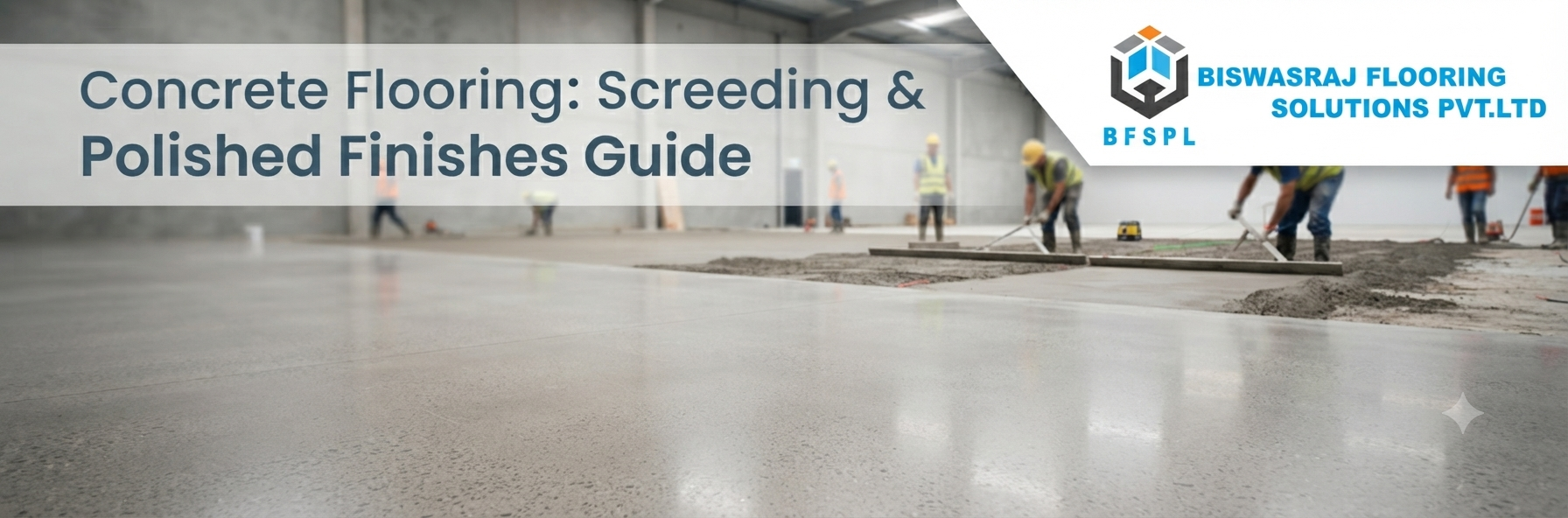
Concrete Flooring: Screeding & Polished Finishes Guide
 18 Sep 2026
Concrete Flooring: Screeding & Polished Finishes Guide
- Posted by Nagananda Udupa
Concrete flooring is often specified in warehousing, factories, commercial buildings, showrooms, and other demanding environments because it can be made to deliver a resilient and practical floor surface when correctly specified and installed. However, a concrete floor has many additional factors that influence the final performance, and a number of surface preparation and finishing methods need to be evaluated in order to achieve a suitable end result. For facilities that want a resilient and practical floor covering, there are a number of important factors to consider regarding how a concrete floor is levelled and finished. Concrete flooring is a floor covering using materials such as cement, aggregates, water, and other additives as required to formulate the concrete mix. This type of floor is specified in a number of applications including: Industrial facilities Warehouses Manufacturing units Workshops Commercial buildings Parking areas Retail spaces Institutional buildings Utility areas Depending on the application, a number of surface treatments are available and should be selected to suit the required usage. This includes hardening, densification, grinding, polishing and/or protective treatments. The final surface should be specified according to the expected loadings, traffic, environmental exposure, and appearance requirement. The final quality of a concrete floor is highly dependent on preparation and execution. While the floor may look fine at the point of completion, a number of issues can appear later on if preparation, levels, joints, curing and surface finishing are not done correctly. Proper preparation enables: More uniform levels Good surface finish Enhanced usability Suitable surface characteristics Increased performance under traffic Easier maintenance This is why concrete flooring should be considered as a complete system and not be viewed as a concrete placement exercise. Screeding is the process of striking off and levelling freshly placed concrete or screed material to achieve the required floor level and surface profile. During this activity the material is placed and spread across the required area and then a screed or another suitable technique is used to strike off the excess material and establish the desired level. Depending on the project, screeding may be accomplished manually or by way of mechanised methods. Proper screeding is important since irregular floor levels can lead to many issues with the final floor surface. Why Screeding Is Important in Concrete Flooring Screeding is an important activity to achieve a consistent floor surface. A properly screeded floor provides a more controlled surface level, particularly in facilities where equipment, storage systems and material-handling vehicles are involved and operate on the floor. Uneven concrete can lead to localised high and low spots. Screeding allows for attaining a more uniform surface which allows for subsequent finishing activities to be performed. A properly levelled concrete surface provides a good basis for the subsequent finishing activities. Depending on the final surface required, the concrete surface can be subjected to power trowelling, grinding, densification or polishing works. A reasonably uniform floor can facilitate movement of people, trolleys, and material-handling equipment, which can be of greater importance in facilities such as warehouses and industrial environments. Floor level and surface regularity can therefore be important considerations in the design process. Larger industrial flooring works may utilise mechanised methods such as laser screeding for a number of benefits. Laser screeding uses a laser reference to control the elevation of freshly placed concrete, and is suitable for large area flooring works. The method may be employed where consistency in floor levels and large-area concrete placement is required, as well as to utilise mechanised installation and reduce manual levelling. The appropriate method should be selected in accordance with project size, specification and site conditions, and the required floor tolerances. Screeding is a part of a number of activities in constructing a concrete floor. The concrete is placed and screeded to achieve the required level, and further finishing works may be required depending on the final floor surface. These may include: 1. Initial levelling 2. Surface finishing 3. Curing works 4. Surface hardening or densification 5. Grinding activities 6. Polishing works 7. Protective treatments if required Each activity has a different objective, and therefore the final flooring specification should be determined before commencing construction works to ensure that the concrete, finishing process, and expected performance work together. Proper curing is an important part of concrete construction, and following recognised curing practices can help the concrete develop its intended properties. TheAmerican Concrete Institute’s guidance on concrete curing provides additional technical information on curing practices for slabs and other concrete construction. Polished concrete floors are concrete surfaces that have been mechanically ground and progressively polished to attain a smoother and more refined finish. The mechanical process exposes the characteristic of the concrete, and can yield different sheen levels depending on the specification selected. Polished concrete can be specified in a number of applications including: Commercial spaces Showrooms Retail environments Offices Warehouses Institutional buildings Selected industrial applications The final appearance depends on a number of factors including the mix, aggregate in the concrete, grinding depth, surface condition and polishing specification. Polishing a concrete floor is not only a cosmetic procedure. Mechanical grinding and polishing of the surface can enhance the surface qualities while also providing a more refined and easier-to-maintain floor surface. A typical process may consist of: The surface is mechanically ground to remove any imperfections and prepare for further steps. The surface is progressively ground to attain a finer surface. A suitable densifier may be applied to react with components in the concrete and improve the characteristics of the surface. Further polishing stages can be carried out to attain the required smoothness and sheen level. Depending on the application, an appropriate treatment may be considered to protect or provide stain resistance to the surface. The exact process depends on the existing concrete condition and the final specification desired. Concrete flooring and polished concrete are two terms that are related, but are not the same thing. Concrete flooring refers to flooring constructed using concrete as the primary material, while polished concrete refers to a concrete surface that has been mechanically ground and polished to attain a refined finish. Therefore a concrete floor does not necessarily become a polished concrete floor. Polishing is a surface treatment and is selected when the project specifically needs its characteristics. Polished concrete can be utilised in a number of environments where the existing or newly placed concrete meets the required conditions. These may include: Polished surfaces can create a more aesthetically pleasing floor while facilitating maintenance activities. Polished concrete can be considered where a durable surface that also offers a nice appearance is required. A polished surface can aid the presentation of a commercial space. Where a modern hard-surface floor is required, polished concrete can be considered as one option. Certain industrial areas may benefit from polished concrete, although the specification should be selected according to traffic, loadings, chemical exposure and operational needs. The selection of a floor covering using concrete should start with understanding how the floor will be utilised. Forklifts, vehicles, pallet movement and heavy pedestrian traffic can place different demands on a floor. The floor should be designed according to the expected loadings. Some facilities only need a functional surface, while others may also want a specific appearance, or smoothness level. The expected cleaning regimes and schedule should be considered before selecting the final finish. Existing moisture conditions can influence the suitability of certain treatments and finishes. Chemical exposure, water, temperature variation, and other factors should be considered when selecting a flooring solution. Problems can arise when laying a concrete floor when installation and finishing activities are not carried out properly. Problems may include: Uneven floor levels Surface dusting Cracking Premature surface wear Uneven finishing Poor curing Localised surface defects Inconsistent polishing Not all floor problems have the same origin, and a proper assessment should be carried out before deciding whether the solution involves repairs, grinding, polishing treatments or other options. Maintenance of the final floor surface is important in order to prolong the life of the floor. Basic maintenance activities include: Removing any dirt and debris regularly Cleaning spills promptly Using appropriate cleaning methods Avoiding unnecessary chemical exposure Checking on high-traffic areas Monitoring cracks and surface deterioration Maintaining drainage where applicable Addressing damage before it becomes extensive For polished surfaces, the maintenance procedure should also be compatible with the selected finish and protective treatment. A concrete floor may need to be refurbished when surface deterioration starts to impact on the appearance, maintenance or general operations. Indicators may include: Excessive wear Surface dusting Staining Uneven surface areas Minor surface deterioration Loss of the desired finish Difficult cleaning Heavy traffic-related wear Depending on the condition, refurbishment may involve surface grinding, polishing, densification, repairs or other suitable treatments. The correct solution should be determined after evaluating the existing floor rather than applying the same treatment to every surface. Explore BiswasRaj Flooring Solutions for reliable concrete, industrial and polished flooring solutions tailored to your project requirements. Screeding is the leveling of freshly placed concrete or screed material to achieve the required floor level and surface profile. Polished concrete floors can be suitable for selected industrial applications, depending on traffic, loading, surface requirements and environmental exposure. Not necessarily. The condition, quality, thickness, surface characteristics and existing damage of the concrete should be assessed before polishing. Proper screeding helps establish consistent floor levels, and provides a suitable surface for subsequent finishing activities. In many cases, an existing concrete floor can be mechanically ground and polished, but its condition should be assessed first to determine whether polishing is appropriate. Looking for a durable concrete flooring solution for your project?Contact BiswasRaj Flooring Solutions to discuss your flooring requirements with our teamWhat Is Concrete Flooring?
Why Proper Concrete Floor Preparation Matters
What Is Screeding?
1. Enables Achieving the Required Level
2. Achieves Surface Uniformity
3. Enables Subsequent Finishing Works
4. Enhances Floor Usability
Screeding and Laser Screeding
From Screeding to Surface Finishing
What Are Polished Concrete Floors?
How Polishing Changes a Concrete Floor
Initial Grinding
Progressive Grinding
Densification
Fine Polishing
Final Treatment
Concrete Flooring vs Polished Concrete
Where Can Polished Concrete Be Used?
Warehouses
Commercial Buildings
Showrooms
Offices and Institutional Spaces
Industrial Areas
Factors to Consider Before Choosing Concrete Flooring
Expected Traffic
Loading Requirements
Surface Requirements
Maintenance Needs
Moisture Conditions
Environmental Exposure
Common Problems When Concrete Flooring Is Poorly Executed
Maintaining Concrete and Polished Concrete Floors
When Should an Existing Concrete Floor Be Refurbished?
Frequently Asked Questions
1. What is screeding in concrete flooring?
2. Are polished concrete floors suitable for industrial spaces?
3. Is every concrete floor suitable for polishing?
4. How does screeding affect the finished floor?
5. Can an existing concrete floor be polished?
Discuss Your Concrete Flooring Requirements with BiswasRaj