


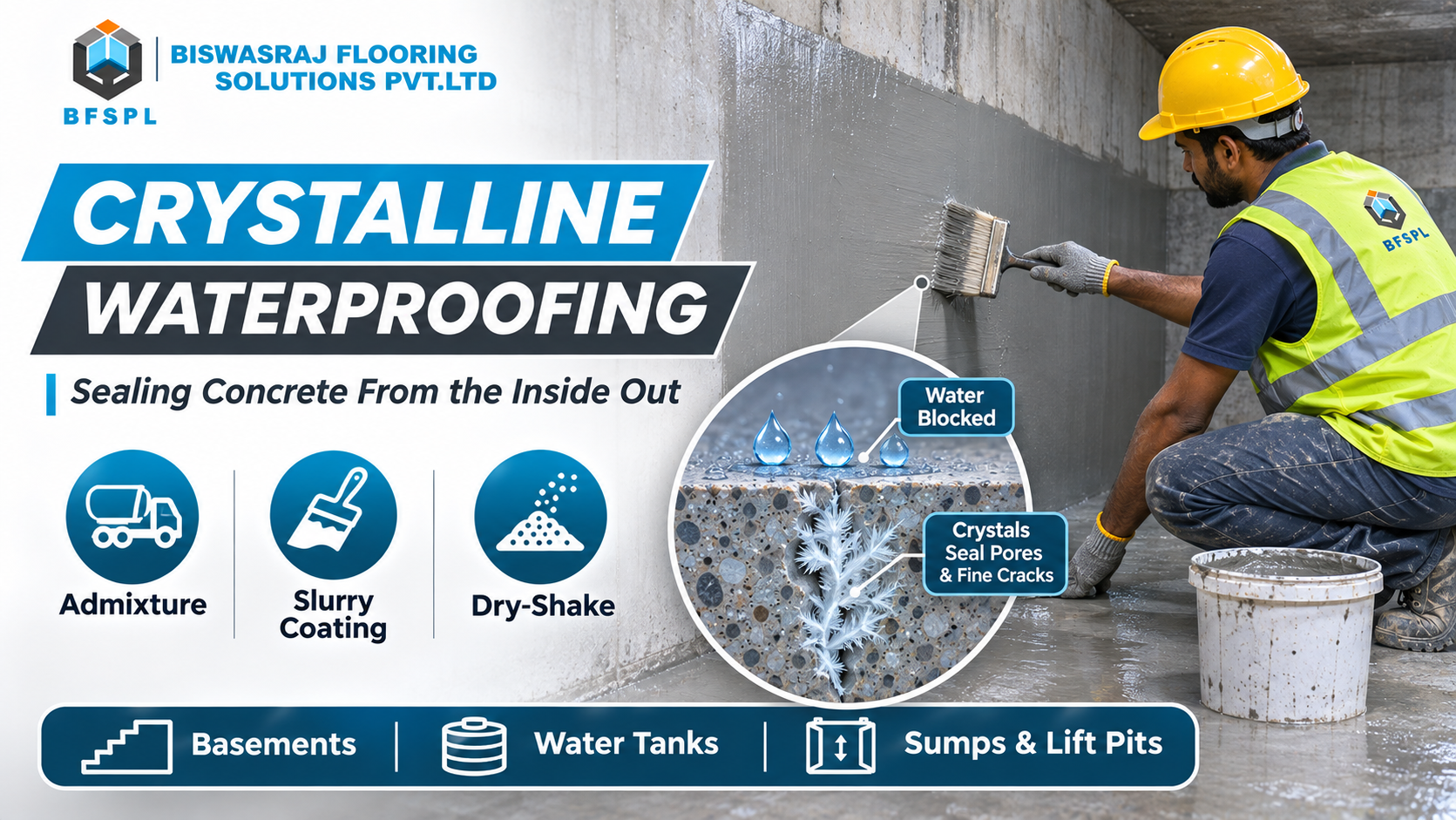
Crystalline waterproofing treats concrete with chemicals that react with moisture and cement to grow insoluble crystals inside pores and fine cracks, blocking water from within. It comes in 3 forms: an admixture added to the mix, a slurry brushed onto the surface, and a dry-shake on fresh slabs.
It is one of several ways to keep water out of below-ground structures. For the full picture of how seepage starts and which methods suit which leak, read our basement waterproofing guide.
At A Glance
- Forms
- Admixture, brush-on slurry, and dry-shake
- Works by
- Growing crystals inside pores and fine cracks
- Best for
- Basements, tanks, sumps, pits, and below-ground walls
- Not for
- Moving cracks, roofs with high thermal movement, or dry concrete
Results depend on the product, the concrete, and how well it is applied.
How Does Crystalline Waterproofing Work?
Concrete is full of tiny pores and capillaries that let water travel through it. Crystalline waterproofing adds reactive chemicals that, in the presence of water, combine with by-products of cement hydration to form crystals that fill those channels and block water movement.
The American Concrete Institute groups these products with other permeability-reducing admixtures. Its education bulletin on permeability-reducing admixtures explains that hydrostatic-grade products react with cement to form crystalline, pore-blocking deposits, and that those with crystalline reactivity can self-seal leaking cracks.
Three points follow from how the chemistry works:
- It needs water to react: the crystals form only when moisture is present
- It stays dormant: unreacted chemicals can restart if water returns through a new hairline crack
- It becomes part of the concrete: there is no separate film to peel, puncture, or wear off
That last point is why it is often called integral waterproofing. The protection sits within the concrete itself rather than on its surface.
The self-sealing effect has limits, though. It suits fine hairline cracks, while wider or moving cracks still need repair first, as our concrete floor crack repair guide explains.
What Are The Three Types Of Crystalline Products?
The chemistry is the same, but the way it reaches the concrete differs. Crystalline waterproofing comes as an admixture for new concrete, a slurry coating for existing surfaces, or a dry-shake for fresh slabs. Each suits a different stage of construction.
| Form | How it is applied | Best for | Watch out for |
|---|---|---|---|
| Admixture | Added to the concrete at the batching plant or on site | New basements, tanks, sumps, and foundations | Dose and mixing must follow the maker’s data sheet |
| Slurry coating | Brushed or sprayed onto damp, prepared concrete | Existing structures, often from the inside | Needs open pores and careful curing |
| Dry-shake | Spread on fresh concrete and trowelled in | New slabs, pits, and floors below ground | Timing with the finishing crew is critical |
A waterproofing admixture for concrete suits new work, because it treats the full thickness of every pour. Slurries suit repairs and older buildings, where the concrete already exists and can only be reached from one side.
Not every admixture marketed as waterproof is the same. ACI separates products meant for damp-proofing from those rated for water under pressure, so check which category a product claims before it goes into a tank or basement.
Where Does Crystalline Waterproofing Work Best?
It works best on concrete that stays damp or wet and does not move much. Basements, water tanks, sumps, lift pits, tunnels, and retaining walls are classic uses, because water is always present to keep the crystals growing and the structure is relatively stable.
Good applications include:
- Basement walls and slabs: especially where the outside face cannot be reached
- Water and fire tanks: where a lining could peel under constant water
- Sumps and lift pits: small, deep structures with high water pressure
- Retaining walls: concrete holding back damp soil
- Treatment plants: concrete tanks holding process water
Its biggest advantage is negative side waterproofing. When water pushes from outside and only the inside is reachable, a membrane on the inner face can be pushed off, while crystalline waterproofing works within the concrete instead of sitting on it.
Water pressure matters here. Every metre of water head adds about 9.81 kPa, so a deep sump or basement puts real load on any treatment applied from inside.
Where Is A Membrane Or Other System Still Needed?
Crystalline products seal pores and fine cracks in sound concrete. They cannot bridge cracks that keep opening and closing, cannot treat blockwork or brick, and do little on concrete that stays dry. In those cases a membrane, coating, or injection system is the better tool.
Choose another method, or combine one with crystalline treatment, when:
- Cracks keep moving: expansion joints and live cracks need flexible sealants or injection
- Roofs face sun and rain: large daily temperature swings open and close cracks
- The structure is masonry: bricks and blocks lack the cement chemistry crystals need
- Concrete is honeycombed: large voids must be repaired before any treatment
- Leaks are flowing: active leaks need plugging or injection grouting first
Our terrace waterproofing guide explains why exposed roof slabs usually need a flexible membrane or coating instead.
Independent testing is also worth remembering. A Florida Department of Transportation study of permeability-reducing admixtures reported conflicting laboratory performance across products, so ask for test data on the specific product rather than relying on brochure claims.
How Does It Compare With Membranes And Coatings?
Each system protects concrete in a different way. Membranes and coatings form a barrier on the surface, while crystalline waterproofing changes the concrete itself. The right choice depends on access, movement, and water pressure.
| Feature | Crystalline treatment | Sheet membrane | Liquid coating |
|---|---|---|---|
| Where it sits | Inside the concrete | On the surface | On the surface |
| Handles moving cracks | No | Yes, within its stretch | Some, depending on type |
| Works from inside (negative side) | Yes | Poorly | Poorly, unless rated for it |
| Risk of puncture or peeling | None | Yes, during backfill | Yes, from wear or pressure |
| Needs a dry surface | No, needs damp concrete | Usually | Usually |
| Suits brick or block walls | No | Yes | Yes |
Many projects use more than one. A typical approach is crystalline treatment for the concrete box of a basement, flexible sealants at joints, and injection at any active leaks. Our industrial waterproofing guide for floors and basements covers how these layers fit together.
How Is A Crystalline Treatment Applied?
For existing concrete, crystalline waterproofing is a surface treatment that relies on open pores and moisture. The surface must be clean, rough, and damp, every active leak must be stopped first, and the coating must be kept moist while it cures.
- Inspect the structure: map leaks, cracks, joints, and damaged concrete.
- Stop active leaks: plug flowing water and inject live cracks before coating.
- Open the surface: remove paint, plaster, and laitance by grinding or blasting.
- Repair defects: cut out honeycombed patches and rebuild with suitable mortar.
- Treat joints separately: seal movement joints with a flexible sealant.
- Pre-wet the concrete: soak it so the surface is damp but without standing water.
- Apply the slurry: brush or spray the coats specified on the data sheet.
- Keep it moist: mist or cover the coating during curing so the crystals can form.
New construction is simpler. The admixture is dosed into each pour, and the effort shifts to good joint detailing and proper curing, because crystals cannot fix poorly compacted concrete.
Check the result before calling the job done. The crystals keep developing for weeks, so judge performance over time rather than on the first day:
- Watch damp patches after rain and note whether they shrink or disappear
- Take moisture readings at marked points and compare them every few weeks
- Fill tanks and sumps and record the water level with all outlets closed
- Recheck joints and repaired cracks, since these are treated by other methods
If a patch stays wet, look for a moving crack, an untreated joint, or a pipe entry before blaming the coating.
Frequently Asked Questions
Is a crystalline treatment permanent?
It becomes part of the concrete, so it does not peel or wear off like a coating. Performance still depends on the product, the concrete quality, and whether new cracks keep moving.
Can it be applied from the inside?
Yes. Crystalline waterproofing is one of the few treatments that works well on the negative side, where water pushes from outside and only the inner face can be reached.
Does it work on brick or block walls?
No, because the crystals need the chemistry of cement-rich concrete. Brick and block walls usually need a cementitious coating, membrane, or another system suited to masonry.
Is it safe for drinking water tanks?
Only if the specific product is certified for drinking water contact. Ask for the certificate and the data sheet before using any product inside a potable water tank.
Can you paint or tile over it?
Usually yes, once it has cured, but check the maker’s guidance. Some finishes need extra surface preparation or a compatible primer over the treated concrete.
Does it stop leaks straight away?
Not always. Flowing leaks need plugging or injection first, and the crystals need time and moisture to grow before full effect.
What Do The Numbers Say?
- 2 ACI categories of permeability-reducing admixtures: PRAN for non-hydrostatic and PRAH for hydrostatic conditions American Concrete Institute, Education Bulletin E4-12
- 9.81 kPa Water pressure added for every metre of water head against a wall or slab Standard hydrostatic formula (P = density x g x depth)
Is Crystalline Waterproofing Right For Your Structure?
Start with an inspection, not a product. Our team checks the concrete, the cracks, and the water pressure, then advises whether crystalline waterproofing, a membrane, or a combination suits the job. Explore our waterproofing services to arrange a site visit.
Sources
- Admixtures Part 2: Permeability Reducing Admixtures (ACI Education Bulletin E4-12) (American Concrete Institute)
- Basement Waterproofing: Find the Seepage Source, Then Fix It (BiswasRaj Flooring Solutions Pvt. Ltd.)
- Waterproofing Services in India (BiswasRaj Flooring Solutions Pvt. Ltd.)