


How Much Does SFRC Flooring Cost in India?
 11 Aug 2026
How Much Does SFRC Flooring Cost in India?
- Posted by Sathish K
SFRC flooring costs between 55 and 110 rupees per square foot in India, all in with ready mix concrete, steel fiber, and labour. The exact number moves with fiber dosage, slab thickness, and how much prep the base concrete needs.
This guide breaks down SFRC flooring cost in India by load class, shows what drives the price up or down, and gives you a simple way to estimate your own project before you call a contractor.
The Headline Numbers
• SFRC flooring costs 55 to 110 rupees per square foot installed in most Indian cities
• Steel fiber dosage typically runs 20 to 40 kilograms per cubic metre of concrete
• SFRC skips separate TMT mesh, which usually offsets 15 to 20 percent of the fiber cost
• Slab thickness for a warehouse floor usually runs 150 to 200 millimetres depending on rack loads
• A cracked or soft sub-base can add 10 to 20 rupees per square foot before the pour even starts
What Does SFRC Flooring Cost In India?
SFRC flooring cost in India runs 55 to 110 rupees per square foot for a standard industrial floor, covering ready mix concrete, steel fiber, laser screeding, and curing. Add another 20 to 40 rupees per square foot if the slab also needs a dry shake hardener or a coating on top.
The total splits across a few line items:
• Ready mix M25 to M30 concrete, roughly 45 to 60 percent of the total cost
• Steel fiber, priced by the kilogram, usually 55 to 90 rupees per square foot equivalent at standard dosage
• Laser screeding and finishing labour, 8 to 15 rupees per square foot
• Dry shake hardener or sealer, if added, as a separate line item
For the full scope of what a professional crew includes in a pour, see our SFRC flooring services guide, which covers site prep, curing, and joint design.
A worked example makes this concrete. A 10,000 square foot warehouse bay at medium duty, priced around 80 rupees per square foot, lands close to 8 lakh rupees for the slab alone.
Add a dry shake hardener at 15 rupees per square foot and the project moves to roughly 9.5 lakh rupees before taxes and site logistics.
What Factors Change The SFRC Flooring Price?
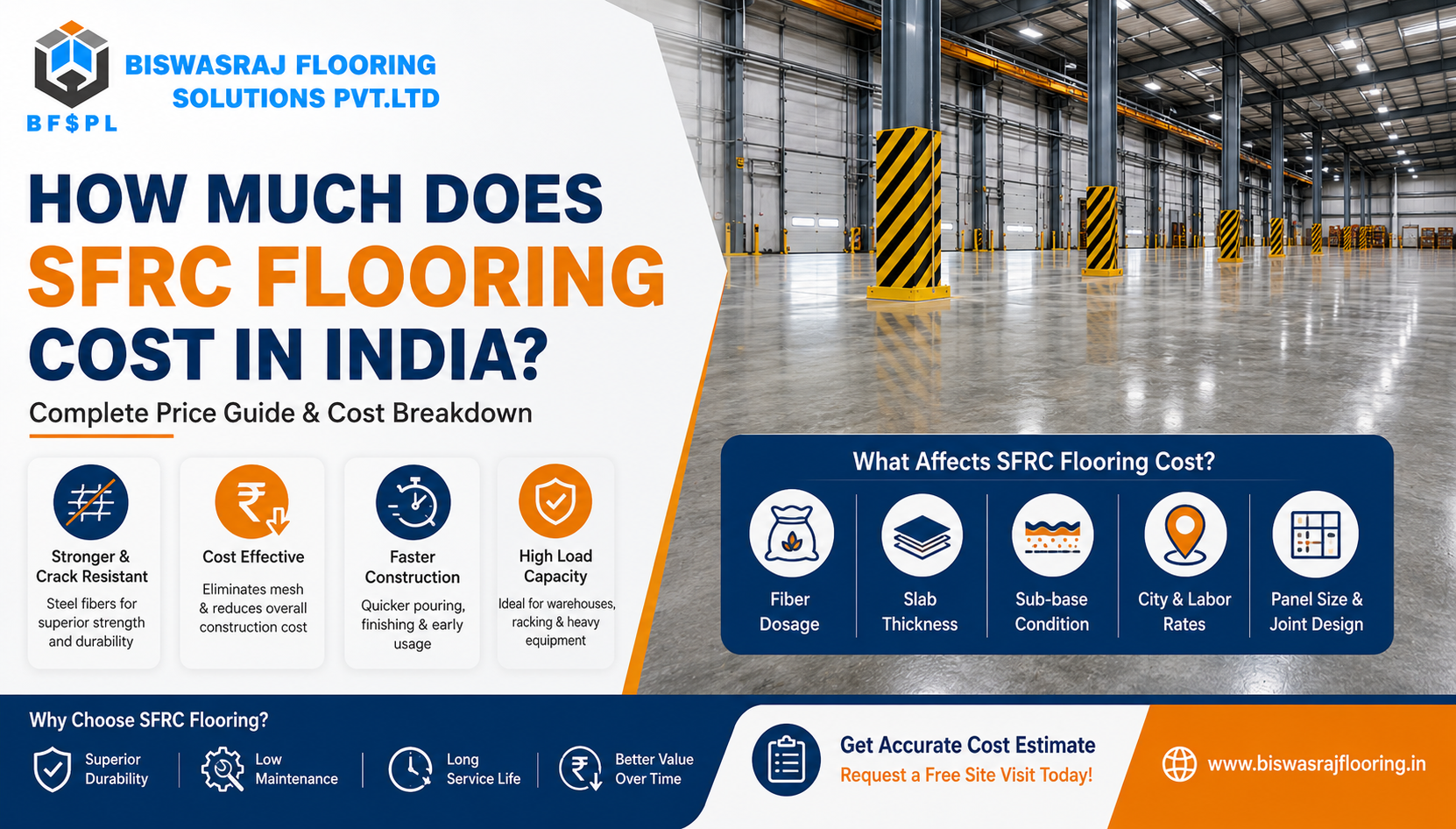
Four things move SFRC flooring cost in India the most: fiber dosage per cubic metre, slab thickness, how much the existing base needs levelling, and which city you are building in.
Fiber dosage is the biggest lever. A light duty office or retail floor might use 20 to 25 kilograms of fiber per cubic metre, while a warehouse with back to back racking or very narrow aisle trucks needs 30 to 40 kilograms. Every extra 5 kilograms typically adds 4 to 6 rupees per square foot.
Thickness follows load. A 150mm slab suits light forklift traffic, but rack post loads above 60 kN per leg usually push the design to 175 or 200mm. City also matters. Metro rates in Mumbai or Delhi tend to run 10 to 15 percent above tier two cities, mostly due to labour and transport.
Panel size plays a smaller but real role. Steel fiber lets you pour larger jointless panels than a mesh floor, often 20 by 20 metres or more, which cuts the number of armoured joints you need to buy and install.
Fewer joints means less long-term maintenance, since joints are usually where warehouse floors fail first under repeated forklift wheel loads.
Weather and season affect the labour side rather than the material side. A monsoon pour needs covered curing and slower finishing, which can add a small premium in June through September in most Indian cities.
How Does SFRC Flooring Price Compare By Load Class?
SFRC flooring cost in India scales with the load class you specify, not just the floor area. A light duty retail unit and a very narrow aisle warehouse floor use the same base method but very different fiber dosage, thickness, and finish.
That is why two quotes for the same square footage can differ by 30 rupees or more. A contractor pricing against the wrong load class either overbuilds a light duty floor or underbuilds a heavy one, and both mistakes cost you later.
Use this SFRC flooring price per sq ft table as a starting point, then get a site specific quote once your load class and sub-base condition are confirmed. Racking suppliers can usually confirm your point load and rack post spacing before the flooring contractor visits.
|
Load Class |
Typical Use |
Fiber Dosage (kg/m3) |
Slab Thickness |
Price Per Sq Ft |
|
Light duty |
Retail, office, light storage |
20 to 25 |
125 to 150mm |
Rs 55 to Rs 70 |
|
Medium duty |
General warehouse, forklift traffic |
25 to 30 |
150 to 175mm |
Rs 70 to Rs 90 |
|
Heavy duty |
Back to back racking, container yards |
30 to 35 |
175 to 200mm |
Rs 90 to Rs 105 |
|
VNA or automated |
VNA trucks, AGVs, high racking |
35 to 40 |
200mm and above |
Rs 100 to Rs 120 |
Is SFRC Flooring Cheaper Than Mesh Reinforcement?
SFRC flooring cost in India usually comes out 15 to 25 percent lower than a conventional welded mesh or TMT rebar floor of the same thickness, mainly because you skip the labour of cutting, tying, and placing mesh sheets before the pour.
Steel fiber is manufactured to a fixed international specification, ISO 13270, which standardises dimensions and classification so material pricing stays fairly consistent between suppliers. Mesh, by contrast, needs site labour for every square metre, which is where most of its extra cost sits.
In an SFRC flooring vs mesh reinforcement comparison, mesh still wins on one point. It is easier to inspect visually before the pour, since a laid mesh grid is obvious while fiber distribution inside wet concrete is not.
Timeline is the other real difference. A mesh crew needs a day or two just to cut, lay, and tie sheets across a large bay, while a fiber batch mixes at the plant and pours the same day. On a tight construction schedule, that alone can be worth more than the per-square-foot saving.
If part of your site still needs a vacuum dewatered base, our VDF flooring team can run SFRC and VDF side by side so you compare both methods on the same slab.
How Do You Estimate Your SFRC Flooring Cost?
You can estimate SFRC flooring cost in India in about ten minutes once you know four numbers: your floor area, expected traffic, current sub-base condition, and city.
1. Measure the exact area in square feet, including ramps and dock aprons
2. Classify your traffic as light, medium, heavy, or VNA using the load class table above
3. Check the existing base. A cracked or soft sub-base adds 10 to 20 rupees per square foot for repair before the pour
4. Multiply your area by the price band for your load class and city tier
5. Book a site visit so a contractor can confirm soil bearing and rack loads before finalising the fiber dosage
What Hidden Costs Catch People Out?
The quoted price per square foot rarely covers everything a real site needs. Four add-ons show up on almost every invoice, and skipping them upfront just moves the cost to a change order later.
• Sub-base repair. A soft or uneven base needs granular fill or extra compaction before the pour, typically 10 to 20 rupees per square foot
• Armoured joints. Load transfer plates at expansion joints protect the slab edge from forklift wheel impact and usually run as a per-metre charge, not a per-square-foot one
• Dry shake hardener or sealer. Improves abrasion resistance and dust control, and adds roughly 15 to 25 rupees per square foot if specified
• Access and logistics. Sites with narrow gates, night-only pour windows, or multi-storey pumping face extra mobilisation charges that a simple price list will not show
Ask any contractor to itemise these four before comparing quotes. A low headline rate that leaves out sub-base repair or armoured joints is not actually the cheaper option once the project is complete.
Frequently Asked Questions
What Is SFRC Flooring?
SFRC, or steel fiber reinforced concrete, is concrete mixed with short steel fibers instead of, or alongside, welded mesh. The fibers spread through the pour and resist cracking from every direction.
How Much Does SFRC Flooring Cost?
SFRC flooring cost in India typically runs 55 to 110 rupees per square foot, depending on fiber dosage, slab thickness, and site prep.
Is SFRC Flooring Cheaper Than TMT Bar Reinforcement?
Yes, usually 15 to 25 percent cheaper for the same slab thickness, mainly because fiber skips the labour of tying and placing bars by hand.
How Thick Should An SFRC Floor Be For A Warehouse?
Most warehouse floors use 150 to 200mm of SFRC, depending on rack post loads and forklift class. A structural engineer should confirm the exact thickness for your racking design.
Does SFRC Flooring Need A Topcoat?
Not always. Many warehouses leave SFRC as a dry shake finished slab, but some add an epoxy topcoat for dust control or a specific colour code.
How Long Does SFRC Flooring Take To Cure?
Light foot traffic is usually safe after 3 to 4 days. Forklifts and racking loads should wait 14 to 28 days for full design strength.
Ready To Budget Your SFRC Flooring Cost?
Getting an accurate SFRC flooring cost in India starts with a real site visit, not a phone estimate. Soil bearing, rack loads, and existing slab condition all move the final number more than any price list can.
Request a free site visit and quote and we will confirm your load class, fiber dosage, and price per square foot before you commit to a contractor.