


IPS Flooring Explained: Mix, Thickness And Finish
 06 Aug 2026
IPS Flooring Explained: Mix, Thickness And Finish
- Posted by Sathish K
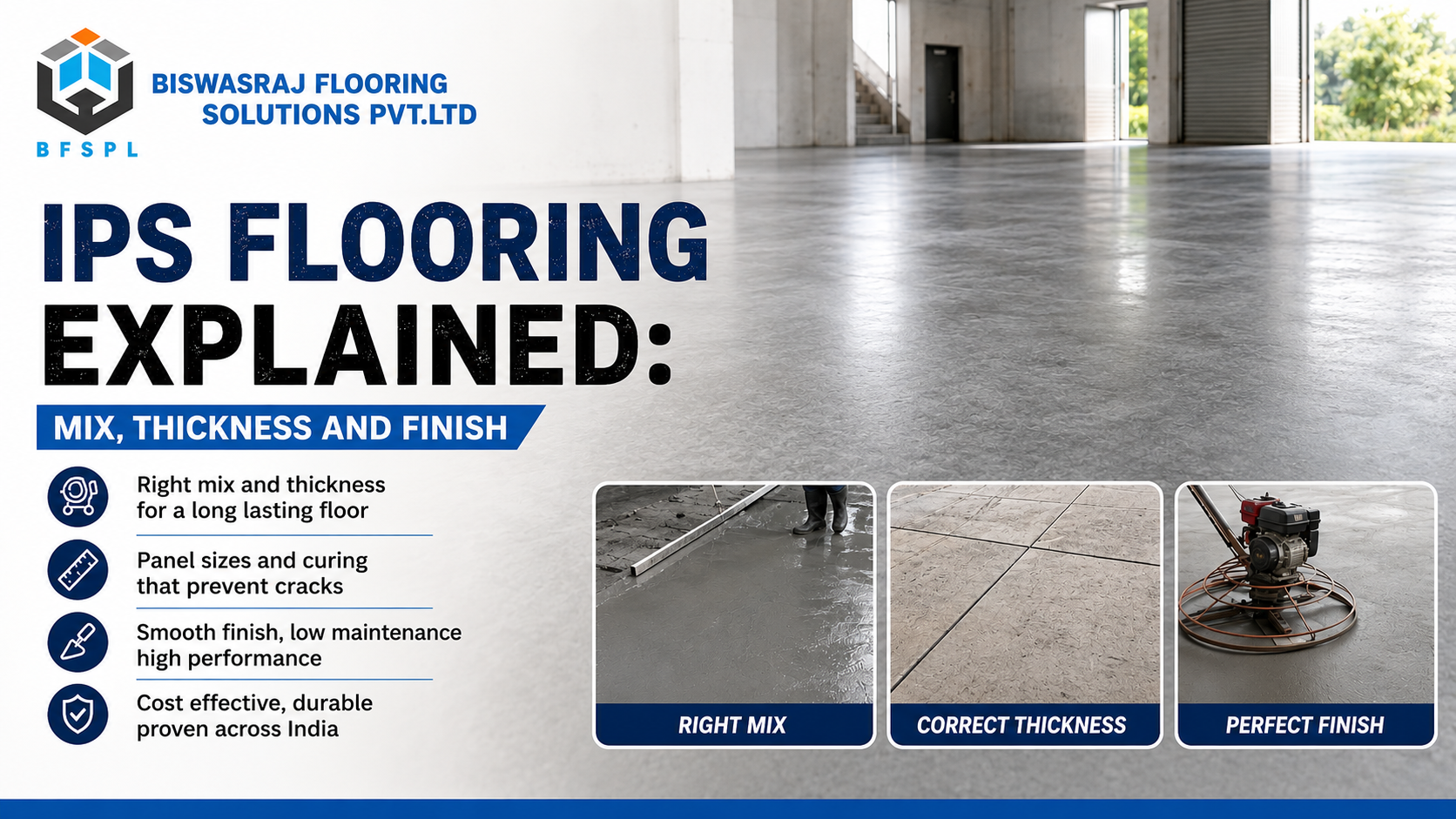
Indian Patent Stone is the plainest floor on any Indian site and the one most often blamed unfairly. It cracks, dusts and lifts far more from bad panel sizes and short curing than from anything wrong with the material.
Laid properly, IPS flooring is a hard, cheap, repairable surface with decades of service behind it. Laid in a hurry, it is a maintenance bill. Here is the difference between the two.
Key Points
• IPS is a cement concrete topping laid over a base slab, not a separate product
• Panel size and curing time cause more failures than mix design ever does
• The governing Indian code limits it to non industrial and light industrial buildings
• Toppings run roughly 20 mm bonded on ground and 40 mm where wear is heavy
• Hardeners, grinding or a coating lift performance when the base floor is sound
What Is IPS Flooring And Where Is It Used?
IPS flooring is in situ cement concrete flooring, laid as a rich concrete topping over a prepared base and finished by trowel. The name Indian Patent Stone is a legacy term for the same thing: a monolithic concrete wearing surface with no tiles, joints or adhesives involved.
It stays popular because it is cheap per square foot, uses materials available on every site, and can be repaired in patches rather than replaced in bays.
Typical uses across India include the following.
• Godowns, small workshops and light manufacturing sheds
• Terraces, balconies, staircases and passages in residential and commercial buildings
• Ramps, parking aprons and yards where a plain hard surface is enough
• Schools, hospitals and institutional corridors, often under a later floor finish
• Base for tiles, epoxy or a polished finish added afterwards
What Mix And Thickness Does The Topping Need?
IPS flooring uses a topping of roughly 1:2 to 1:3 cement and stone aggregate passing 4.75 mm, or a 1:2:4 concrete where the aggregate runs up to 12.5 mm. Thickness then follows the wear expected, not the budget available.
The Bureau of Indian Standards sets this out in IS 2571, the code for laying in situ cement concrete flooring, which states plainly that it covers non industrial and light industrial buildings and does not deal with heavy duty floors or acid resisting finishes. That single line settles most arguments about where this floor belongs.
|
Where it is laid |
Typical topping thickness |
Notes |
|
Monolithic over base concrete on ground |
20 mm |
Laid while the base is still green |
|
Bonded on a hardened base on ground |
25 to 40 mm |
Needs slurry bonding and full preparation |
|
Monolithic over a structural slab |
15 mm |
Laid as soon as the slab stiffens |
|
Bonded over a structural slab |
25 mm |
Greater thickness, better level control |
Below the topping, the base matters just as much. A well compacted sand layer of at least 100 mm under a 100 mm base concrete is the standard build, with an added hard core layer where wheeled traffic is expected.
Why Does An IPS Floor Crack, And How Do You Stop It?
Cracking in IPS flooring is almost always shrinkage plus oversized panels plus short curing. Concrete shrinks as it dries, and if you give it a large unbroken area and only a few days of water, it will relieve that stress by cracking wherever it chooses.
The code sets clear limits that most sites ignore. No panel dimension should exceed 4 m where the topping is laid monolithically with the base, or 2 m where it is laid separately on a hardened base.
Curing is the second half of the answer. The surface should be kept continuously moist for at least fifteen days, and regular traffic should wait until twenty eight days. Every week cut from that schedule shows up later as dusting and crazing.
• Fix panel sizes on the drawing, not by eye on the day of the pour
• Use glass or aluminium strips for clean panel edges and straight joints
• Keep the mix as stiff as workability allows, since extra water means extra shrinkage
• Never trowel dry cement into surface water, which is the classic cause of a dusting floor
• Cover with wet gunny bags or ponded water rather than an occasional hose
How Much Does An IPS Floor Cost In India?
IPS flooring cost sits at the low end of every comparison, which is the main reason it survives. The rate moves with topping thickness, whether a hardener is broadcast into the surface, and how much base preparation the site needs before laying.
The bands below are indicative for planning only. A firm rate needs a look at the existing slab and the area involved.
|
Build up |
Indicative rate per sq ft |
Where it suits |
|
Plain topping, 20 to 25 mm |
Rs 40 to Rs 70 |
Godowns, terraces, passages |
|
Heavy duty topping, 40 mm with hardener |
Rs 70 to Rs 120 |
Workshops, ramps, light industry |
|
Topping plus grinding and densifier |
Rs 110 to Rs 180 |
Showroom floors, exposed finishes |
Compare that against the whole life cost rather than the first bill. A cheap floor laid on a soft base and cured for four days will be patched twice before a properly laid one needs attention.
Area size also swings the rate. A single 400 sq ft terrace carries the same mobilisation and curing effort as a much larger pour, so small jobs almost always quote higher per square foot than a full shed.
How Is An IPS Floor Laid Step By Step?
Sequence decides the quality of IPS flooring more than any material choice. The rule that governs the whole job is that a monolithic topping must go down while the base concrete is still green, generally within two to three hours, or it becomes a bonded floor needing full preparation instead.
1. Compact the ground, lay and consolidate the sand filling, then the base concrete
2. Divide the area into panels with screed strips set to the finished level
3. Lay the topping monolithically within two to three hours, or prepare and bond it later
4. Tamp thoroughly, screed to level, then float with a wooden float
5. Trowel three times at intervals to close the surface and remove laitance
6. Cure continuously with water for at least fifteen days
7. Apply a surface hardener or take the floor to mechanical grinding and polishing if a denser finish is wanted
Where the finished floor still dusts, sodium silicate or a silico fluoride hardening solution helps, though these treatments need renewing at roughly yearly intervals rather than lasting the life of the floor.
Is It Still The Right Choice For An Industrial Slab?
Often not. For a warehouse taking forklift traffic, pallet racking loads or daily washdown, IPS flooring is being asked to do a job the code never intended for it, and the failures follow a predictable pattern.
Where the duty is heavier, three routes work better.
|
Requirement |
Better option |
Why |
|
Forklift traffic, heavy point loads |
Vacuum dewatering raises density and cuts dusting |
|
|
Chemical spillage, hygiene, easy cleaning |
Seamless film closes pores and resists spills |
|
|
Existing sound slab that only looks tired |
Grinding and densifying |
Keeps the slab, upgrades the surface |
None of this makes the traditional floor obsolete. It makes it a light and medium duty finish, which is exactly what the standard says it is.
Frequently Asked Questions
What Is IPS Flooring In Construction?
It is in situ cement concrete flooring: a cement and aggregate topping laid over a base slab and trowelled to a hard, jointless wearing surface, commonly called Indian Patent Stone flooring.
How Thick Should The Topping Be?
Around 20 mm laid monolithically over base concrete on ground, 25 to 40 mm where it is bonded to a hardened base, and about 15 mm over a structural slab laid monolithically.
How Long Before The Floor Can Take Traffic?
Keep it continuously moist for at least fifteen days. Regular traffic should be held back until twenty eight days, though light foot movement is usually tolerable sooner.
Can It Be Polished Like A Terrazzo Floor?
Yes. Once cured, the surface can be diamond ground and densified to a smooth, low dust finish that costs far less than laying stone or tiles over the same area.
Why Does My Floor Keep Producing Dust?
Dusting means a weak surface layer, usually from excess water, cement troweled into surface laitance, or short curing. A densifier treatment fixes the symptom, better practice prevents it.
Does It Work Outdoors?
Yes, for yards, ramps and aprons, provided falls are built into the base for drainage and the panels are kept small enough to handle the wider temperature swings outdoors.
How Do You Get Started?
Send us the area, the location and what the floor has to carry. We will tell you whether IPS flooring is genuinely the right specification for that space or whether your money is better spent on a heavier system.
Our team runs free site visits across India and quotes against your actual slab condition. Start with the enquiry form and we will take it from there.